Insurance marketing automation is the use of software, data, workflows, and AI to attract leads, nurture prospects, retain policyholders, and trigger timely communications without relying on manual follow-up for every interaction. In 2026, it has moved from a “nice to have” to a core growth capability for agencies, brokerages, and carriers that need to personalize at scale while controlling operating costs and staying compliant.
The reason the topic matters now is simple: insurance buyers expect fast, relevant, omnichannel experiences, while insurers need better retention, stronger renewal performance, and more efficient growth. McKinsey and Accenture both point to AI, personalization, and connected customer journeys as critical drivers of modern insurance performance, which makes insurance marketing automation part of a much larger strategic shift across the industry.
Why insurance marketing automation matters in 2026
Insurance buyers now expect fast, personalized, and seamless communication – not slow follow-ups and generic email blasts. Insurance agencies still relying on spreadsheets and manual processes are falling behind.
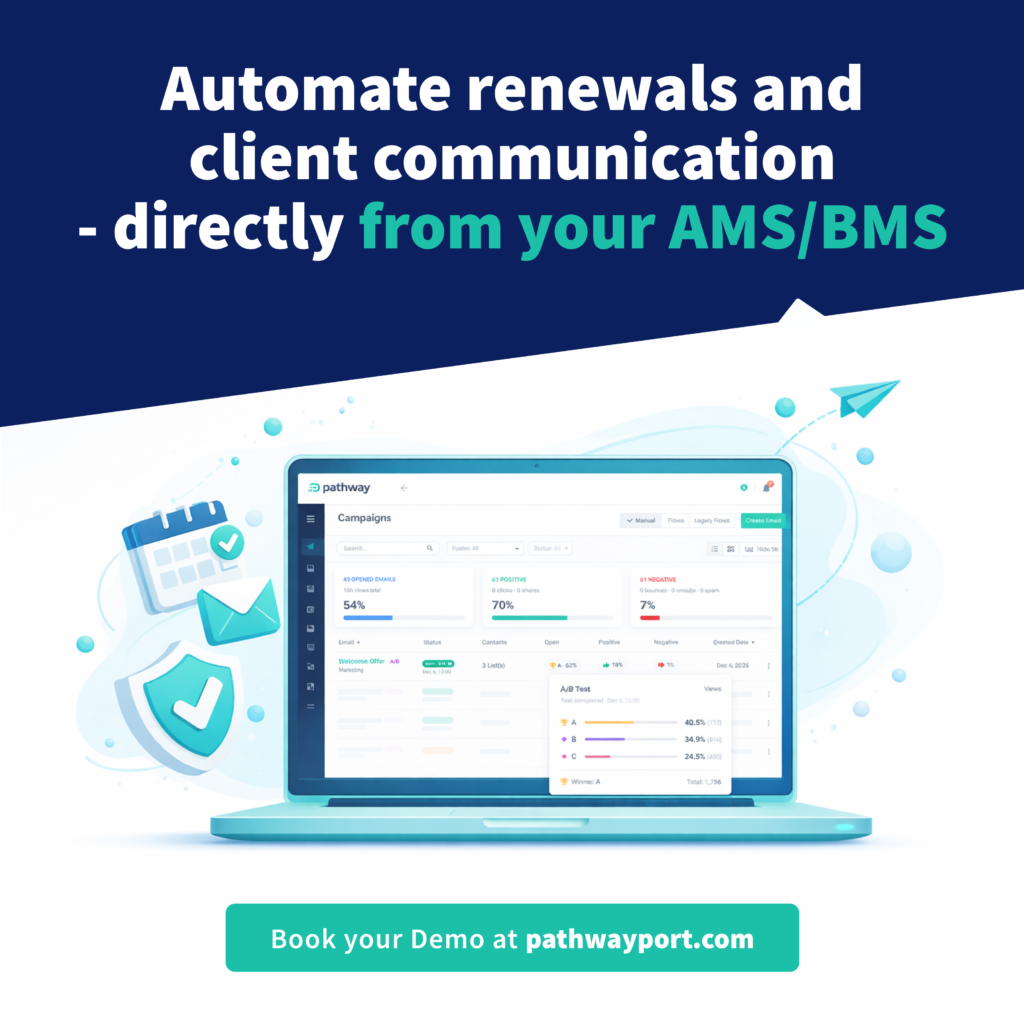
Insurance marketing automation helps agencies automate renewals, follow-ups, review requests, compliance workflows, and cross-sell campaigns with consistent, timely communication. The result: better lead conversion, stronger retention, and clearer visibility into what drives revenue.
As insurers continue prioritizing operational efficiency, faster client communication, and connected customer experiences, marketing automation has evolved beyond campaign management. In 2026, automated renewals, billing reminders, policy communications, and workflow orchestration have become core systems for improving retention, reducing administrative workload, and supporting scalable growth across insurance organizations.
What insurance marketing automation includes
At its core, insurance marketing automation connects customer data, content, timing, and workflow logic so outreach happens automatically based on real behavior or policy events. A mature system often includes:
- Lead capture from quote forms, chats, referrals, and inbound calls.
- Segmentation by line of business, lifecycle stage, geography, and engagement history.
- Email and SMS nurture journeys for new leads and quote follow-up.
- Renewal reminders and lapse-prevention campaigns.
- Cross-sell and upsell sequences triggered by policy milestones or profile changes.
- Review and referral request workflows after positive service interactions.
- Lead scoring and prioritization so agents focus on the most sales-ready prospects.
- Reporting that ties activity to appointments, binds, retention, and lifetime value.
A simple example makes the concept easier to see. When a prospect requests an auto insurance quote, the system can instantly send a confirmation email, notify the assigned producer, launch a three-touch follow-up sequence, suppress duplicate outreach, and trigger a renewal-focused nurture path if the lead converts. That is insurance marketing automation in action: timely, personalized, measurable communication without manual intervention at every step.
How to automate insurance marketing automation
The best way to automate insurance marketing automation is to build it in layers rather than trying to launch every workflow at once. Start with the customer journey, identify repeatable communication moments, connect the right systems, and then add logic, compliance review, and reporting over time.
A practical rollout usually follows these steps:
- Map the journey from first touch to renewal, including quote requests, non-responses, purchase, onboarding, service moments, renewal windows, and lapse risk.
- Centralize contact and policy data in a CRM or agency/brokerage platform so campaigns can trigger from real customer events instead of static lists.
- Segment audiences by product, state, lifecycle stage, and behavioral signals such as form fills, opens, clicks, and quote status.
- Build automated journeys for the highest-value use cases first, such as new lead response, quote nurture, renewal reminders, review requests, and lapsed-client win-back.
- Add lead scoring and internal alerts so agents know when a prospect is warm, when a renewal is at risk, or when a cross-sell opportunity appears.
- Create approval gates for regulated or state-specific content before messages can go live.
- Measure results weekly and refine timing, messaging, segmentation, and handoff rules based on conversion and retention data.
This stepwise approach matters because insurance organizations rarely fail from lack of tools. They fail when the workflow is disconnected from operations, data quality is weak, or compliance review is bolted on after launch. Effective automation works when marketing, sales, service, and compliance are linked from the beginning.
Automate renewals and billing reminders
Renewals are one of the most valuable insurance marketing automation workflows because they directly impact retention, revenue, and customer experience. Beyond simple reminders, advanced automation can trigger quote follow-ups, prioritize accounts, escalate unbound policies, and assign tasks to producers automatically.
Strong renewal automation typically includes:
- Reminder sequences at 90, 60, 30, and 7 days before expiration
- Triggered follow-ups for unreviewed or unbound quotes
- Personalized messaging based on claims history, billing status, or coverage gaps
- Internal alerts for high-value accounts needing human outreach
Billing reminders are equally important. Automated payment notifications before due dates or after failed payments help reduce preventable churn and improve retention consistency.
Document sending and e-delivery
Insurance marketing automation also streamlines document delivery. Policy packets, onboarding forms, renewal notices, billing confirmations, and service updates can all be sent automatically through secure e-delivery workflows, reducing manual work and improving response times.
Because insurance regulations vary by state, effective e-delivery workflows should include consent management, proof of delivery, document classification, and compliance-aware rules. The best systems integrate e-delivery into the broader customer journey while tracking what was sent, delivered, and completed.
Advanced segmentation for cross-sell campaigns
Many agencies struggle with cross-sell because they still rely on generic list-based campaigns. Advanced segmentation improves targeting by grouping clients based on policy mix, lifecycle stage, engagement, payment behavior, and coverage gaps.
Effective cross-sell automation can identify:
- Clients likely to bundle policies
- High-retention households nearing renewal
- Customers with strong engagement and payment history
- Accounts showing signals for coverage reviews
Instead of sending the same message to everyone, automation delivers more relevant outreach at the right time.
NPS and post-service automation
NPS becomes far more valuable when connected to automation workflows. After a renewal, onboarding, or service interaction, agencies can automatically request feedback and trigger the next action based on the response.
Promoters can enter referral or review campaigns, while detractors can be escalated into retention workflows before the relationship declines. This turns NPS into a real operational signal instead of just a survey metric.
Automate forms and questionnaires
Forms and questionnaires play a major role in lead capture, onboarding, underwriting readiness, and service efficiency. Insurance marketing automation helps streamline these workflows with:
- Pre-filled customer data
- Conditional logic by product or situation
- Automated routing by urgency or line of business
- Follow-up reminders for incomplete forms
- Workflow triggers after submission
Automated forms reduce delays, improve data quality, and eliminate unnecessary back-and-forth between staff and customers.

Compliance and review workflows
Insurance marketing automation must balance speed with compliance. Because insurance is heavily regulated, workflows should include approval routing, disclaimer checks, consent management, version control, and audit trails.
Strong compliance automation helps teams:
- Manage email, SMS, and consent requirements
- Apply state-specific disclosures
- Archive approvals and message history
- Handle opt-outs properly
- Add human review for high-risk communications
The most advanced teams automate the review process itself — routing campaigns to the right approvers, checking for missing disclosures, and blocking launch until compliance requirements are met.
Best tools for insurance marketing automation
The best tools for insurance marketing automation depend on agency size, product mix, compliance needs, and how deeply the platform needs to connect to daily insurance workflows. In general, the market breaks into three categories: insurance-native platforms, general marketing automation tools, and workflow/compliance systems.
| Category | Best fit | Examples |
| Insurance-native CRM and automation | Agencies that need quote, renewal, billing, and producer workflows in one environment. | PathwayPort, Applied Systems, EZLynx, AMS360, other agency-centric platforms. |
| General marketing automation | Teams that need strong segmentation, email journeys, analytics, and broad integrations. | Insightly, HubSpot, Marketo, Mailchimp. |
| Workflow and compliance automation | Teams that need approvals, routing, evidence collection, and audit trails around campaigns and communications. | Process Street and related compliance workflow tools. |
For small insurance agencies, simplicity and insurance-specific fit usually matter more than broad enterprise functionality. Tools such as EZLynx are often favored for smaller agencies because they are built around everyday insurance operations, while CRM-first options such as HubSpot can work well when lead management and marketing flexibility matter more than deep agency-management features.
This is also the point where PathwayPort belongs in the conversation. PathwayPort explicitly positions its insurance marketing automation around streamlining workflows, automating renewals, and personalizing client engagement for agencies and brokerages. A strong editorial framework is to explain the category objectively, then show how a specialist platform like PathwayPort may be a better fit when the goal is to combine insurance marketing, renewals, e-delivery, forms, and compliance-aware workflow design in one operating layer.
What the best programs do differently
Top-performing insurance marketing programs do more than automate emails. They connect automation to customer behavior, renewals, compliance workflows, and revenue outcomes.
The strongest teams:
- Trigger workflows from real customer signals, not generic blasts
- Automate renewals, billing reminders, and e-delivery together
- Use segmentation to improve cross-sell timing and relevance
- Turn NPS and service feedback into follow-up actions
- Combine automation with human oversight for high-value interactions
In 2026, insurance marketing automation is no longer just a communication tool. It’s the operational layer connecting customer experience, compliance, retention, and growth.
FAQ
What is insurance marketing automation?
Insurance marketing automation is the use of software, workflow rules, and AI to automate lead nurturing, renewal communication, customer segmentation, and personalized outreach across the insurance customer lifecycle.
How is insurance marketing different from insurance marketing automation?
Insurance marketing is the broader discipline of attracting, converting, and retaining policyholders, while insurance marketing automation is the technology-driven system that executes much of that work through triggers, sequences, and workflow rules.
What should insurers automate first?
Most insurers and agencies should start with new lead response, quote follow-up, renewal reminders, billing reminders, review requests, digital forms, and lapsed-customer win-back campaigns because those workflows are high-frequency, measurable, and directly tied to revenue and retention.
How do you keep insurance marketing automation compliant?
The safest approach is to embed compliance into the workflow itself through approval routing, disclosure checks, audience controls, consent management, version history, proof of delivery where required, and audit logs.
Which tool is best for small insurance agencies?
Small agencies usually benefit most from a platform that balances insurance-specific workflow support with ease of use and low administrative overhead, which is why agency-focused systems and lighter CRM-plus-automation stacks often outperform heavyweight enterprise suites for that segment.
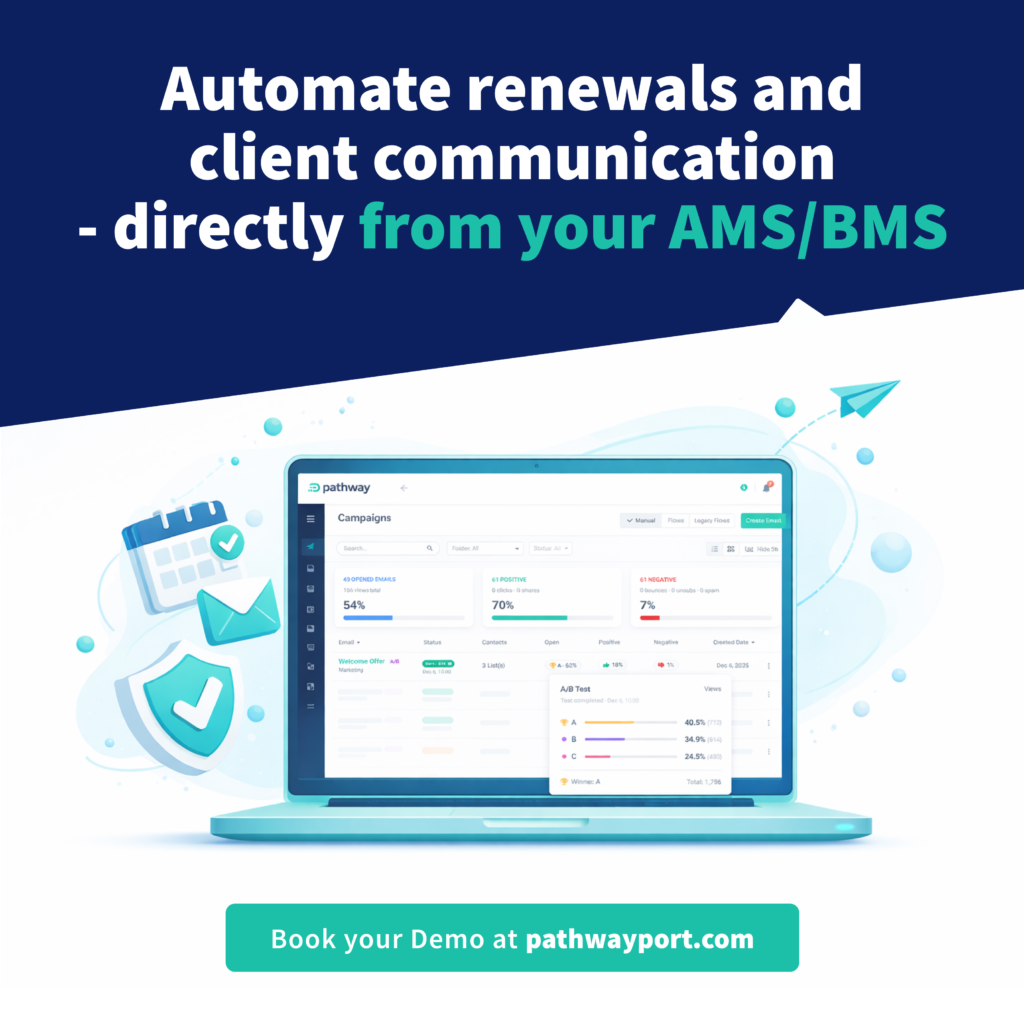
PathwayPort helps insurance agencies automate renewals, billing reminders, document delivery, client follow-ups, and personalized communication directly from their AMS/BMS data. By reducing manual work and creating consistent client touchpoints, agencies can improve retention, increase operational efficiency, and uncover new growth opportunities through smarter insurance workflow automation.
Recent Posts
 Email Marketing Insi…August 28, 2026
 How Do UK Insurance …August 6, 2026
 Insurance Email Temp…July 30, 2026
Collapsible

Leave a Comment