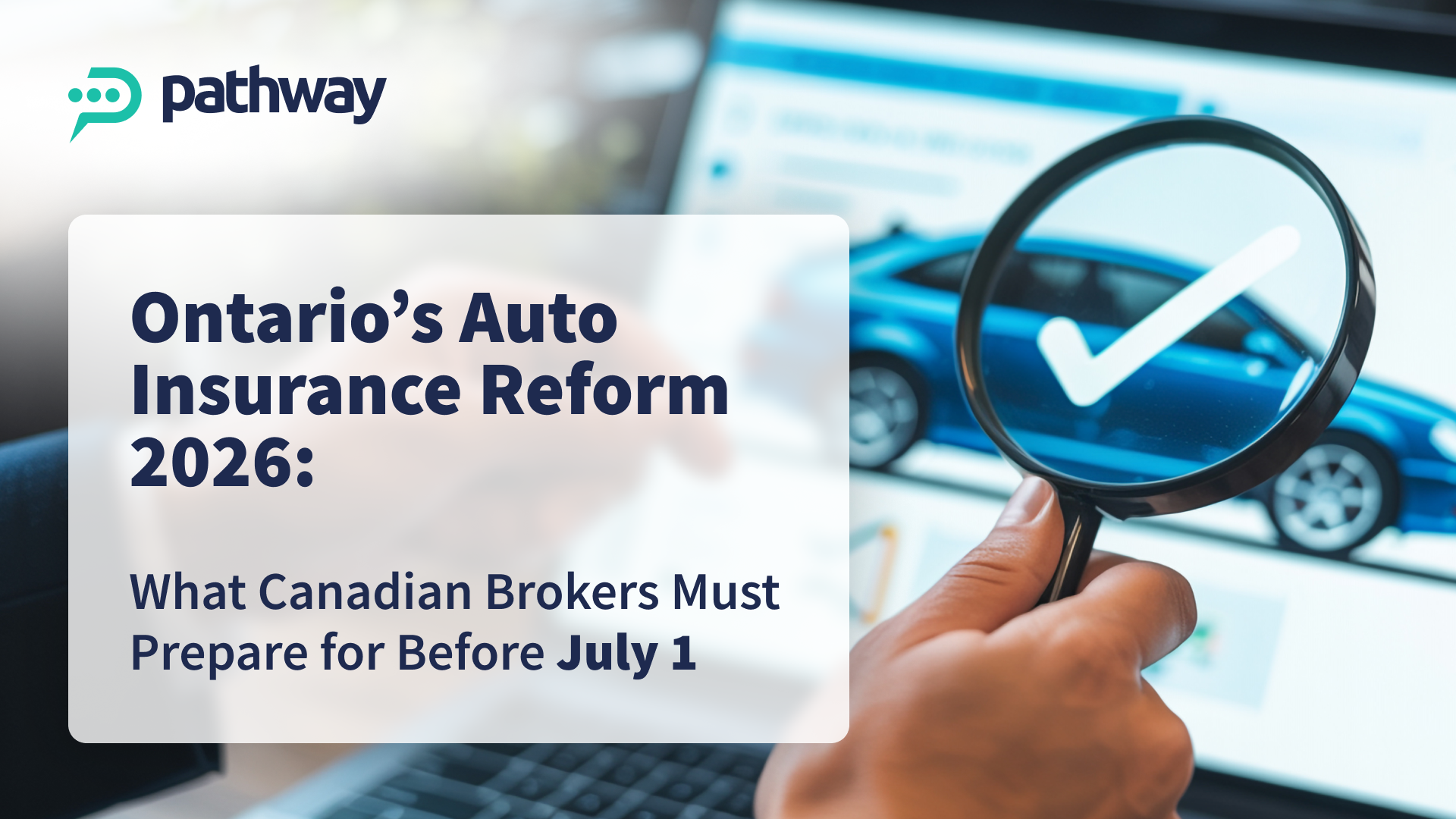
Preparing for Ontario’s July 1 Auto Insurance Reform: A Broker Playbook
Ontario’s auto insurance reform takes effect July 1, 2026, introducing a modular accident benefits system overseen by the Financial Services Regulatory Authority of Ontario (FSRA).
Most coverage focuses on drivers.
But the operational impact will be felt most by Ontario insurance brokers.
This reform affects:
- Renewal workflows
- Accident benefits advisory
- E&O documentation standards
- Client segmentation
- BMS processes
- Broker compliance exposure
For Canadian brokerages, this is not just regulatory change.
It’s a structural shift in how auto insurance is sold and renewed in Ontario.
What Changes Under Ontario’s Modular Auto Insurance Model?
As of July 1, 2026:
Mandatory Accident Benefits:
- Medical Care
- Rehabilitation
- Attendant Care
Optional Accident Benefits:
- Income Replacement
- Caregiver Benefits
- Housekeeping & Home Maintenance
- Death & Funeral Benefits
- Non-Earner Benefits
Additionally:
- Auto insurance becomes first payer for medical and rehabilitation (excluding prescriptions).
- Optional benefits apply only to named insureds, spouses, dependents, and listed drivers.
This introduces new advisory responsibility for Ontario brokers. To learn more about optional benefits, drivers must contact their insurance brokerage.
Why This Matters for Ontario Insurance Brokers
Under the previous system, accident benefits were bundled. The new reforms remove the one-size-fits-all model, so drivers no longer have to pay for coverage they already have or do not need.
Starting July 1, 2026, drivers can customize their auto insurance to match their preferences, choosing the optional benefits that provide the right level of protection for themselves and their families, and declining those they do not need. If drivers remove benefits that are now optional from their existing coverage, their premium may change.
After July 2026, Ontario brokers must:
- Explain optional benefits clearly
- Document removal decisions in writing
- Compare workplace disability vs auto Income Replacement
- Identify household dependency exposure
- Ensure compliance with FSRA expectations
Every renewal becomes a structured advisory event.
Without systemized processes, this increases:
- Service workload
- Inconsistent explanations
- E&O exposure
- Renewal friction
The E&O and Compliance Risk for Canadian Brokerages
Ontario’s modular reform increases decision points.
When clients remove:
- Income Replacement
- Caregiver coverage
- Death & Funeral benefits
Brokers must show:
- Proper explanation
- Clear documentation
- Written modification
In high-claim scenarios, missing documentation becomes liability.
Canadian brokerages handling thousands of auto policies annually must implement standardized workflows.
The Automation Opportunity for Canadian Brokers
This reform creates complexity, but automation creates control.
PathwayPort helps Ontario brokers manage modular accident benefits with structured automation built specifically for insurance workflows.

How PathwayPort Supports Canadian Brokers
Automated Renewal Education (Ontario-Specific)
Before renewal, Canadian brokers can automatically send:
- Ontario accident benefit comparison guides
- Income Replacement explanation scenarios
- Workplace benefit checklist
- Modular coverage overview
Reducing repetitive calls while maintaining consistent messaging.
BMS-Triggered Renewal Workflows
PathwayPort integrates with broker management systems (BMS) to:
- Trigger renewal campaigns 60–90 days before expiry
- Segment Ontario clients by income, family status, or employment (Coverage Advisor)
- Log all communication automatically
- Track engagement for compliance visibility
This ensures structured, repeatable renewal processes across Ontario brokerages.
PathwayPort’s Coverage Advisor
Documentation & Audit Trail Support
With optional benefits requiring written modification, automation enables:
- Timestamped communication logs
- Centralized coverage summaries
- Digital confirmation tracking
- Consistent explanation templates
Supporting E&O risk mitigation for Canadian brokers.
Segmentation for Ontario Client Profiles
Not all Ontario drivers need the same guidance.
Automation allows segmentation by:
- Self-employed professionals
- Families with dependents
- Students (Non-Earner benefit considerations)
- Retirees
- High-income earners
Delivering relevant guidance increases advisory credibility.
Why Google Search Traffic Matters Now
Ontario brokers are actively searching for:
- “Ontario auto insurance reform broker impact”
- “July 1 2026 accident benefits optional”
- “Ontario insurance compliance 2026”
- “Auto insurance E&O Ontario”
- “Insurance renewal automation Canada”
Canadian insurance brokerages preparing now will gain operational advantage before competitors react.
Strategic Positioning for Canadian Brokers
Canadian brokers that combine:
- Strong advisory practices
- Structured documentation
- Automated renewal workflows
Will:
- Improve retention
- Reduce compliance risk
- Protect margins
- Scale without additional staff
Ontario’s reform increases responsibility. Insurance automation restores operational control.
Final Takeaway for Canadian Insurance Brokers
The July 1, 2026 Ontario auto reform is not just a product adjustment.
It is:
- A compliance shift
- A renewal workflow transformation
- An advisory elevation
- An operational challenge
Ontario brokerages that implement structured automation now will navigate modular accident benefits confidently.
PathwayPort enables Canadian insurance brokers to:
- Automate renewal education
- Log compliant communication
- Segment clients intelligently
- Reduce service overload
- Strengthen documentation standards
In a modular system, structure wins. Book a demo.
Ontario Auto Insurance Reform 2026 – Key FAQs:
1. What changes are coming to Ontario accident benefits on July 1, 2026?
Starting July 1, 2026, Ontario auto insurance will move to a modular system. Medical, rehabilitation, and attendant care benefits remain mandatory. All other accident benefits: including Income Replacement, Caregiver, Housekeeping, Death, and Non-Earner benefits, become optional. Drivers must now choose which protections to keep.
2. Which accident benefits are optional in Ontario after July 2026?
After July 1, 2026, the following accident benefits become optional:
- Income Replacement
- Non-Earner benefits
- Caregiver benefits
- Housekeeping & Home Maintenance
- Death & Funeral benefits
- Lost educational expenses
- Damage to personal items
Only medical, rehabilitation, and attendant care remain mandatory under Ontario’s auto insurance system.
3. Who is covered by optional accident benefits in Ontario?
As of July 1, 2026, optional accident benefits only apply to:
- The named insured
- The spouse
- Dependants
- Listed drivers on the policy
Passengers, pedestrians, and cyclists are not covered by optional benefits unless they fall into one of these categories. Standard accident benefits still apply to everyone.
4. Does auto insurance pay before workplace benefits in Ontario after July 2026?
Yes. Starting July 1, 2026, auto insurance becomes the first payer for medical and rehabilitation expenses related to an auto accident (excluding prescription drugs). This means your auto insurer pays before your workplace or private health plan.

Related Posts
Recent Posts
 Insurance Automation…April 9, 2026
 Insurance Workflows,…March 30, 2026
 How Insurance Broker…March 27, 2026
Recent Comments
on Top10 Best Triggered Email Marketing Campaigns for Insurance BrokersThanks for sharing, it's…
on Top10 Best Triggered Email Marketing Campaigns for Insurance BrokersI would like to point out…
on Marketing Automation for Insurance: 6 Best PracticesIts like you read my mind…
Leave a Comment