A good insurance broker emails do not start with the subject line. They start with a decision.
Which client should receive this message? Why now? What do we already know about their policy? What should happen after they respond?
That is where insurance agencies and brokerages increasingly need to rethink email communication.
Templates still matter. A brokerage should not rewrite the same welcome, renewal or claims message hundreds of times.
But a template alone cannot determine whether the communication is relevant. The client and policy data behind it can.
This matters because there is still a significant gap between the information insurance businesses hold and how understood customers feel. Guidewire’s 2026 European Insurance Consumer Survey found that only 27% of consumers felt understood by their insurer, down from 32% in 2025. The same study found that 43% believed premium increases were not clearly communicated.
Sending more emails is unlikely to solve that problem. Using insurance data more intelligently might.
The five insurance broker emails below cover important moments in the client relationship. But rather than looking only at what the emails should say, we will look at four questions around each one:
- What should trigger it?
- Who should receive it?
- What information should shape it?
- What should happen next?
That is where an email template becomes part of an insurance workflow.
The Five Insurance Broker Emails at a Glance
| Client moment | Main purpose | Useful data | |
|---|---|---|---|
| New policy | Welcome email | Establish the relationship | Policy type, effective date, branch, assigned broker |
| Approaching renewal | Renewal email | Prepare the client for review | Renewal date, policy type, premium, policy changes |
| Mid-policy period | Check-in | Identify changes and opportunities | Policies held, renewal timing, segment, branch |
| Claim or incident | Claims support | Reduce uncertainty | Claim information, status, assigned contact |
| Annual review | Policy review | Reassess needs and identify relevant conversations | Existing policies, account changes, renewal information |
The email is only one column in this table. The other columns are what make automation valuable.
1. The Welcome Email: Make the First Communication Useful
Purpose: Establish the relationship and explain what happens next.
When to send: After the relevant new-business or policy-effective event.
A typical welcome email says: Thank you for choosing us. We are delighted to have you as a client.
Perfectly polite. But a new client usually needs more than a welcome. They need orientation. Who manages their account? What should they do if their circumstances change? Where do they go with a policy question? Who should they contact if they need to make a claim? When will the brokerage contact them again? A useful welcome email answers those questions without overwhelming the client.
Example welcome email
Subject: Welcome to [Brokerage Name]. Here is what happens next
Hi [First Name],
Welcome to [Brokerage Name].
Your [Policy Type] cover is now in place, and [Broker/Account Manager] will be your main contact.
You can contact us whenever you need help with:
- changes to your circumstances or policy
- policy documents or questions
- support if you need to make a claim
- reviewing your insurance needs
We will also stay in touch at relevant points during your policy period, including ahead of renewal.
If anything changes in the meantime, simply reply to this email.
Best regards,
[Broker Name]
How automation improves the welcome email
Without automation, somebody needs to recognise the new client, find the appropriate template, confirm the right contact information and send the message.
Insurance automation can use the policy or onboarding event itself as the starting point.
The workflow can also use available information such as policy type, assigned broker, branch and other mapped client data to determine who enters the journey and how the message is personalised.
PathwayPort workflows can use events such as effective dates and policy activity, then filter audiences using fields including policy type, premium, location, risk information and assigned handler.
That changes the welcome email from a task someone needs to remember into part of the onboarding process.
2. The Policy Renewal Email: Give Clients Something More Useful Than a Date
Purpose: Prepare the client and broker for an informed renewal discussion.
When to send: Early enough to collect information, review the account and address questions before expiry. For many workflows, this may begin 60–90 days before renewal, depending on the risk and brokerage process.
A policy renewal email is one of the most important communications a brokerage sends.
It is also one of the easiest to reduce to a reminder:
Your policy expires on [date]. Please contact us. The client learns when the policy renews. They learn very little about what they should actually consider. A stronger renewal email begins the review.
Example policy renewal email
Subject: Your [Policy Type] renewal is approaching
Hi [First Name],
Your [Policy Type] policy is due for renewal on [Renewal Date].
Before we complete the renewal review, please let us know if anything has changed since we last spoke.
This could include:
- changes to your property, vehicles or equipment
- changes in your business activities
- new locations or employees
- changes in personal circumstances
- any additional insurance needs you would like to discuss
Once we have the updated information, we can review your existing arrangements and discuss anything that deserves attention.
[CTA: Review Your Information]
Kind regards,
[Broker Name]
Why renewal communication needs policy context
The renewal date tells the brokerage when something is happening. It does not tell the brokerage what changed. That distinction matters. A client may immediately notice that their premium increased by 10%.
- But what happened to the deductible?
- Was a coverage added?
- Was another removed?
- Did a limit change?
- Did the insured property or risk information change?
This is where Policy Compare adds another layer to renewal communication.
PathwayPort Policy Compare can compare the incoming renewal with the current policy state and surface changes in areas including premium, coverage, limits and deductibles for broker review.
Consider two accounts:
- Client A: Premium increased 8%, with no significant change identified in the main coverage reviewed.
- Client B: Premium increased 8%, a deductible changed and a coverage was removed.
A basic renewal campaign sees two clients with approaching renewal dates. A broker looking at the underlying policy differences sees two very different conversations. That is the point.
Better renewal communication starts with understanding the renewal, not writing the email.
The broker remains responsible for interpreting the changes and advising the client. Technology helps make the differences easier to identify before that conversation starts.
3. The Mid-Year Check-In: Use Segmentation Before You Use the Template
Purpose: Stay connected between transactions and identify relevant changes.
When to send: Often around the middle of the policy period, or when account information provides a relevant reason to reconnect.
One of the simplest emails an insurance broker can send is:
- Has anything changed since we last spoke?
- It can also be one of the most useful.
- Clients do not change their circumstances according to the renewal calendar.
- A business can add employees.
- A household can buy another vehicle.
- A client can purchase property.
- A company can open another location.
- A new insurance need can appear months before renewal.
Example mid-year check-in
Subject: Has anything changed since we arranged your cover?
Hi [First Name],
We wanted to check in and make sure your current insurance arrangements still reflect your circumstances.
If anything has changed since we last reviewed your cover, such as your property, vehicles, business operations or other insurance needs, please let us know. We would be happy to review whether anything needs attention before your next renewal.
Simply reply to this email if you would like to talk.
Best regards,
[Broker Name]
This works as a general relationship email.
But segmentation can make it far more useful.
Insurance Segmentation Should Start with a Business Question
Traditional email segmentation often begins with the database.
- Select a field.
- Apply a filter.
- Build a list.
Insurance agencies and brokerages can approach the problem differently because they already hold detailed policy information. Start with the question.
For example: Which clients currently have home insurance with us but do not have Auto?
Then narrow it: Which of those clients renew within the next 60 days?
Then: Which of those accounts belongs to a particular branch?
The result is no longer a broad “Home customers” list. It is a defined group with a specific reason for a potential conversation.
PathwayPort can use available policy and client fields to define workflow audiences, including product or policy type, premium, location, risk information and assigned handler.
That makes segmentation useful well beyond newsletters.
It can support:
- renewal communication
- cross-sell opportunities
- client check-ins
- quote follow-ups
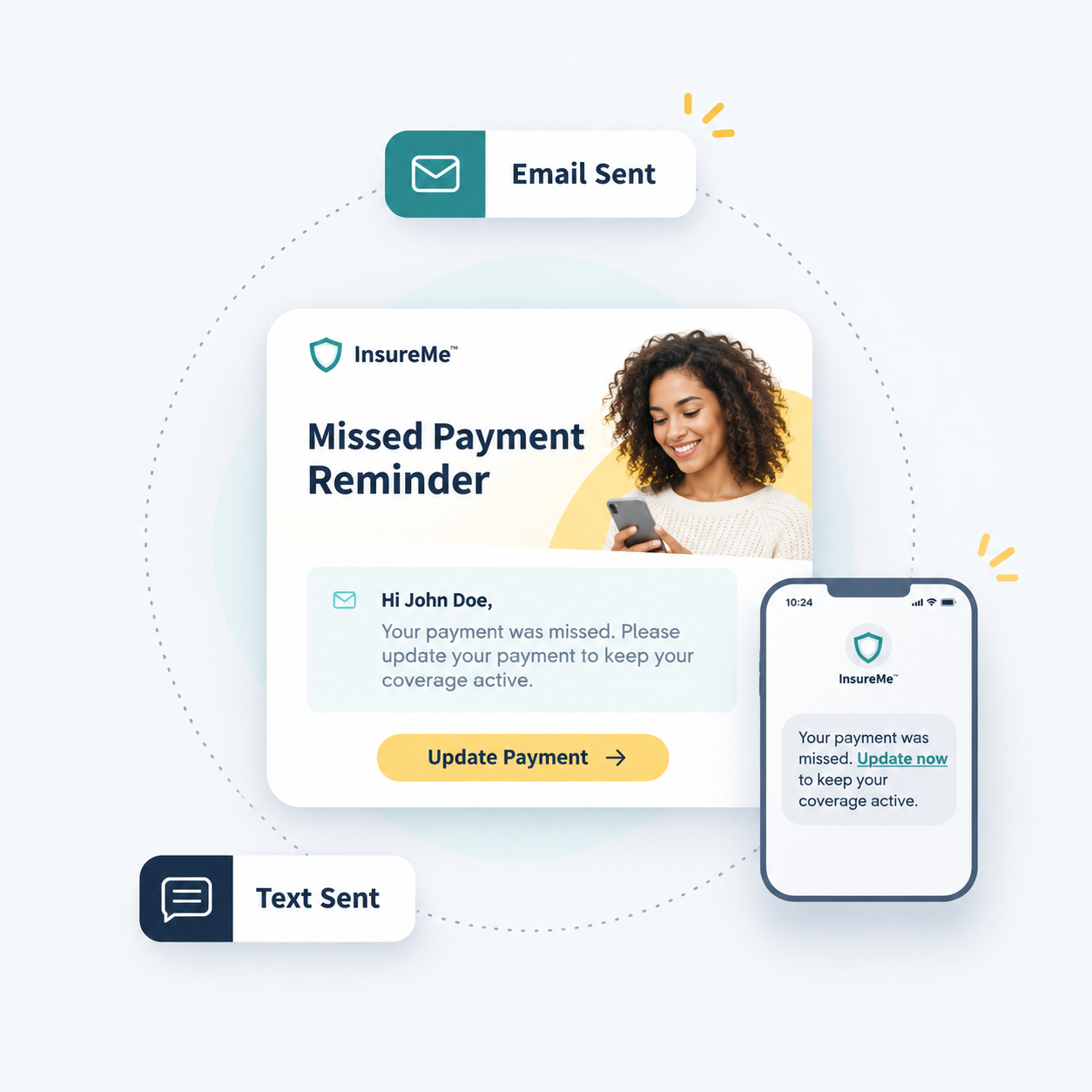
- billing communication
- claims-related journeys
- reviews and referrals
- re-engagement
Capgemini’s 2025 P&C Insurance Trends research identifies customer-centricity, personalised customer experiences and better use of data as major industry priorities. Its research notes that 63% of policyholders are willing to share more data in return for greater transparency and discounts, while insurers are increasingly using analytics to support more relevant customer interactions.
The implication for brokerages and agencies is not that every field should be used in every email.
It is that policy context can help decide whether an email should be sent at all.
4. The Claims Support Email: Make the Next Step Easier to Understand
Purpose: Reduce uncertainty and help clients understand the process.
When to send: Following the relevant claim notification or update, depending on the brokerage’s role and workflow.
Claims communication is different from marketing communication. The client is not looking for a campaign. They are looking for clarity. What is happening? What information is needed?
Who is dealing with it?When should they expect another update?
Example claims support email
Subject: An update on your insurance claim
Hi [First Name],
We are following up regarding your recent claim.
Claim reference: [Reference]
Current status: [Status]
At this stage, [brief explanation of the next step]. If we require any further information or documentation, we will let you know. If you have questions or anything changes, please contact [Broker/Claims Contact].
We will continue to keep you informed as the claim progresses.
Kind regards,
[Broker Name]
For this type of communication, automation has a very specific job. It can support the predictable update. It should not force a complicated situation through a generic sequence. That distinction also matters as AI becomes more common in insurance.
Guidewire’s 2026 survey found that when consumers were asked what would increase their confidence in insurers’ use of AI, 39% ranked the ability to refer an AI decision to a person as the most important factor. When AI was helping an agent support customers, 41% were comfortable with its use.
Use technology to organise information, identify the relevant account, prepare communication and reduce repetitive investigation. Keep a clear route to the broker where interpretation or advice is required.
5. The Annual Policy Review: Turn Existing Policy Data into Better Questions
Purpose: Reassess the client’s current needs and identify areas worth discussing.
When to send: Annually, often ahead of renewal.
The annual review is where client communication and business development naturally meet. But that does not mean it should begin with:
Would you like to buy another policy? It should begin with: Has anything changed that we should review?
Example annual policy review email
Subject: Is your insurance still aligned with what has changed this year?
Hi [First Name],
As we prepare for your annual insurance review, we would like to check whether anything has changed since your last review.
This could include:
- new property, vehicles or equipment
- changes in your business activities
- additional employees or locations
- changes in your personal circumstances
- other risks or insurance needs you would like to discuss
We can review your current arrangements with you and identify anything that may deserve further attention.
Would you be available for a short review?
Best regards,
[Broker Name]
The email is intentionally simple. The intelligence should sit behind it.
AI Can Help Insurance Broker Emails Be drafted to a Specific Audience
PathwayPort AI helps insurance brokers decide who to contact and why, before they start writing an email. Teams can ask questions about their own account data in everyday language, such as “Which clients have Home insurance with us but no Auto?”, then narrow the results to clients renewing within 60 days or managed by a particular branch. This makes it easier to build a relevant audience without working through multiple reports and complex filters. The same approach can help teams explore renewal completion rates, upcoming premiums and premium at risk, with recommendations to support their next steps. The value is practical: less time assembling lists, clearer priorities and better-timed client conversations.
Let the Business Question Shape the Campaign
A clear business objective gives your communication a stronger starting point. If you want to grow Auto business among existing Home clients, first identify those without an Auto policy recorded with your agency or brokerage. Then narrow the audience by renewal date and branch to decide where outreach may be timely and relevant.
PathwayPort helps teams explore these account-specific questions, review the resulting audience and prepare a campaign using an existing template. Before sending, decide what the message should help clients understand and how your team will handle replies. This connects audience selection, content and follow-up around a clear purpose.
A missing Auto policy in your records does not necessarily mean the client lacks cover or needs another policy. It highlights an opportunity to ask. The broker brings the judgement needed to turn that opportunity into a useful conversation.
Build the Insurance Broker Emails Template Once. Make Each Message Relevant.
A useful insurance email template saves your team time while helping clients understand what needs their attention. A renewal email, for example, should identify the policy, show the renewal date, explain the next step and make it easy to contact the assigned broker. Merge tags can populate these details from available account data, reducing repetitive editing and the risk of copying information from the wrong client’s email.
Conditional content adds another level of relevance. Based on your filters, one template can display different guidance or offers to different client groups. A home insurance client without an auto policy recorded with your brokerage could receive an invitation to discuss auto cover, while clients who already hold both policies receive a different message. Your team maintains fewer templates, and clients receive communication that better reflects their circumstances.
For practical examples, explore PathwayPort’s Insurance Email Templates: The Complete Guide for Insurance Agencies and Brokers.
Use Client Data With Purpose
Personalisation should help clients understand why you’re contacting them and what to do next. Including their policy type, renewal date and broker’s contact details can make a reminder more useful. Adding unrelated personal information can make the same message feel intrusive.
PwC’s 2025 Customer Experience Survey illustrates this balance: 53% of consumers see value in sharing personal information when it makes their experience smoother, but 93% say mishandling it would damage their trust. For insurance agencies and brokerages, the practical rule is to use only the details that help the client understand or act on the message. Information can help you select the right audience without needing to appear in the email itself.
Measure Whether Clients Can Take the Next Step
An email can be delivered, opened and still leave a client unsure what to do. Communication quality depends on whether people understand the message and can complete the action it asks of them.
The FCA’s 2026 work on Consumer Understanding connects communication design with testing, monitoring and governance. For insurance teams, that means using calls, complaints, surveys and incomplete journeys to find problems that email engagement metrics may miss. Repeated questions can reveal unclear wording. Abandoned renewal forms may point to confusing instructions or unnecessary steps. Follow-ups sent after a client has responded can expose a workflow that needs updating.
Review these signals together and test improvements with clients. The goal is communication that makes the next step easier, reduces avoidable questions and helps your team recognise when personal support is needed.
What Should Brokers Measure for These Five Emails?
An insurance email does not exist to generate an open. It exists to help something happen. That means each email should have its own practical measure.
| Useful outcome to measure | |
|---|---|
| Welcome | Onboarding completed, fewer avoidable early service questions |
| Renewal | Information received, questionnaire completed, renewal progresses |
| Mid-year check-in | Useful client conversations or account updates identified |
| Claims support | Required information received, client understands next stage |
| Annual review | Review completed, changing needs or relevant opportunities identified |
Open rate and click rate can help diagnose performance. They should not become the definition of success. The measurement should follow the purpose of the communication.
How PathwayPort Connects the Five Pieces
The larger value of insurance automation appears when several capabilities work together.
1. Start with AMS/BMS data
Available client and policy information provides the context.
2. Define the relevant segment
Policy type, renewal timing, premium, branch and other appropriate fields can help determine which clients belong in the workflow.
3. Understand the insurance event
For renewals, Policy Compare can help surface meaningful differences between the incoming renewal and the current policy state.
4. Investigate further
PathwayPort AI can help teams ask specific questions about their own account information and refine the answer rather than relying only on broad reports.
5. Use the appropriate template
The communication begins from an approved, reusable structure and is personalised using relevant data.
6. Automate the next step
The workflow can support reminders, responses, forms, conditions and internal follow-up, depending on the setup.
PathwayPort’s workflow model is built around this type of progression, using broker data to determine who enters a journey, when they enter, what happens next and when human involvement becomes useful.
That is the bigger difference between email automation and insurance automation.
One sends the message. The other uses insurance context to help determine why the message exists in the first place.
Start With Five Insurance Broker Emails. Give Every Template a Clear Purpose.
Welcome emails, renewal reminders, mid-year check-ins, claims support and annual reviews give insurance agencies and brokerages a practical starting point. Their value grows when policy data helps determine who receives each message, when it arrives and what happens afterwards.
A renewal comparison can highlight changes that need a broker’s attention. AI can help identify a relevant cross-sell audience within your own book of business. A client’s response can signal that reminders should stop and a personal conversation should begin. Together, these connections reduce unnecessary follow-ups and help teams focus on clients who need support.
Build your email programme around those decisions. Every message should give the client a useful next step and your team a clear reason to reach out.
Frequently Asked Questions About Insurance Broker Emails
What are the five most useful insurance broker emails?
Five useful client communications are the welcome email, policy renewal email, mid-year check-in, claims support email and annual policy review. They cover key stages of the insurance relationship and can be adapted to the brokerage’s products, market and service model.
How does insurance automation improve broker emails?
Insurance automation can connect client communication with policy and account information. This allows the brokerage and agency to define more precise audiences, trigger communication around insurance events and automate appropriate follow-up.
What is the difference between an insurance email template and an automated workflow?
An email template provides reusable wording and structure. A workflow determines who receives that template, when it is sent, what information personalises it and what happens after the client responds.
Why is segmentation important for insurance email marketing?
Insurance clients differ by policy type, renewal date, account status, branch, existing products and many other factors. Segmentation helps brokerages avoid sending broad messages to clients for whom the communication is not relevant.
How can AI help insurance brokers with client communication?
AI can help teams investigate their own account information using specific business questions. For example, a brokerage might identify clients with one policy but not another, narrow the audience by renewal date or branch and use those results to shape a more relevant communication strategy.
Can AI recommend an insurance marketing strategy?
AI can help analyse available data, surface patterns and suggest potential next steps. Those recommendations should be reviewed by the brokerage, particularly where insurance advice, coverage needs or regulatory obligations are involved.
Should all insurance emails be automated?
No. Automation is most suitable where the trigger, audience and next steps can be clearly defined. Cases involving advice, unusual circumstances or complex client needs should be routed to the appropriate person.
What should an insurance brokerage measure besides email opens?
Depending on the purpose of the workflow, useful measures include completed forms, client responses, renewal progress, reviews, referrals, qualified cross-sell conversations and other actions connected to the original objective.
Make Your Policy Data Useful to Your Next Client Conversation
Knowing who needs a reminder, whose renewal deserves a closer look or which client may benefit from another policy makes every email more useful. PathwayPort helps insurance agencies and brokerages use available policy data to select relevant audiences, personalise messages and automate follow-ups, giving teams more time for conversations that need their expertise.
Book a demo with PathwayPort to see how your everyday client communication could work with less manual effort and more relevance.
Recent Posts
- 5 Insurance Broker E…November 16, 2026
 Insurance Automation…November 9, 2026
 How to Identify Insu…October 20, 2026
Collapsible