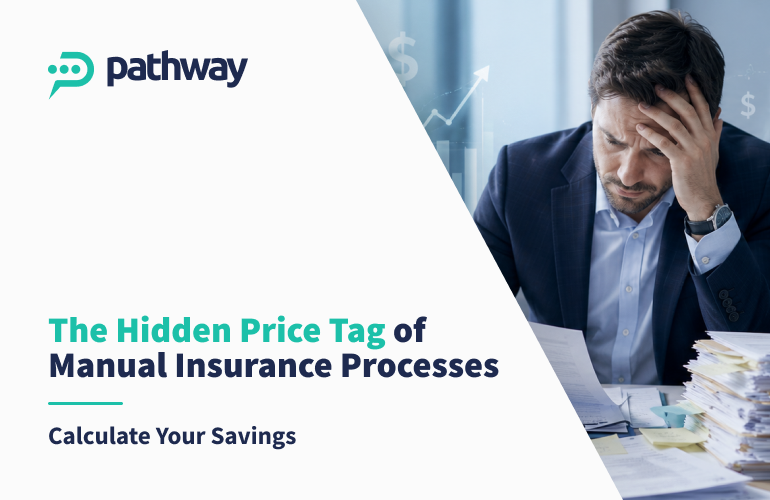
Every manual touchpoint in your insurance operation carries a dollar amount. Most leaders underestimate it by a factor of three. Here’s the industry data and a calculator to find your real number.
| Metric | Value | Source |
|---|---|---|
| Share of Insurer Operating Costs Tied to Claims | 70–80% | McKinsey |
| Annual U.S. Insurance Fraud Cost | ~$308 Billion | Coalition Against Insurance Fraud (cited by FBI) |
| Error Rate: Manual vs. Automated Claims | 2% vs. 0.3% | Accenture, 2023 |
| Possible Reduction in Claims Costs via Automation | 20–30% | McKinsey |
| Reduction in Loss Adjustment Expenses Through Automation | 25–30% | McKinsey |
| Claims Activities Automatable by 2030 | ~50% | McKinsey |
| Typical Payback Period for RPA Projects 6–12 months | Up to 200% | Deloitte |
Key Question for Insurance Leaders
If your organization processes 10,000 claims annually at an average manual cost of $40–$50 per submission, you’re spending $400,000–$500,000 in administrative overhead alone – before a single dollar of benefit is paid out.
The True Cost of Manual Insurance Processes
Manual processes in insurance aren’t just slow – they’re structurally expensive in ways that don’t always show up on a single line of the P&L. Costs are distributed across labor, error correction, fraud leakage, customer churn, and compliance risk. Learn how Acces Conseil reduced manual insurance processes by Nearly 70%.
Labor: The Most Visible Cost
McKinsey quantifies that 70–80% of an insurance company’s operating costs come from claims processes – both payouts and the people managing them. In insurance, operations are the primary cost center.
The U.S. Bureau of Labor Statistics Employment Cost Index for insurance carriers is approximately 172 in early 2026 (indexed from December 2005), reflecting steady upward pressure on compensation. Every hour an employee spends on manual data entry or re-keying is an hour not spent on relationship-building or closing business.
The 50% Opportunity Hidden in Manual Insurance Processes
Accenture (2023) found that manual claims processing carries a 2% error rate, compared to 0.3% for automated systems. At 50,000 claims per year, that’s 1,000 errors requiring rework – each consuming labor, potentially triggering compliance reviews, and frustrating policyholders.
RPA achieves roughly 90% error reduction on tasks it handles, dramatically shrinking the rework burden.
McKinsey’s claims research states that more than half of claims activities could be replaced by automation by 2030.
– McKinsley
Where Are the Biggest Insurance Savings? A Process-by-Process Breakdown
| Process Area | Manual Baseline | Automation Savings Potential | Source |
|---|---|---|---|
| Claims Adjudication | $40–$50 per submission | 20–50% cost reduction | Premier Inc.; Deloitte |
| Full Claims Lifecycle | 70–80% of total insurer costs | Up to 30% lifecycle cost reduction | McKinsey |
| Manual Error Rate | 2% error rate | 90% error reduction via RPA | Accenture 2023 |
| Loss Adjustment Expenses (LAE) | Baseline LAE | 25–30% reduction in LAE | McKinsey |
| First-Year RPA ROI | $50K–$250K+ implementation | Up to 200% ROI in Year 1 | McKinsey |
| Fraud Detection Gap | Manual processes miss many indicators | 53% more fraud flags via AI | The Times |
| Claims Processing Speed | Days to weeks | 50–74% faster; some claims <24 hours | McKinsey |
Key Takeaways
- Claims adjudication costs can be reduced by 20–50% through automation.
- End-to-end claims operations may see up to 30% lower costs.
- RPA (Robotic Process Automation) can reduce manual errors by up to 90%.
- AI-driven fraud detection identifies 53% more fraud indicators than manual processes.
- Claims processing times can be reduced from days or weeks to under 24 hours for some claim types.
- Organizations implementing RPA can achieve up to 200% ROI in the first year.
Claims First Notice of Loss (FNOL)
Automated FNOL can reduce intake time from days to minutes. McKinsey shows automation reducing the entire claims lifecycle cost by up to 30%, with FNOL (First Notice of Loss) representing a disproportionate share of that gain.
Underwriting & Policy Administration
Rules-based underwriting tasks are prime RPA candidates. Zurich Insurance Group automated 50+ manual processes using RPA, saving millions and freeing underwriters for complex risk assessment. McKinsey projects >90% of pricing and underwriting for standard policies will be automated by 2030. Read our guide to Modern Insurance Policy Administration.
Claims Adjudication
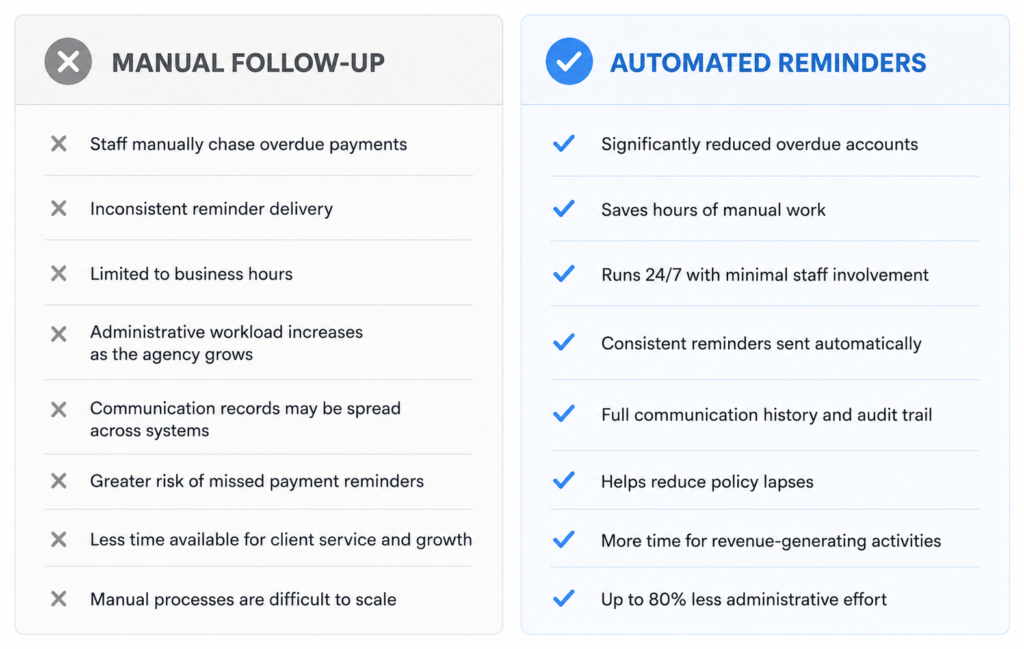
Payer costs average $40–$50 per submission for manual adjudication. Automated adjudication can process routine claims at a fraction of this cost with greater accuracy. Deloitte reports 20–50% cost reductions from automation and AI in claims operations.
Insurance Document Processing & Data Entry
OCR and AI-powered document processing eliminates a major labor sink. RPA bots automate roughly 40% of manual claims tasks with 90% error reduction (Accenture, 2023).
Real-World Proof: What Leading Insurers Are Achieving
Aviva: ~£100 Million Saved in a Single Year
Aviva’s AI-assisted liability assessment:
- Cut processing time by 23 days per case
- Improved case routing accuracy by 30%
- Reduced customer complaints by 65%
- Increased Net Promoter Score 7×
- Contributed to ~£100 million (~$127M) in documented savings
Zurich Insurance Group: 50+ Processes Automated
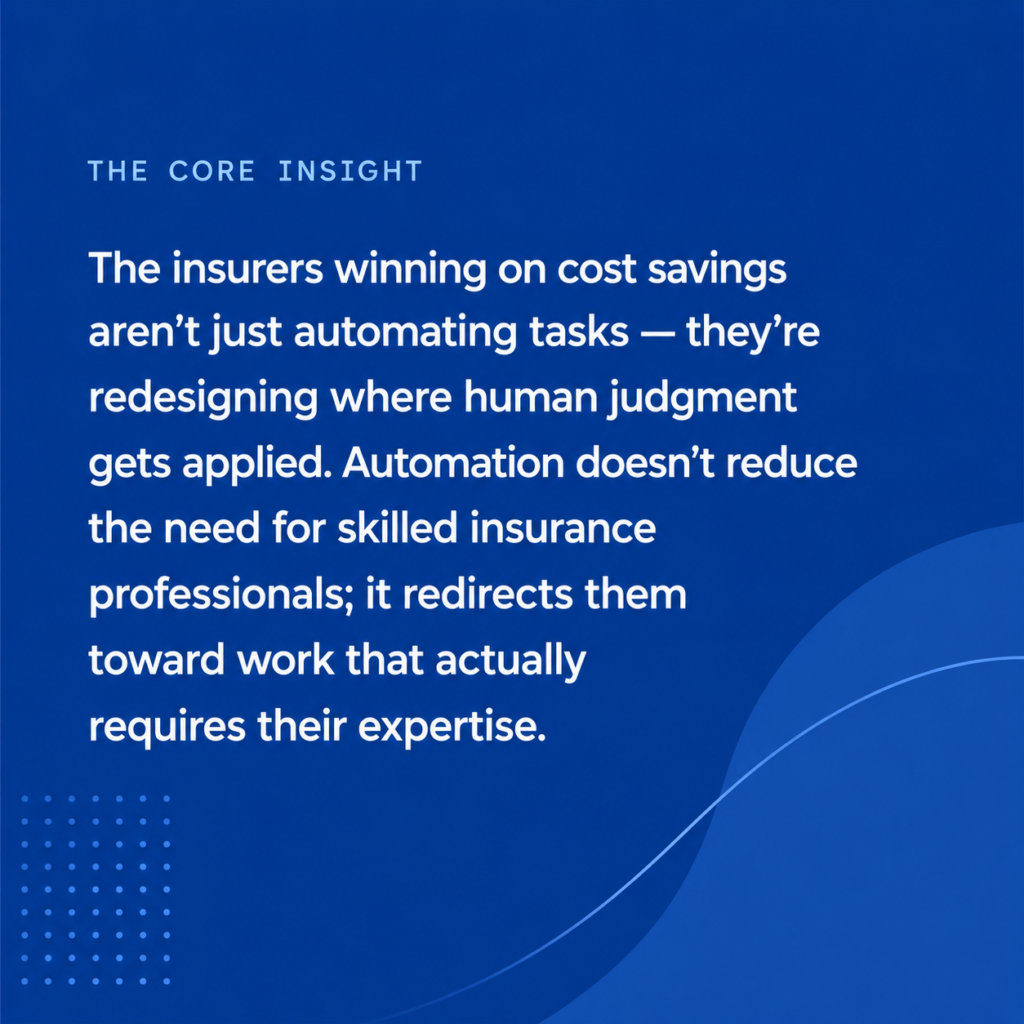
Zurich automated 50+ manual processes using RPA, generating millions in operational savings, with some workflows seeing ~51% cost reduction, while freeing employees for higher-value work.
The Market Context: Why Insurance Automation Matters Now More Than Ever
- Combined ratio: S&P Global forecasts U.S. P&C combined ratio at 98–100% in 2025, up from 97.2% in 2024. A 1–3 percentage point margin improvement from automation becomes a competitive necessity.
- Workforce retirements: An estimated 25–30% of the insurance workforce is approaching retirement by 2030. Manual process expertise walks out with those employees.
- AI adoption: The global AI in insurance market is projected to grow from ~$13.45B in 2026 to ~$154B by 2034, at roughly 35.7% CAGR.
- Customer expectations: Accenture found ~77–80% of insurance customers are willing to share personal data for faster, better service.
- Claims speed: Digital claims processing cuts settlement time by 50–74%.
How to Use This Analysis: A Practical Framework
- Baseline your manual cost profile using the calculator and refine with time-motion studies on your top five workflows.
- Prioritize by volume × error rate. High-volume, high-error processes deliver the fastest ROI.
- Measure ROI over 12–24 months, not quarters. Conservative first-year ROI target: 50–80%; best-case up to 200%.
- Expand automation incrementally, paired with customer journey mapping. McKinsey (2025) found this approach increased customer satisfaction by 30% and reduced processing time by 25%.
How Automation of Insurance Processes Can Help
Manual processes in insurance aren’t a legacy quirk – they’re an active, ongoing financial drain. The data is unambiguous:
- $25.7B annual claims adjudication cost burden in healthcare (Fierce Healthcare)
- 20–50% operational cost reduction achievable via automation (McKinsey)
- 90% error reduction via RPA
- 53% more fraud indicators detected by AI
- 50–74% faster claims settlement
The question facing insurance leaders isn’t whether automation delivers cost savings.
The question is: What is your organization’s specific savings opportunity, and what is the cost of waiting another year to capture it?
Recent Posts
 Email Marketing Insi…August 28, 2026
 How Do UK Insurance …August 6, 2026
 Insurance Email Temp…July 30, 2026
Collapsible




Leave a Comment