Why expectations changed
The policyholder has changed. After years of rising premiums, climate losses, and digital expectations, insurance clients are coming to renewal with more scrutiny and far more leverage. The advisors winning today are the ones adapting to that shift.
The 2026 policyholder is not the same person who renewed without question five years ago. They’re shopping more, switching faster, and expecting clearer answers, better coverage, and more responsive service.
Hyper-Personalization Is No Longer a Premium Feature
Hyper-personalization is no longer a luxury feature. It is the minimum expectation.
Clients want insurance that reflects how they actually live, work, and earn income. That means asking better questions at renewal:
- Has your work situation changed?
- Do you rent out part of your home?
- Do you drive for rideshare or delivery?
- Have you added expensive equipment, an EV, or other assets?
The goal is not to sell more add-ons. The goal is to avoid coverage surprises later. A simple annual lifestyle audit can uncover gaps before a claim creates a problem.
The American Customer Satisfaction Index documented an industry-wide decline in customer experience scores across a turbulent 2025, driven in part by the growing disconnect between what policyholders thought they owned and what they actually had at claims time.
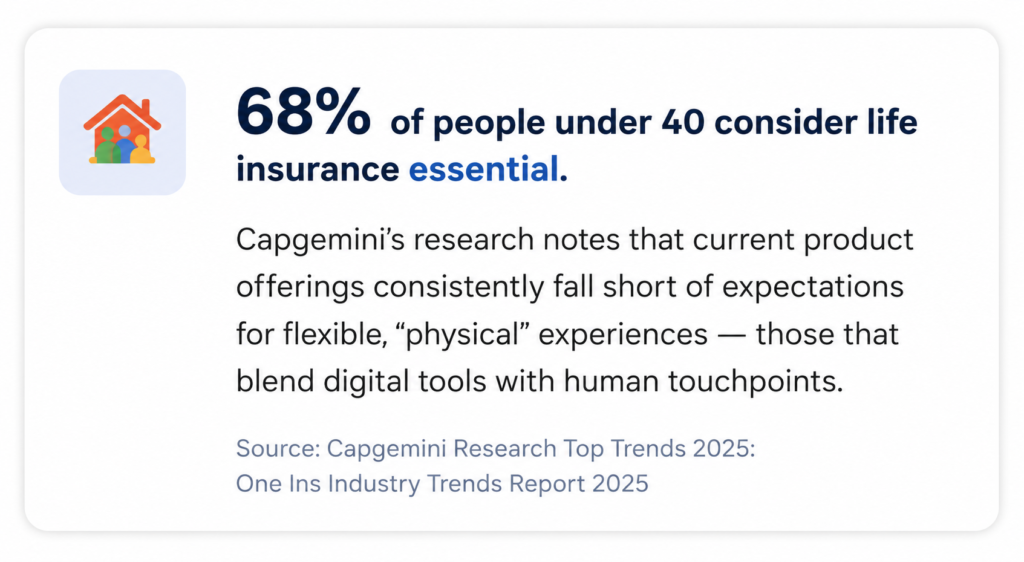
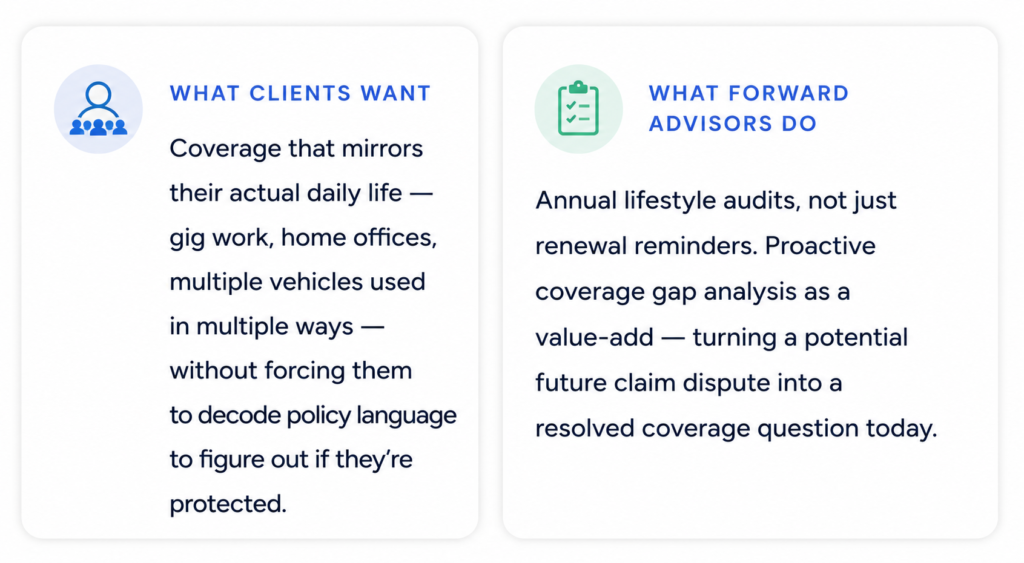
Annual lifestyle audits, not just renewal reminders. Proactive coverage gap analysis as a value-add – turning a potential future claim dispute into a resolved coverage question today.
The “sticker shock” challenge – policyholders canceling coverage or slashing limits in response to rate increases – is also best addressed through personalization rather than persuasion. Customizing deductibles, limits, and bundling options gives clients a sense of agency and control that keeps them in the relationship rather than fleeing to the next quote.
Claims Must Move at the Speed of Modern Life
Claims are where client trust is tested most. In 2026, people expect the claims process to feel more like modern digital service and less like a paperwork bottleneck.
That does not mean replacing people with bots. It means using technology for intake, triage, status updates, and routine communication, while keeping human support available for complex or emotional claims. The winning model is fast automation at the front end and real expertise when it matters most.
A practical claims workflow should include:
- Mobile-first claim submission.
- Instant confirmation.
- Clear status updates.
- Human escalation for complex cases.
- Simple explanations of next steps.
Carriers that have invested in digital claims infrastructure are beginning to see measurable returns on that investment. J.D. Power’s 2026 U.S. Property Claims Satisfaction Study found that overall satisfaction improved despite significant cost pressures – with the gains attributed specifically to efficiency improvements in digital communication throughout the claims process.
Capgemini’s research identifies customer service as the leading near-term area for AI deployment across the insurance sector. 70% of insurers cite customer service as their top priority for large-scale AI transformation in 2026. Travelers, for example, deployed an AI voice agent for auto damage claims in early 2026 – accelerating claim initiation and meaningfully reducing call center load.
Source: Capgemini Research Institute, late-2025 survey · SCNSoft Insurance AI Trends Q1 2026
But the picture isn’t purely technological. The same research that celebrates AI’s efficiency gains is quick to note the persistent need for human judgment and empathy at complex claim moments. A homeowner filing after a total loss doesn’t want a chatbot. They want a person – fast, informed, and compassionate. The winning model in 2026 is AI handling the intake, triage, and status updates, with skilled adjusters available the moment the situation calls for it.
“Thanks to investments made over the past several years in digital channels, insurers have made important efficiency gains that are translating into better customer experience. Despite the improvement, customer expectations are not always met – almost one in five customers indicated their experience was not great.” Mark Garrett, Director of Insurance Intelligence – J.D. Power, 2026 U.S. Property Claims Satisfaction Study
There is still significant runway. J.D. Power’s 2026 claims study found that while 51% of insurers fully meet expectations and 15% exceed them, 34% of customers report their policy did not fully meet expectations – with lack of explanation and high out-of-pocket costs as the top complaints. Meeting the bar set by the best carriers is not optional for advisors who want to maintain client relationships through a claim.
Insurance Clients Want to Prevent Loss, Not Just Get Reimbursed for It
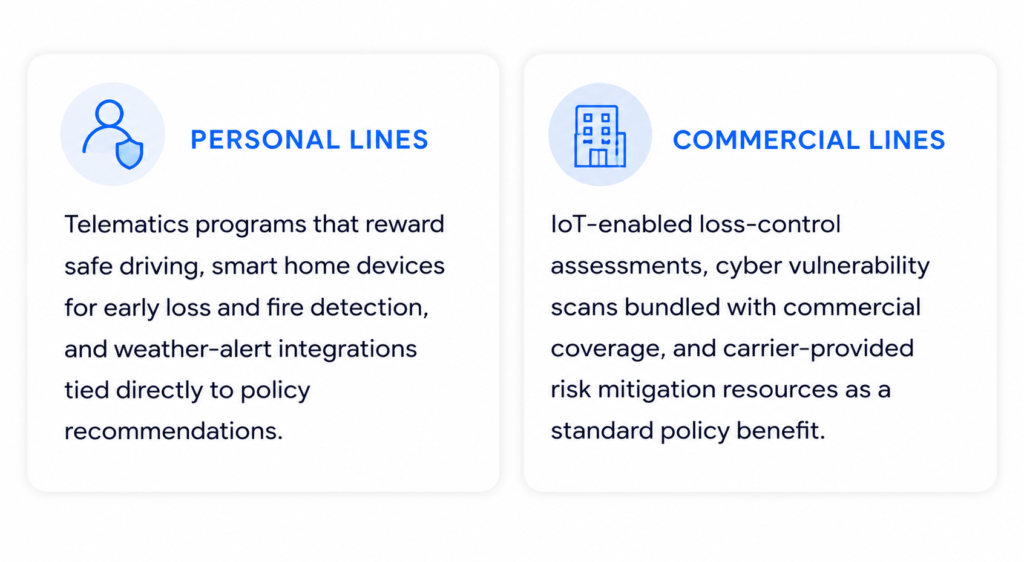
Clients increasingly want help preventing losses, not just getting reimbursed after a claim. This shift is especially strong in homeowners, auto, and small-business insurance, where tools like telematics, water-leak detection, and property monitoring are becoming more popular.
As premiums rise and risks such as extreme weather and cyber threats increase, clients are looking for advisors who help reduce claims – not just process renewals. The most successful agents are evolving into risk advisors, providing proactive guidance and prevention strategies.
In commercial insurance, carriers are also embedding IoT sensors and real-time monitoring tools into their offerings, creating ongoing partnerships focused on risk reduction. For many businesses, preventing a major loss is far more valuable than securing the lowest premium at renewal.
Auto insurers are seeing meaningful adoption of usage-based and telematics programs. J.D. Power reports that 26% of auto customers now carry deductibles above $1,000 in an effort to manage costs – making proactive loss prevention tools like telematics not just a nice-to-have but a real value lever for premium management. Source: J.D. Power, 2026 Rate Pressure & Customer Retention Reportl.
Deloitte’s 2026 global insurance outlook frames this shift clearly: insurer boundaries are blurring. Technology tools, data partnerships, and proactive risk intelligence are becoming competitive differentiators – not just in winning new clients, but in justifying the advisor relationship itself. Clients who feel their advisor is helping them manage risk – not just process paperwork are the clients who refer, bundle, and stay.
Transparency on Pricing Is Now a Non-Negotiable
Rate increases are no longer something clients will accept without explanation. If a renewal changes materially, they expect to know why before the bill arrives.
Transparent pricing communication should explain:
- What changed in the policy.
- What changed in the market.
- What changed in the client’s risk profile.
- Which tradeoffs exist between premium, deductible, and coverage limits.
That kind of explanation does more than defend a renewal. It helps clients feel informed and respected, which makes retention easier even in a high-premium market.
After years of rising insurance premiums, clients expect more transparency from their advisors. They want to understand why rates are increasing before renewal time, not after. Advisors who proactively explain market conditions and the factors driving premium changes are more likely to build trust, improve retention, and help clients prepare for higher costs.
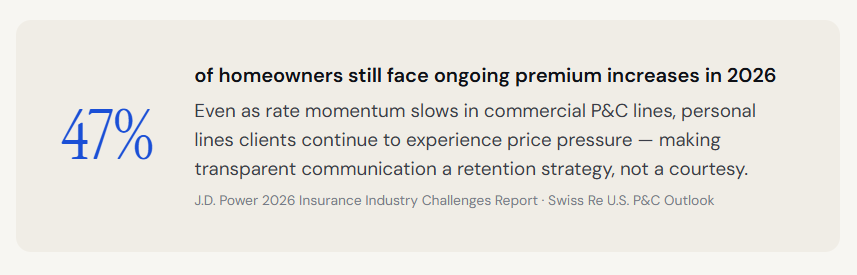
Forrester’s insurance predictions for 2026 note that proactive communication, transparent rate explanations, and personalized options – including usage-based insurance – will be among the top drivers of customer engagement and satisfaction in the year ahead. Advisors who deliver these proactively, without waiting to be asked, significantly differentiate themselves in a market where switching rates remain elevated.
Source: Forrester Insurance Predictions 2026 · IA Magazine, Dec 2025
Transparency now extends beyond pricing to the digital experience. Clients expect to communicate on their preferred channel and access information when it’s convenient for them. Insurance agencies that provide seamless, multi-channel communication and self-service options are better positioned to meet modern customer expectations and strengthen client relationships.
Technology Amplifies the Advisor – It Doesn’t Replace Them
The best workflow is usually:
- AI handles intake and routine follow-up.
- The advisor handles exceptions, complex decisions, and relationship management.
- The client gets speed without losing human support.
AI and human expertise are proving complementary, not competitive. Clients expect the speed of AI alongside access to trusted advisors for complex situations. The most successful insurers use technology to boost efficiency while strengthening customer trust. As the U.S. P&C market stabilizes, insurers and advisors have a valuable opportunity to rebuild trust through transparency, consistency, and meaningful service.
🤝Wipfli’s 2026 insurance industry analysis describes the winning model as “AI, but make it people-first.” Policyholders want to file and track claims via mobile apps while retaining access to human claims adjusters for complex or stressful situations. The advisor who understands both dimensions and can navigate them fluently on behalf of the client, is the advisor with a durable book of business.
Source: Wipfli 2026 Insurance Industry Trends
What clients expect from agents
In 2026, clients expect insurance agents and brokers to:
- Ask more questions at renewal.
- Explain pricing changes clearly.
- Offer coverage options that match real life.
- Respond quickly across channels.
- Help prevent loss, not just pay claims.
- Make digital interactions simple and human.
That is the new standard. Anything less feels outdated. Read more about the latest automation tools and strategies insurance agencies can implement in 2026.
What to do now
If you are an insurance agent, broker, or carrier team, the practical response is straightforward:
- Review renewal conversations and add lifestyle audit questions.
- Tighten claims communication and status updates.
- Build a plain-English explanation for pricing changes.
- Offer a mix of digital convenience and human escalation.
- Position your role around risk management, not just policy placement.
The firms that do this well will keep more clients, earn more referrals, and reduce churn.
FAQ
What do insurance clients want in 2026?
They want personalized coverage, faster claims, transparent pricing, and more help preventing losses before they happen.
Why are insurance clients more demanding now?
Premium increases, climate-related losses, and digital service expectations have made clients more selective and more willing to switch.
How should agents respond to renewal pushback?
They should explain pricing clearly, review coverage gaps, and offer options that give the client more control over premium and protection.
Is AI replacing insurance agents?
No. AI is best used to speed up routine tasks while agents handle complex advice, claims support, and relationship management.

Recent Posts
 Email Marketing Insi…August 28, 2026
 How Do UK Insurance …August 6, 2026
 Insurance Email Temp…July 30, 2026
Collapsible

Leave a Comment