Small insurance agencies are being asked to do more with the same headcount. Clients expect faster responses, more personalization, and smoother digital service, while agency teams are still carrying renewal work, billing follow-up, cross-sell outreach, and service requests.
That is why insurance marketing automation has become more than a nice-to-have. For small agencies, the right platform can reduce manual follow-up, improve consistency, and help teams stay on top of renewals and retention without adding staff.
But not every automation platform is built for insurance. A generic marketing tool may handle email campaigns, but it usually cannot connect cleanly to an agency management system, respect insurance-specific workflows, or maintain the audit trail agencies need. The best platforms are designed around the way independent agencies actually work: policy data in the AMS, communication triggered by lifecycle events, and activity logged back for visibility and accountability.
This article breaks down what scalable insurance automation should look like, what to evaluate, and which platform types are best suited to a small agency.
Why generic marketing tools fall short
Most general-purpose marketing platforms (HubSpot, Zoho, Mailchimp, Active Campaigns, etc.) were built for broad audience nurturing, not insurance operations. That difference matters.
Insurance agencies do not manage client relationships in a standalone CRM. Policy details, renewal dates, coverage types, producer assignments, and endorsements usually live in the AMS or BMS. If an automation platform cannot sync with that system, staff end up exporting lists, updating segments manually, and fixing timing errors after the fact. That is not real automation.
Compliance also matters. Agencies need communications to be trackable, auditable, and connected to servicing records. A generic platform can send a message, but it usually cannot log activity back into the agency system in a way that supports E&O-conscious workflows.
Insurance also has its own communication rhythm. Renewal outreach, billing reminders, claims touchpoints, cross-sell prompts, and proof-of-insurance requests are not ordinary marketing campaigns. They follow operational triggers, not just audience interests. Platforms that are not built for those workflows often require expensive customization or ongoing manual maintenance.
The agencies that are pulling ahead are not just sending more messages. They are using automation to make the right message happen at the right time, every time.
What insurance marketing automation scalability really means
When small agencies evaluate automation, “scalable” should mean more than “can send lots of emails.” A scalable platform should reduce work as volume grows, not create more of it.
The five most important capabilities are:
Native AMS/BMS integration
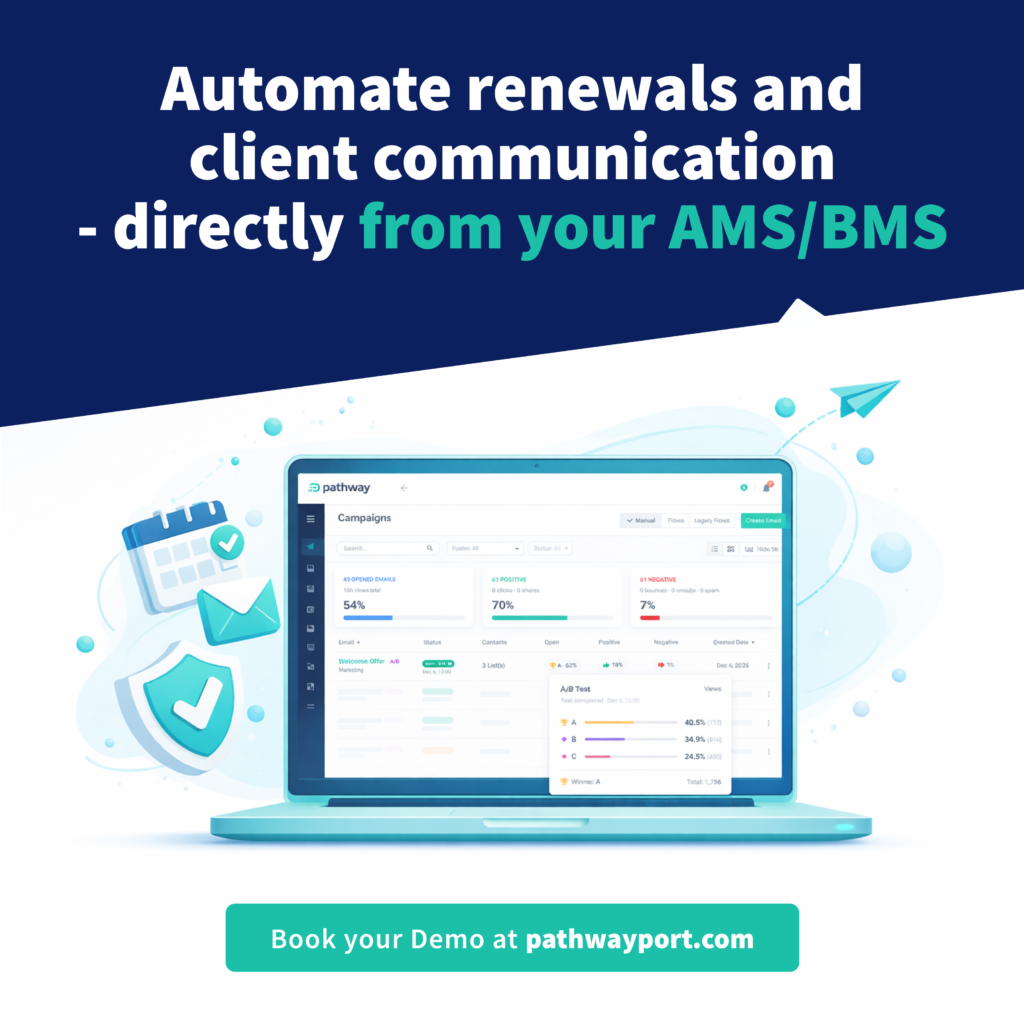
Insurance Marketing automation platform should connect directly to your agency management system and sync data both ways. It should read policy and renewal information from the AMS, trigger workflows from that data, and write communication history back for the team to see.
Without that loop, your automation becomes disconnected from the rest of the agency.
Pre-built insurance workflows
Small agencies do not have time to build every workflow from scratch. The platform should come with ready-to-use sequences for renewals, billing reminders, welcome campaigns, cross-sell outreach, claims updates, referral asks, and review requests.
The difference between “configurable” and “usable out of the box” is critical.
Smart segmentation
Insurance automation works when it can segment by policy type, renewal date, tenure, producer, coverage level, or client status. The platform should let you separate single-policy clients from bundled households, promoters from detractors, and expiring accounts from active ones. Learn how insurance teams boost efficiency by 80% using insurance marketing automation.
Predictable pricing
Many general-purpose platforms charge based on contact count. That becomes expensive as the book grows. Small agencies should look for pricing that is easier to forecast and does not punish growth.
Email and SMS in one workflow
Time-sensitive communication often performs better by text than by email. For billing reminders, renewal alerts, and service updates, SMS can improve responsiveness. Insurance marketing automation that manages both channels in one place is easier for a small team to run.
What insurance industry suggests
The pressure behind automation is not theoretical. Independent insurance agencies are operating in a harder service environment, with flat staffing and higher client expectations.
Industry studies continue to show that insurance agencies are prioritizing operating efficiency, digital service delivery, and retention. That lines up with what many small agencies already know from experience: manual follow-up is inconsistent, and even strong teams miss opportunities when everything depends on human memory and spare time. Read what insurance teams are saying.
The practical result is this: insurance agencies that automate renewals, reminders, and client communications are better positioned to stay responsive without scaling payroll at the same pace.
What to ask before choosing insurance marketing automation platform
Before evaluating any insurance automation tool, ask these questions:
- Does it sync with my AMS today, or is integration on the roadmap?
- How long before I can launch my first workflow?
- Can communication activity be written back into the AMS?
- How does the insurance marketing automation handle suppression when a policy renews mid-campaign?
- Does it include ready-made insurance workflows, or do I have to build everything myself?
- How does pricing change as my book grows?
If the answers are vague, insurance marketing automation platform may be more flexible than practical.
PathwayPort: built for insurance workflows
PathwayPort is designed specifically for insurance agencies that need automation without the overhead of stitching together multiple tools.
It connects directly with major agency management systems and is built to keep policy data and communication history aligned. That makes it easier to trigger the right workflow from the right event and reduce the manual work that usually comes with renewals, billing follow-up, and client outreach.
Core workflow support
PathwayPort includes insurance-specific automations such as:
- Renewal reminders and pre-renewal outreach.
- Billing reminders.
- New client welcome series.
- Cross-sell campaigns.
- Referral requests.
- NPS surveys.
- Review generation campaigns.
- Claims communications.
- Win-back campaigns.
- Birthday and prospect campaigns.
- Digital document delivery.
Multi-channel communication
The platform supports both email and SMS inside the same workflow. That matters for agencies that need to reach clients quickly about deadlines, reminders, or service updates.
Segmentation and forms
PathwayPort can segment audiences using policy data from the AMS, making it easier to target the right clients with the right message. It also includes digital forms that replace paper workflows and help reduce back-and-forth on routine requests.
Automation that saves staff time
For agencies with heavy renewal volume, PathwayPort’s renewal review automation can reduce the manual comparison work that usually consumes CSRs and producers. Instead of reviewing every case the same way, staff can focus on exceptions that need judgment.
Client self-service
The self-service portal gives policyholders a place to access documents, submit claims, make payments, and request certificates without tying up the agency team. For small offices, that can make a real difference in call volume.
Compliance-minded design
PathwayPort is built to support auditability and communication tracking, which is important for agencies that need more than a basic marketing tool.
How leading platform types compare
Not every agency needs the same level of automation. Here is how the main platform categories generally stack up.
| Platform type | Best for | Strengths | Limitations |
|---|---|---|---|
| Purpose-built insurance automation | Agencies that want renewals, billing reminders, cross-sell, and retention workflows | Native insurance logic, AMS integration, workflow depth, auditability | Usually more specialized than generic tools |
| AMS-native automation | Agencies that want basic reminders inside their system of record | Convenience, fewer tools to manage | Limited campaign depth, weaker segmentation, fewer SMS and nurturing features |
| Lead management tools | Agencies focused on prospect follow-up and new business | Good for initial lead response and conversion | Often weak on retention, renewals, and servicing |
| General marketing automation platforms | Agencies with simple email needs or internal marketing teams | Flexible, affordable, familiar interfaces | Usually require customization, integrations, and ongoing upkeep |
How Leading Insurance Automation Platforms Compare
Zywave AI Producer Agent
Best for: Large commercial brokerages
Strengths: Advanced AI prospecting, deep data, strong AMS integrations.
Limitations: Enterprise-focused, complex, expensive, and primarily built for large organizations.
PathwayPort Advantage: Faster deployment, transparent pricing, and ready-to-use retention, renewal, and client communication workflows.
Agency MVP
Best for: Lead-heavy agencies
Strengths: Lead management, follow-up automation, and pipeline tracking.
Limitations: Focused on new business rather than retention and client servicing.
PathwayPort Advantage: Covers the entire client lifecycle, including renewals, cross-sell, billing reminders, and servicing workflows.
Insureio
Best for: Life and health insurance agents
Strengths: Lead nurturing, CRM, and carrier submission tools.
Limitations: Limited AMS integrations and lacks P&C-specific workflows.
PathwayPort Advantage: Built specifically for P&C agencies with native AMS two-way connectivity and insurance-focused automation.
Insightly Marketing
Best for: General business marketing
Strengths: Email automation, segmentation, and CRM alignment.
Limitations: No insurance-specific workflows or AMS integrations.
PathwayPort Advantage: Delivers insurance automation, compliance tracking, and AMS two-way synchronization out of the box.
Zoho CRM & ActiveCampaign
Best for: Small agencies with simple marketing needs
Strengths: Affordable, flexible, and highly customizable.
Limitations: Require extensive setup and ongoing maintenance to support insurance workflows.
PathwayPort Advantage: Pre-built insurance automation, AMS two-way sync integration, and faster time-to-value without technical expertise.
AMS-native tools
Some AMS platforms include basic automation features, such as triggered emails or renewal reminders. These can be useful for getting started, especially if a team wants to keep everything in one place.
The tradeoff is that AMS-native automation is often limited. It may not support more advanced segmentation, multi-step campaigns, SMS, or richer lifecycle communications.
Lead-focused tools
Lead management platforms can be useful if an agency is spending heavily on prospecting. They help organize new leads, automate first-touch follow-up, and prioritize active opportunities.
But lead tools are not the same as full client lifecycle platforms. If the goal is retention, renewals, and service automation, they usually need to be paired with something else.
General-purpose tools
Platforms like Zoho CRM or ActiveCampaign can work for very small agencies that need simple outreach and do not yet require deep insurance-specific automation.
The downside is that the agency has to do more of the heavy lifting: building workflows, maintaining integrations, managing suppression, and keeping communication logic aligned with agency operations.
Which insurance marketing platform fits which agency
The right fit depends on the agency’s size, workflow complexity, and growth priorities.
- Best fit for small P&C agencies: A purpose-built insurance automation platform with AMS integration, lifecycle workflows, and multi-channel communication.
- Best fit for lead-heavy agencies: A lead management platform that focuses on prospect follow-up and can be paired with other tools later.
- Best fit for very small or early-stage agencies: A general-purpose platform may be acceptable if the agency only needs basic email marketing and has time to manage setup.
- Best fit for agencies with growing retention goals: A platform that can handle renewals, billing reminders, cross-sell, and service communications without requiring custom development.
What small agencies should prioritize first
If an agency is just beginning to automate, the best place to start is usually renewals.
Renewal outreach is predictable, repetitive, and high value. Automating pre-renewal communication and reminders saves staff time immediately and improves consistency.
After renewals, the next priorities are usually billing reminders and post-renewal follow-up. Those workflows reduce missed payments, improve client communication, and cut down on manual chasing.
Once those basics are working, agencies can add:
- NPS surveys.
- Cross-sell sequences.
- Review requests.
- Win-back campaigns.
- Digital forms.
- Self-service tools.
That sequence keeps the rollout manageable and makes the ROI easier to see.
The bottom line
Insurance marketing automation is only useful if it matches the way a small agency actually operates. That means connecting to the AMS, using insurance-specific workflows, logging activity back to the agency record, and reducing manual follow-up instead of adding another system to manage.
For agencies that want to improve retention, speed up communication, and support growth without adding staff, the best platforms are the ones built for insurance from the start.
PathwayPort is one example of that approach: a platform designed to help agencies automate renewals, reminders, cross-sell, and client communication in a way that is practical for a small team.
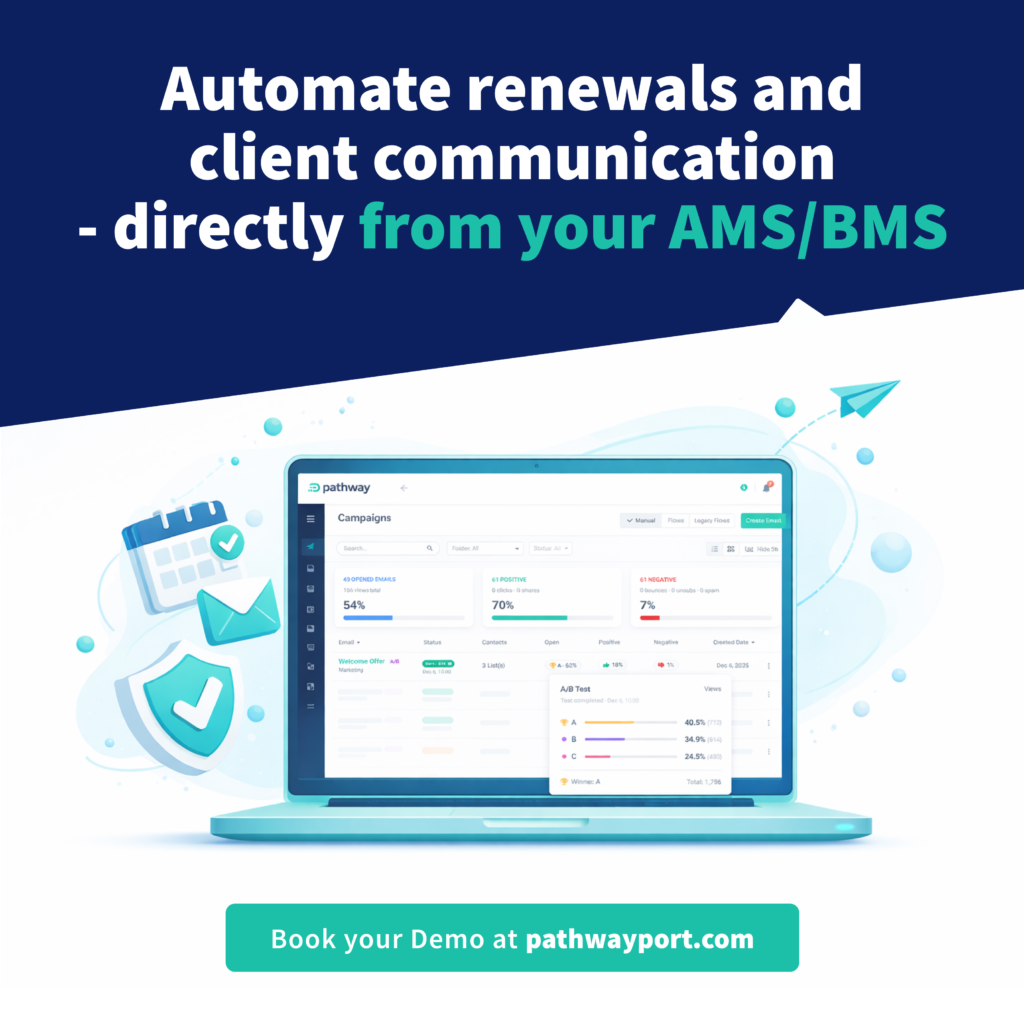
Ready to see how PathwayPort fits your agency’s workflows? Visit pathwayport.com to book a demo.
Recent Posts
 Email Marketing Insi…August 28, 2026
 How Do UK Insurance …August 6, 2026
 Insurance Email Temp…July 30, 2026
Collapsible

Leave a Comment