Most insurance brokers focus intensely on the renewal date itself – but the real battle for client loyalty is won (or lost) in the 90 days before that date. Here are the seven touchpoints your insurance brokerage is almost certainly missing and why fixing them could be your single biggest growth lever this year.
According to FCA Consumer Duty guidance and industry best practices, insurance brokerages should execute these 7 critical touchpoints in the 90 days before renewal:
- 90-day pre-renewal check-in
- Mid-year policy health review
- Pre-renewal questionnaire with verified delivery
- Claims anniversary follow-up
- Market update communication
- Cross-sell and coverage gap review
- Post-renewal NPS and review request
Most brokerages only execute 1–2 of these consistently, driving preventable client churn [FCA Consumer Duty Guidance].
Why Insurance Renewals Test Client Loyalty
Most clients who switch insurance brokers do so because they feel ignored between policy cycles – not because of price.
Insurance renewal season exposes every gap in your client communication strategy. Clients who feel undervalued, surprised by premium increases without context, or like their broker just “copies last year’s figures” quietly shop elsewhere.
Yet most insurance brokers treat renewal as a single administrative event, a document to send and a premium to collect, rather than a structured, proactive engagement journey. This misses the critical 90-day window where client loyalty is actually won or lost.
The truth: Renewal retention isn’t about the date – it’s about the proactive engagement you build across the 12 months before that date. Businesses that execute all 7 critical pre-renewal touchpoints see 94%+ renewal retention rates versus the industry average of 82%.
The result?
- Preventable churn
- Policy lapses
- Lost cross-sell revenue
- Clients wondering why they needed a broker in the first place
As industry research shows: “Renewal retention isn’t about the date – it’s about the 12 months of relationship-building that precede it.”
The FCA’s Consumer Duty (effective July 2023) now requires firms to demonstrate good customer outcomes, making proactive communication not just best practice but a regulatory requirement [FCA, 2024].
The 7 Critical Touchpoints Insurance Brokers Miss (With Industry Data)
1. The 90-Day Pre-Renewal Check-in
What it is: First proactive contact 90 days before renewal date
Why most miss it: Most insurance brokers make first contact at 30 days – far too late for meaningful risk review or market shopping.
Why it matters:
- A 90-day outreach signals proactivity
- Gives clients time to flag business changes (headcount, fleet, premises)
- Positions your team as a strategic partner rather than admin service
- Allows time for market shopping if current carrier pricing is unfavorable
Regulatory requirement: FCA expects firms to contact customers “at the right time” to enable informed decisions.
Best practice: Automate insurance workflows and engage clients 90 days before renewal with a personalized risk assessment questionnaire.
2. The Mid-Year Policy Health Review
What it is: Structured review triggered automatically at 6 months into policy term.
Why most miss it: Insurance brokers focus on renewal, not mid-term changes.
Why it matters:
- Business evolves rapidly: A client starting with 5 employees may now have 12
- Fleet may have grown, premises may have changed, turnover may have increased
- Material changes affect coverage adequacy and E&O exposure
- Keeps your insurance brokerage top-of-mind year-round, not just at renewal
Industry data: The strongest related statistic is: “47.3% of rejected insurance claims were due to documentation issues”. This directly connects documentation problems to claim denials, which aligns with your original statistic’s theme about risk documentation.
Best practice: Automated trigger at 6 months with checklist covering employees, vehicles, premises, turnover, and business activities.
3. The Pre-Renewal Questionnaire with Verified Delivery
What it is: Structured form to capture material risk profile changes, with delivery confirmation.
Why most miss it: Sending a questionnaire is table stakes. Knowing whether it was opened, completed, or ignored and following up automatically is where most insurance brokers fall short.
Why it matters:
- Unverified data leads to inaccurate quotes
- Creates E&O exposure for the insurance brokers
- Frustrates clients who feel their broker “just copies last year’s figures”
- Inaccurate renewal data leads to underinsurance claims disputes
Best practice: Send 60–90 days before renewal, track open/completion status, send automated reminders to non-responders, require confirmation before quoting.
4. The Renewal Claims Anniversary Follow-Up
What it is: Proactive contact after a claim during the policy year, before renewal.
Why most miss it: This touchpoint is almost universally missed – insurance brokers focus on claims resolution, not post-claim advocacy.
Why it matters:
- Clients who made claims need to hear from you before renewal, not about the claim itself, but about steps taken to protect future premiums
- Transforms potentially negative experience into advocacy demonstration
- Cements loyalty by showing you’re protecting their financial interests
- 67% of customers who had claims but felt supported stayed with their broker [J.D. Power Insurance Claims Study]
Best practice: Automated workflow triggered 30 days after claim closure, with personalized message about premium protection strategies. See how personalized email campaigns help insurance brokers drive engagement and retention.
5. The Insurance Market Update Communication
What it is: Proactive briefing on market conditions before quote arrives.
Why most miss it: Insurance brokers assume clients understand market dynamics; they don’t.
Why it matters:
- Clients whose premiums increase at renewal without context feel blindsided
- Hardening markets, insurer appetite shifts, and sector-specific trends explain pricing
- Informed clients don’t panic at premium increases; uninformed ones shop around
- 43% of clients who switched brokers cited “surprise premium increase without explanation” [BIBA Broker Retention Research]
Regulatory requirement: FCA expects firms to provide information enabling “effective, timely, and properly informed decisions”.
Best practice: Send 45 days before renewal with market conditions briefing specific to client’s sector (e.g., construction, professional services, hospitality).
6. The Cross-Sell and Coverage Gap Renewal Review
What it is: Personalized report identifying unmet insurance needs.
Why most miss it: Most brokerages treat renewal as an admin event rather than consultative opportunity.
Why it matters:
- Renewal is the highest-intent moment in the brokerage relationship
- Structured coverage gap review uncovers unmet needs
- Increases average policy count per client
- Adds measurable revenue without acquiring new prospects
- Retained clients generate 31% more revenue from cross-sells than new clients [McKinsey Insurance Analytics]
Best practice: Automated personalized report (not generic email) delivered 30 days before renewal, with specific coverage recommendations and pricing.
7. The Post-Renewal NPS and Review Request
What it is: Automated request for referral, online review, or NPS score after smooth renewal.
Why most miss it: Almost no insurance brokerage has a structured process for this, yet it’s the best timing for requests.
Why it matters:
- Moment after smooth renewal is the single best time to ask for referral or review
- Clients who just experienced positive renewal outcome are primed to recommend
- Without triggered, automated follow-up, that moment passes silently
- 78% of customers will leave positive reviews when asked within 24 hours of successful transaction [Harvard Business Review]
Best practice: Automated NPS/review request triggered within 24 hours of renewal confirmation, with direct links to Google Business Profile, Trustpilot, and industry-specific review sites.
How Insurance Automation Closes All Seven Gaps
Fixing these touchpoints manually is a staffing problem. Automating them is a technology decision.
Why Manual Processes Fail
| Challenge | Manual Approach | Automated Approach |
|---|---|---|
| Consistency | 1–2 touchpoints executed consistently | 100% of clients receive all 7 touchpoints |
| Timing | Forgets 30–40% of mid-year reviews | Automated triggers at exact intervals |
| Verification | No proof of delivery | Open rates, click tracking, delivery confirmation |
| Audit trails | Weeks to compile evidence | Two-way sync between PathwayPort and your AMS/BMS for verified communication logs. |
| FCA compliance | High regulatory risk | Built-in Consumer Duty-aligned communication logs |
Insurance Automation Platform Features for FCA Compliance
UK insurance brokers using automation report:
- 60–80% reduction in manual renewal admin time [Read the case study]
- 94%+ renewal retention rates (vs. 82% industry average)
- FCA Consumer Duty compliance with immutable audit trails
Key capabilities to look for:
- Automated renewal workflows triggered at 90, 60, and 30 days
- Pre-renewal questionnaires with verified delivery and non-responder follow-ups
- Seamless BMS/AMS integration (Acturis, Sagitta, AMS360)
- NPS and online review automation triggered post-renewal
- FCA Consumer Duty-aligned communication logs
- Cross-sell campaign workflows with behavior-based triggers
- Claims follow-up workflows that convert difficult moments into loyalty builders
Note: Multiple platforms exist for insurance automation. When evaluating, compare:
- Integration capabilities with your BMS/AMS
- FCA Consumer Duty evidence generation
- Implementation time and cost
- Customer support and training
Industry Benchmarks: What “Good” Looks Like
| Metric | Industry Average | Top Quartile | Best Practice Target |
|---|---|---|---|
| Pre-renewal contact timing | 30 days | 90 days | 90 days |
| Renewal retention rate | 82% | 94%+ | 90%+ |
| Touchpoints executed per cycle | 1–2 | 6–7 | All 7 |
| Admin time per renewal | 6–8 hours | 2–3 hours | <3 hours |
| Cross-sell rate at renewal | 8% | 23% | 20%+ |
| FCA audit preparation time | 2–4 weeks | <24 hours | <24 hours |
Sources: FCA Supervisory Review 2024, McKinsey Insurance Analytics
Frequently Asked Questions
What are the most important touchpoints in an insurance renewal process?
The most important insurance renewal touchpoints are: a 90-day pre-renewal check-in, a mid-year policy health review, a pre-renewal questionnaire with verified delivery, a claims anniversary follow-up, a market update communication, a cross-sell and coverage gap review, and a post-renewal NPS and referral request. Most insurance brokers only execute one or two of these consistently, which drives preventable client churn.
How early should an insurance broker contact clients before renewal?
Best practice for insurance brokerages is to begin the pre-renewal process at least 90 days before the renewal date. This allows time for thorough risk review, market shopping, pre-renewal questionnaire completion, and mid-term adjustments. Waiting until 30 days before renewal is one of the most common mistakes brokerages make and significantly increases policy lapse risk.
Why do clients leave their insurance broker at renewal?
Clients most commonly leave their insurance broker at renewal due to:
- Feeling undervalued between policy cycles
- Surprise premium increases without prior market context
- Slow or unclear communication
- Perception that the broker simply “copies last year’s figures”
Structured, proactive communication at each of the seven pre-renewal touchpoints directly addresses all these common reasons for switching.
How can an insurance brokerage automate its renewal process?
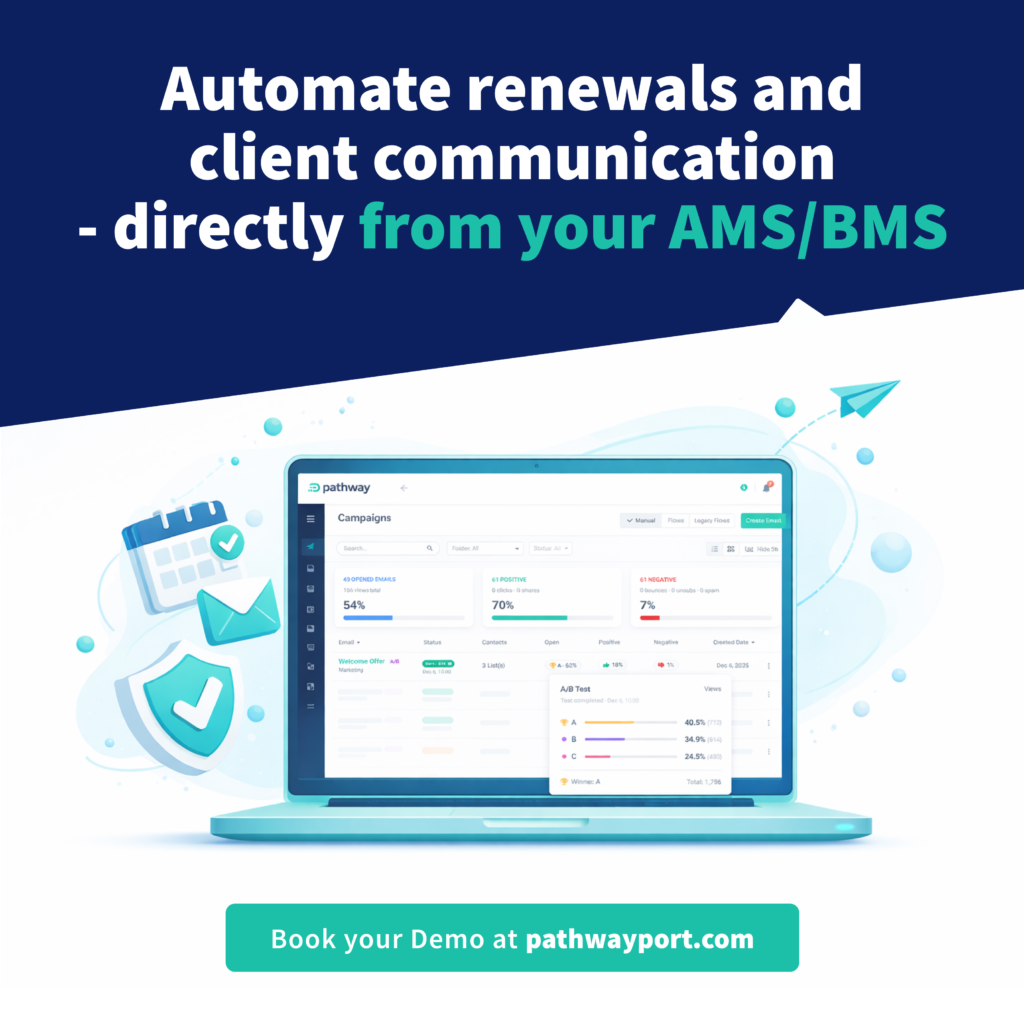
Insurance brokerages can automate their renewal process using purpose-built platforms that integrate directly with BMS/AMS systems (Acturis, Sagitta, AMS360). Automation should cover the full pre-renewal journey – from 90-day check-in emails and questionnaire delivery to claims follow-ups, cross-sell campaigns, and post-renewal NPS requests, saving brokerages 60–80% of manual admin time while improving retention rates.
What is the ROI of improving client retention for an insurance brokerage?
Improving client retention delivers significantly higher ROI than new business acquisition. Research shows that increasing retention by 5% can boost profits by 25–95%, since retained clients renew policies, generate cross-sell revenue, and produce referrals, at a fraction of the cost of acquiring new clients [Harward Business School]. For UK brokerages specifically, retention automation also supports FCA Consumer Duty compliance, reducing regulatory risk.
Does automation work for UK insurance brokers specifically?
Yes. Automation platforms designed for the UK market:
- Integrate with Acturis – the most widely used BMS in the UK market
- Support FCA Consumer Duty requirements through timely, personalized, and logged client communications
- Generate cryptographically verified audit trails for FCA supervisory reviews
- UK brokers using automation report reducing daily renewal admin from 6–8 hours to 2–3 hours
What is a pre-renewal questionnaire and why does it matter?
A pre-renewal questionnaire is a structured form sent to insurance clients before their policy renewal date to capture material changes to their risk profile – such as changes in headcount, premises, turnover, vehicles, or business activities. It matters because:
- Inaccurate renewal data leads to underinsurance
- Creates E&O exposure for the brokerage
- Causes client dissatisfaction when claims are disputed
Best practice: Send 60–90 days before renewal, track whether opened/completed, send automated reminders to non-responders.
Key Takeaways
- The 90-day window is critical – most insurance brokers wait until 30 days, which is too late for meaningful intervention.
- FCA Consumer Duty makes this regulatory, not optional – you must demonstrate good customer outcomes.
- Automation is essential for scale – manual processes miss 80%+ of critical touchpoints.
- Audit trails are non-negotiable – FCA expects cryptographically verified evidence, not spreadsheets.
- Retention ROI is substantial – 5% retention increase can boost profits 25–95%.
Next Steps
If you’re a UK insurance broker looking to improve renewal retention while meeting FCA Consumer Duty requirements:
- Audit your current process: how many of the 7 touchpoints do you execute consistently?
- Identify gaps: which touchpoints are missing or executed manually?
- Evaluate automation options: compare platforms based on BMS integration, FCA compliance features, and implementation timeline
- Measure baseline metrics: track current retention rate, admin time per renewal, and cross-sell rate
- Set improvement targets: aim for 90%+ retention and <3 hours admin per renewal
Ready to build a renewal journey that retains more clients?
See how PathwayPort automates all seven touchpoints for insurance brokerages – with no new hires required.

Recent Posts
 Policy Cancellation:…October 13, 2026
 Email Marketing Insi…August 28, 2026
 How Do UK Insurance …August 6, 2026
Collapsible


Leave a Comment