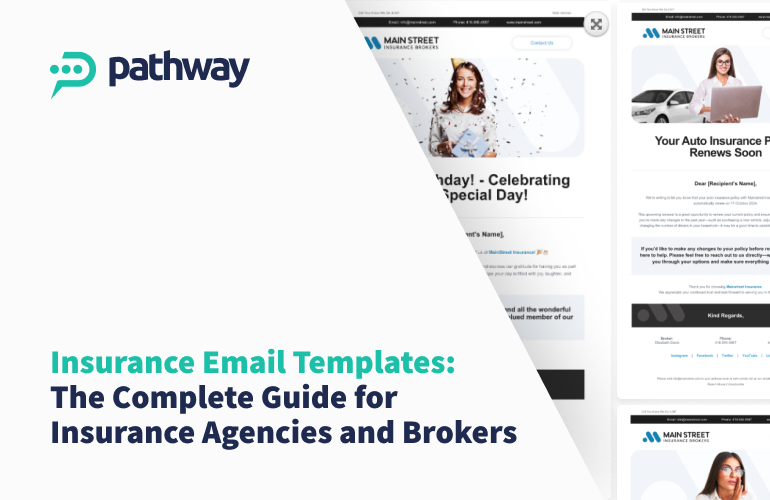
Why Email Templates Are the Most Underused Retention Tool in Your Insurance Agency & Brokerage
Insurance teams growing fastest in 2026 aren’t just writing better policies – they’re communicating better between renewals.
Most insurance agencies and brokerages contact clients twice a year: once at renewal, once when a payment is late. That’s not a client relationship. That’s a billing cycle.
According to J.D. Power’s 2025 U.S. Insurance Intelligence Report, 57% of auto insurance customers actively shopped for a new carrier in 2025 — a record high. Not because prices rose (though they did), but because high-value clients increasingly feel underserved, unseen, and easy to replace.
The agencies and brokerages losing these clients aren’t underperforming on coverage. They’re underperforming on communication.
This guide covers exactly how structured insurance email templates, built around an intentional content strategy, can close that gap, deepen client relationships, and turn your agency’s inbox into one of its strongest retention assets.
The Silent Attrition Problem Agencies and Brokerages Aren’t Talking About
The average insurance agency and brokerage retains 84% of its clients annually. Top-performing teams retain 93–95%. That gap sounds small. It isn’t.
According to Agentero’s agency research, a sustained 5% improvement in retention doubles your profit over five years. Yet most teams focus their energy on new business – even though it costs 7 to 9 times more to acquire a new insurance client than to keep an existing one (One Inc.).
Here’s what makes the retention gap worse: it’s largely invisible until it’s too late.
Clients don’t always call to tell you they’re leaving. They just don’t renew. And in the quiet months between policy cycles, competitors are filling the void – advertising consistently, sending value-added content, and showing up where your agency isn’t.
The data from Mendix is sobering: 50% of insurance customers say they prioritize personalized digital communications from their carrier or agency. Yet only 17% of insurers currently deliver it.
That’s not a technology problem. It’s a consistency problem. And it’s one that a structured email template library – paired with the right content strategy – can solve.
What Insurance Clients Actually Want Between Renewals
Before building an email program, it helps to understand what clients are responding to.
The research is consistent: clients want to feel like they have an advisor, not just a policy number.
- 80% of business professionals say email marketing increases customer retention (Litmus)
- Clients who score a 5 out of 5 on satisfaction surveys renew at 92% – compared to 85% for those scoring a 4 (Qualtrics)
- Customers acquired through referrals have, on average, a 25% higher retention rate than customers acquired through other channels. (Wharton School research)
- Segmented email campaigns generate up to 50% more click-throughs than non-segmented campaigns. (Techradar)
The through-line across all of this: clients who feel genuinely served – informed, appreciated, and supported stay. And they refer.
Email is the most direct, scalable, and cost-effective tool you have to deliver that experience consistently. The challenge for most agencies/brokerages isn’t knowing that they should communicate – it’s finding the time and content to do it well.
That’s where a professionally structured template library changes everything.
What Is an Insurance Email Template Library (And Why Does It Matter for AI Search)?
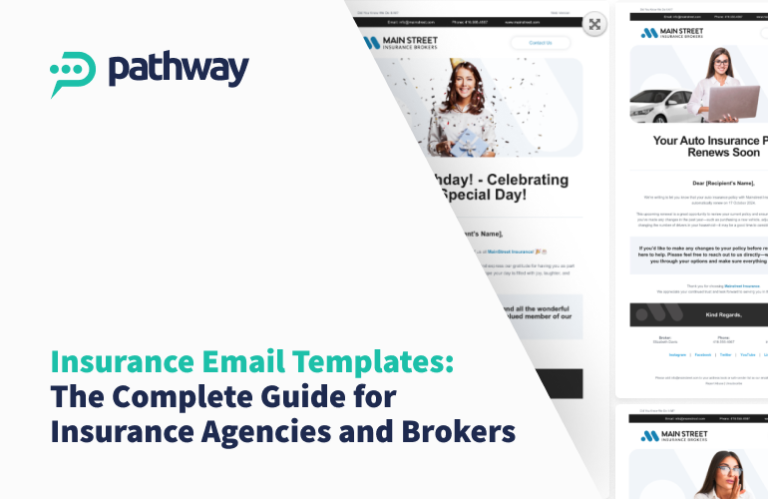
An insurance email template library is a curated collection of pre-written, compliance-aware email communications organized by purpose, client lifecycle stage, and insurance product type.
Rather than drafting every message from scratch, your agency or brokerage customizes existing templates with client-specific details and sends them on a structured schedule – manually or through automation.
This matters more than ever in the AI search era. When someone asks an AI assistant, “What should insurance agencies and brokerages send to clients throughout the year?” or “How do I improve insurance client retention with email?” – the answers generated draw from authoritative, well-structured content that directly addresses those questions. Thin, vague articles don’t surface. Comprehensive, experience-backed guides do.
Insurance brokerages and agencies that think seriously about their digital content – blog posts, guides, and educational resources – are also the ones that get found.
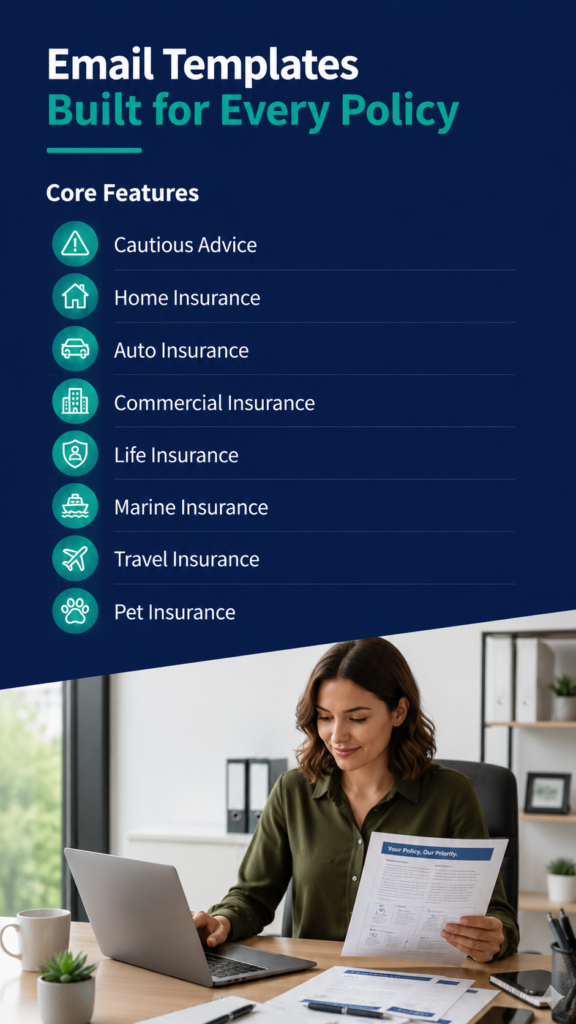
The 8 Email Templates Every Insurance Agency & Brokerage Needs
1. The Renewal Email Sequence (Not Just One Email)
Most agencies and brokerages send a single renewal notice 30 days out. Best-practice teams run a multi-touch sequence starting 90 days before expiration.
A well-designed renewal email sequence might include:
- Day –90: Policy review invitation with a brief coverage checklist
- Day –60: Personalized email noting any life changes that may affect coverage
- Day –30: Direct renewal reminder with easy call-to-action
- Day –14: Urgency reminder with contact information
- Day –7: Final notice with a streamlined response option
The goal isn’t to pressure – it’s to provide enough touchpoints that renewal feels frictionless, and the client never forgets to respond.
2. The Welcome Email Template Series
First impressions in insurance are permanent. A new client’s perception of your agency and brokerage is largely set in the first 30 days.
A strong welcome series does four things:
- Introduces the agency’s people and philosophy (not just services)
- Explains the claims process before it’s ever needed
- Provides access to client portal, payment options, and documents
- Sets expectations for future communication
Welcome email templates generate 320% more revenue per email than promotional messages (Constant Contact). Most insurance teams send one. Best-practice teams send four to six over the first month.
3. Claims Communication Updates
Claims experiences are the single highest-stakes client touchpoints in insurance. A smooth, well-communicated claims process builds loyalty. A confusing or silent one destroys it.
Automated claims status templates, sent at each stage from submission to settlement, reduce inbound calls, improve satisfaction scores, and turn a stressful experience into a service differentiator.
4. Educational Newsletters
This is where most agencies and brokerages underinvest and where the biggest retention and brand opportunity lives.
Educational newsletters have nothing to do with selling. They’re about being useful. Topics can include:
- Homeowners: Seasonal maintenance checklists, storm prep, pipe freeze prevention
- Auto: Winter driving safety, distracted driving statistics, teen driver tips
- Business: Cybersecurity basics, employment practices risk, business continuity planning
- Life/Health: Open enrollment reminders, beneficiary review prompts, Medicare planning for aging clients
When clients associate your agency’s/brokerage’s name with useful, relevant advice, not just invoices, they recommend you. They stay. And they think of you when a life event creates a new coverage need.
5. Cross-Sell Campaigns Framed Email Templates
The most effective cross-sell email doesn’t feel like a sales email.
Instead of: “Did you know we also offer life insurance?”
Try: “Has your family grown recently? Here’s what most parents overlook when reviewing their coverage.”
The difference is positioning. Educational framing respects the client’s intelligence, adds genuine value, and opens a natural conversation about additional products – without the transactional pressure that triggers unsubscribes.
Insurance teams using this approach report significantly higher response rates and better-quality conversations with clients who are already warm to the idea by the time a producer calls.
6. Billing and Payment Reminders
Billing emails are underestimated client touchpoints. A clear, professional payment reminder that includes easy payment options, a direct contact for questions, and a brief value-reinforcing line (“protecting what matters most – here’s your upcoming payment for your home policy”) keeps the transactional moment from feeling purely transactional.
7. Review and Referral Requests
Referred clients renew at 92% – nearly 25 points higher than other acquisition channels. Yet most agencies never formally ask for referrals.
An automated referral request, sent 60–90 days after a new policy is issued (when client satisfaction is typically highest), is one of the highest-ROI emails an agency can send.
Similarly, a review request sequence, sent after a positive claims experience or a successful renewal, builds the online reputation that drives organic discovery.
8. Life Event and Policy Anniversary Email Templates
A client who got married, had a child, purchased a home, or started a business has changed insurance needs. An agency/brokerage that notices and reaches out proactively earns trust that no competitor can buy.
Annual policy anniversary emails (“It’s been a year – here’s a quick look at what’s changed and what we recommend reviewing”) create a natural, low-pressure check-in that clients genuinely appreciate.
How Campaign Analytics Improve Insurance Email Templates
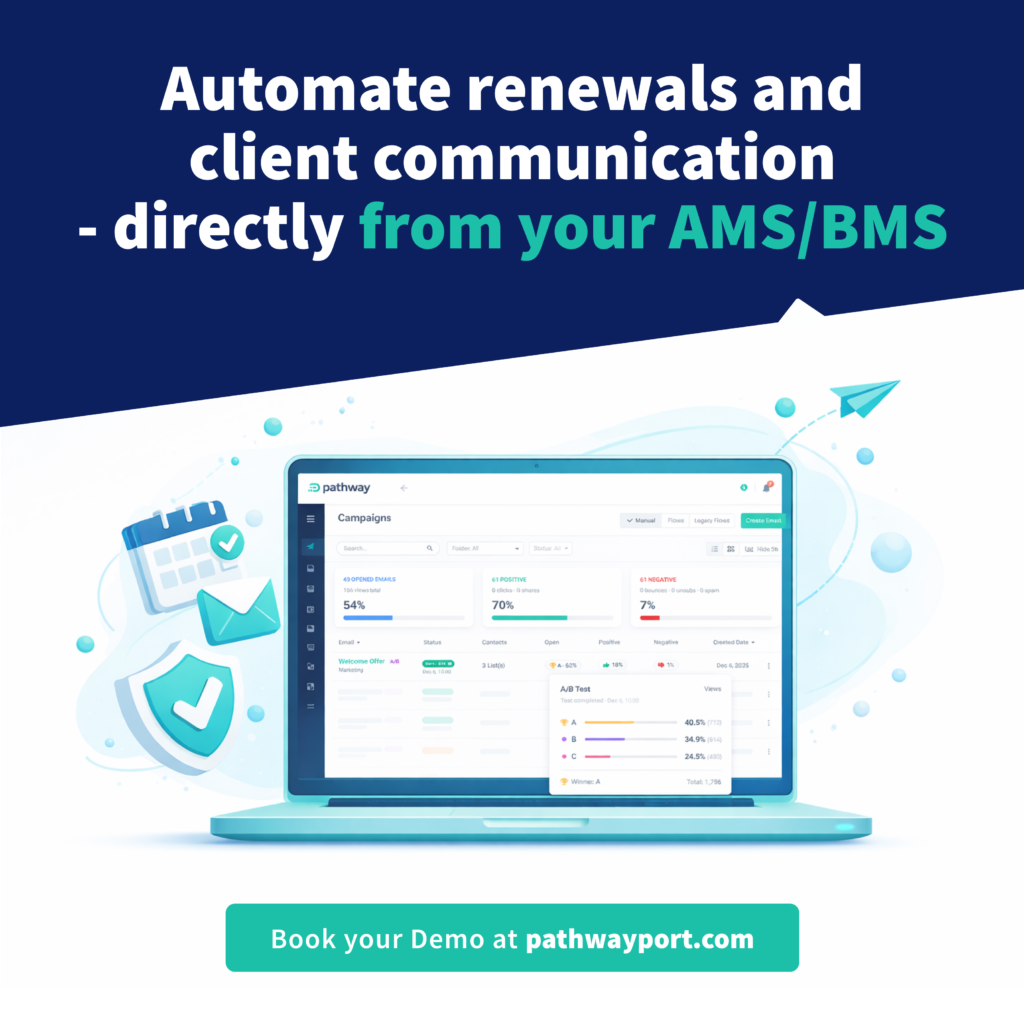
Creating effective insurance email templates is only the first step. Campaign analytics help agencies and brokerages understand how those emails actually perform by tracking key engagement metrics such as opens, clicks, document views, renewal interactions, and self-service activity. These insights reveal which messages resonate with clients, which templates need improvement, and which policyholders may require additional follow-up. By combining insurance email templates with campaign analytics, agencies can continuously refine their communications, automate timely follow-ups, improve client engagement, and build stronger, long-term relationships.
Building a 12-Month Insurance Email Calendar
Random communication is almost as bad as no communication. A structured annual calendar ensures your agency/brokerage stays present without overwhelming your team or your clients.
Here’s a framework:
| Month | Primary Theme | Email Focus |
| January | New Year Planning | Policy review invitation, life changes checklist |
| February | Love What You Have | Home inventory tips, beneficiary review |
| March | Spring Prep | Storm season readiness, outdoor property tips |
| April | Tax Season | Business coverage review, HSA/life insurance reminders |
| May | Family Season | Life insurance education, teen driver tips |
| June | Summer Travel | Travel insurance, vacation home coverage |
| July | Home & Business | Liability reminders, summer business risks |
| August | Back to School | Renters insurance for students, auto policy review |
| September | Fall Planning | Flood season, business continuity |
| October | Cyber Awareness Month | Cybersecurity for businesses and homes |
| November | Year-End Review | Coverage gaps, commercial policy check-in |
| December | Year in Review | Thank you email, referral request, renewal prep |
Mix in renewal sequences, claims follow-ups, and billing reminders at appropriate intervals, and you have a communication strategy that makes clients feel like they have a trusted advisor not just a policy file.
Why Insurance Automation Is the Difference-Maker
Creating email templates is the hard part. Deploying them consistently is where most agencies and brokerages break down.
McKinsey explains that AI-powered, personalized customer interactions help organizations increase customer satisfaction by 15–20%, increase revenue by 5–8%, and reduce cost to serve by 20–30% through proactive, coordinated communications.
The math is straightforward:
- Companies using email automation to nurture leads see a 451% increase in qualified prospects (HubSpot)
- 80% of professionals believe email marketing increases customer retention (Litmus)
- Agencies with more than 1.8 policies per client achieve 95% retention and cross-sell communication is a primary driver of multi-policy relationships (Agentero)
Automation doesn’t replace human relationship-building. It enables it by freeing producers and CSRs from manual follow-up tasks so they can focus on the conversations that actually require them.
The E-E-A-T Advantage: Why Content Quality Is Now a Competitive Moat
Google’s search quality guidelines and the AI models now summarizing search results increasingly reward content that demonstrates Experience, Expertise, Authoritativeness, and Trustworthiness (E-E-A-T).
For insurance agencies and brokerages, this means that the educational emails you send to clients are also marketing assets. A monthly newsletter on cybersecurity risk for small businesses, repurposed as a blog post, signals expertise. A home maintenance guide, shared on your website, attracts homeowners searching for advice. A seasonal driving safety email, posted to your social channels, builds brand visibility.
The agencies/brokerages winning in organic search and getting cited by AI assistants are the ones producing consistent, high-quality, genuinely useful content.
Your email template library, with some thoughtful repurposing, becomes your content engine.
The Business Case: What Email Templates Are Actually Worth
Let’s put numbers to this.
If your agency or brokerage manages 500 client households at an average annual premium of $3,000:
- Moving retention from 84% to 89% saves 25 client households per year
- At $3,000 average premium, that’s $75,000 in retained annual revenue
- At typical agency commission rates, that’s $10,500–$15,000 in additional gross commission annually
That’s without counting the referral value of more engaged, satisfied clients, or the cross-sell revenue generated by educational campaigns that surface unmet coverage needs.
The investment in a structured email program, including professionally written templates and automation setup, typically pays for itself within the first retention cycle.
What Most Agencies and Brokerages Get Wrong About Insurance Email Templates
Before closing, it’s worth naming the mistakes that undermine otherwise solid programs:
Mistake 1: Only emailing at renewal. If the only time clients hear from you is when you want something, they don’t feel like clients. They feel like leads.
Mistake 2: Generic, unbranded templates. Clients can tell when an email came from a template vault with the agency name pasted in. Personalization – even small details like the producing agent’s name and a specific reference to the client’s policy type – makes a material difference in engagement.
Mistake 3: No segmentation. A homeowner and a commercial lines client have very different interests. Blasting the same newsletter to your entire book produces mediocre results. Even basic segmentation by line of business meaningfully improves relevance and engagement.
Mistake 4: Treating email as a one-way broadcast. The best insurance emails invite a response. A question. A review request. A referral. Build in a reason for clients to respond, and your email program becomes a conversation – not a monologue.
Mistake 5: Abandoning the program after a few months. Retention is a long game. Consistent communication compounds over time. The clients who received 18 months of educational emails before renewal are far more loyal than those who received two renewal reminders.
Conclusion: Communication Is the Product, Not Just the Delivery Mechanism
In an era where 57% of insurance clients are actively shopping alternatives and where personalized digital communication is both expected and rarely delivered, insurance brokerages and agencies that win are the ones that treat consistent communication as a core service, not an afterthought.
Insurance email templates aren’t a shortcut. They’re a system – a way to deliver the ongoing value, education, and presence that clients deserve, without requiring your team to reinvent the wheel every month.
Build your template library. Build your calendar. Automate where you can. Educate constantly.
The clients who feel like they have an advisor will stay. The ones who feel like they have a vendor will shop.
PathwayPort helps insurance agencies and brokereage build and deploy professionally written email templates, educational content, and annual communication strategies – so your team can stay focused on what it does best.
Recent Posts
 Email Marketing Insi…August 28, 2026
 How Do UK Insurance …August 6, 2026
 Insurance Email Temp…July 30, 2026
Collapsible


Leave a Comment