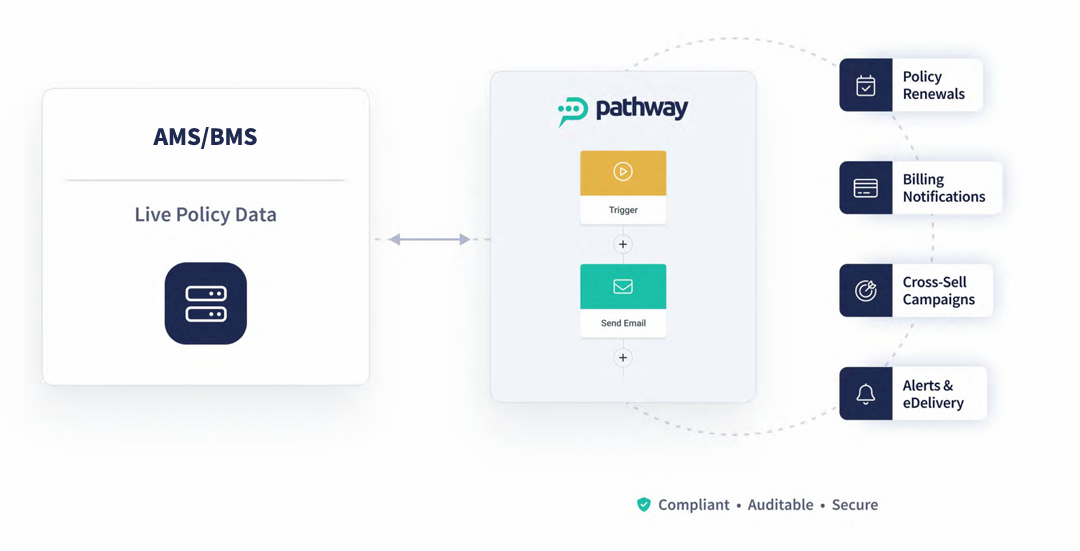
UK insurance brokers automate renewals by connecting their Broker Management System (BMS), usually Acturis, to a marketing automation or CRM platform that triggers timed emails, SMS, and digital forms as a policy approaches its renewal date, then writes the outcome back into the BMS.
Two things have changed the renewal conversation for UK brokers this year, and neither is really about technology. First, the Financial Conduct Authority’s Consumer Duty has turned “we sent a renewal email” into a question the regulator can ask you to prove, not just describe. Second, UK insurance brokers don’t have the people to do this manually even if they wanted to – talent, not AI, is the sector’s number one operational headache going into 2026, according to brokers themselves.
Renewal automation sits at the intersection of both problems and understanding that changes what you should actually build.
Quick answer
- UK brokers trigger renewal workflows from BMS data (mainly Acturis), typically starting 90 days out for commercial lines and 30–60 days for personal lines.
- Communication runs across email, SMS, and digital self-serve forms, with data written back into the BMS so there’s a single source of truth.
- Since 31 July 2023, renewal communications also have to satisfy the FCA’s Consumer Duty – meaning UK insurance brokers need evidence that renewal journeys deliver fair value and genuine customer understanding, not just that an email was sent.
- Switching behavior is at a record low – only 33% of motor and 36% of home policyholders changed insurer in H1 2025– so the goal of renewal automation for most books is retention and compliance, not defending against a wave of churn that, in practice, mostly isn’t happening.
Contents
The Renewal Problem UK Brokers Actually Face in 2026
- The renewal problem UK brokers actually face in 2026
- What “renewal automation” means in practice
- Why the manual process breaks down
- How UK brokers automate renewals, step by step
- The automated renewal timeline
- The compliance dimension: Consumer Duty and the FCA’s 2026 agenda
- What the switching data actually shows
- Automation as a response to the talent crisis, not a replacement for brokers
- Measuring renewal automation performance
- Manual vs. automated renewals, compared
- Getting started
- FAQs
The regulatory bar is moved. Consumer Duty has applied to open products, including renewals, since 31 July 2023, and to closed books since July 2024. In February 2026, the FCA published its first sector-specific Insurance Regulatory Priorities report, replacing more than 40 individual portfolio letters with one consolidated set of expectations for insurers and intermediaries. Four weeks earlier, in December 2025, the FCA had responded to a rare super-complaint from Which? alleging systemic problems in the home and travel insurance markets and while the regulator rejected some of the criticism, it committed to expanding its scrutiny of claims handling and, notably, of how clearly firms explain cover at the point of sale and renewal.
The FCA’s own data, cited in that response, found three in ten consumers say they don’t have enough information to judge the quality of their policy.
Renewal Communication Is Now Squarely Inside That Scrutiny
The workforce shrank. Graduate vacancies in insurance fell 18% in 2025, only 4% of young people say they’re interested in an insurance career, and more than a quarter of UK insurance staff are already over 50.
At the BIBA conference in May 2026, a survey of 92 brokers found talent attraction and retention was their top concern (40%), ahead of AI and automation adoption (24%), emerging risks (21%), and regulation (15%).
UK insurance brokers aren’t chasing automation because it’s exciting. They’re chasing it because the headcount to run renewals by hand isn’t coming back.
Put those two facts together and the brief for renewal automation changes. It’s no longer just “send reminders faster.” It’s “run a renewal process that a smaller team can operate, and that produces evidence a compliance officer can hand to the FCA without a scramble.”
What “Renewal Automation” Means in Practice
Renewal automation doesn’t replace the broker’s advice – it removes the repetitive, time-bound communication work around that advice, so the broker’s time goes toward the conversations that actually need a human: complex risk, price objections, vulnerable customers, and cross-sell.
In a UK broking context, it typically combines:
- A Broker Management System (BMS) – almost always Acturis for UK personal and commercial lines brokers – as the system of record for policy data, renewal dates, and mid-term adjustments.
- A marketing automation or CRM layer sitting alongside the BMS, which owns the timed, multi-channel communication (email, SMS, sometimes post) and pushes activity data back.
- Digital forms and self-serve portals that let clients confirm details, answer underwriting questions, or authorize payment without a phone call.
- Document generation and delivery for renewal letters, IPIDs, policy schedules and quotes, tracked and time-stamped for audit purposes.
The point of connecting these isn’t just to save admin hours (though it does). It’s to create one continuous, logged journey, from the BMS trigger, through every touchpoint, back into the BMS, that can be reconstructed later if a customer complaint or a regulator asks.
Why the Manual Process Breaks Down
The traditional broker renewal workflow is familiar to anyone who has worked a book of business: a CSR pulls a renewal report, exports it to a spreadsheet, drafts an email, phones the client, chases missing information, updates the BMS by hand, prepares the quote, follows up again, and eventually renews the policy assuming nothing falls through a gap along the way.
It’s slow, and every manual handoff is a point where something can go missing: a renewal date slips past the window, a client’s updated details never make it back into Acturis, or a compliance record simply doesn’t exist because nobody wrote it down. None of that is a people problem. It’s what happens when a repeatable, time-critical, high-volume process is run on individual memory and spreadsheets instead of a system.
How UK Insurance Brokers Automate Renewals, Step by Step
1. The BMS triggers the workflow. Acturis (or another UK BMS) holds the live renewal date. As a policy approaches renewal, that date – along with policy type, premium, and client segment – triggers the automation platform, replacing manual spreadsheet exports entirely.
2. Communication runs on a schedule, not on memory. The platform sends a sequence of emails, SMS reminders, and (where relevant) digital questionnaires at pre-set intervals before expiry, personalized with merge fields pulled directly from policy data.
3. Clients self-serve where possible. Digital renewal forms let clients confirm unchanged details, flag a change in circumstances, upload documents, or digitally authorize payment – cutting out a phone call for the majority of straightforward renewals.
4. Documents are generated and delivered automatically. Once terms are approved, renewal letters, policy summaries (IPIDs) and quotes are generated from templates and delivered through a tracked channel, with read/delivery confirmation logged.
5. Everything writes back to the BMS. Every email open, SMS reply, form submission and document delivery is logged against the client record in Acturis – so there’s no separate spreadsheet holding the “real” history, and no gap to reconstruct later.
6. Brokers and CSRs get exception-based alerts, not a full renewal report to work through line by line – a notification when a questionnaire hasn’t been completed, when a form flags a risk change, or when a renewal is approaching without a response, so staff time goes to the cases that actually need a human.
The Automated Renewal Timeline
Timelines vary by product, but this is a broadly representative structure for UK personal and SME commercial lines. Commercial risks with more complex documentation needs often start the process at 60–90 days rather than 30.
| Days before renewal | Typical automated action |
|---|---|
| 90 (commercial) | Initial renewal notice and information request |
| 60 | Digital questionnaire / risk review sent |
| 45 | Reminder if no response; broker notified |
| 30 | Renewal terms and SMS reminder |
| 14 | Quote confirmation sent |
| 7 | Final reminder |
| Renewal date | Policy renews; documents issued |
| After renewal | Thank-you communication; cross-sell/review request |
The Compliance Dimension: Consumer Duty and the FCA’s 2026 Agenda
This is the part most “how to automate renewals” content skips, and it’s arguably the most consequential change for UK brokers this year.
Consumer Duty requires firms to evidence, not just assert, four outcomes – including “price and value” and “consumer understanding” – across the full customer relationship, including renewal.
The FCA has been explicit that fair value isn’t a one-off pricing exercise: firms are expected to monitor outcomes on an ongoing basis using data such as renewal pricing differentials by tenure, complaints trends, and take-up of information at renewal.
In its review of firms’ fair value frameworks, the FCA flagged that many firms were treating the assessment as a static compliance document rather than a living, evidenced process – precisely the gap a logged, timestamped renewal workflow is designed to close.
For brokers specifically, the FCA’s insurance guidance is now pushing past “did the customer receive the IPID” toward “can you show the customer understood it” – testing communications, using plain language in renewal notices, and paying particular attention to how vulnerable customers are supported through the renewal journey.
The FCA’s December 2025 response to Which?’s super-complaint highlighted a clear information gap: although 79% of claimants reported being satisfied with how their claim was handled, around three in ten consumers said they lacked enough information to compare the quality of different policies. The FCA committed to examining this issue further during 2026.
This is also directly linked to the pricing rules that reshaped renewals from January 2022, when the FCA banned “price walking” – quoting loyal customers a higher renewal price than an equivalent new customer would pay for the same cover. The FCA’s own market study found six million policyholders would have collectively saved £1.2 billion in a single year had they been charged the average price for their actual risk, and it estimated the reforms would save consumers more than £4.2 billion over ten years.
Renewal automation platforms that log exactly what price and information a customer received, and when, aren’t just a convenience under this regime – they’re the audit trail a Senior Manager may be asked to produce.
In practice, this means a renewal automation workflow now needs to do more than send messages on time. It needs to prove:
- what the customer was told, and when;
- that the renewal price was checked against the equivalent new-business price;
- that communications were tested for plain-language comprehension, particularly for vulnerable customers; and
- a reconstructable timeline of the entire renewal journey, on demand.
What the Switching Data Actually Shows
A lot of renewal-automation content is implicitly built around one assumption: that customers are shopping aggressively at renewal, and speed is what wins or loses the business. The 2025–2026 data tells a more interesting story.
Switching has fallen to its lowest level on record. According to Consumer Intelligence’s “The End of Churn” report, only 33% of motor and 36% of home policyholders changed insurer in the first half of 2025 – down from nearly 50% for motor in late 2024 and the proportion of customers comparing quotes before renewal has also dropped, to 72% for motor and 70% for home, from highs of 85% and 80% in previous years.
Consumer Intelligence forecasts switching stabilising around 30–35% for motor and 35–40% for home through 2026.
Separately, GoCompare’s Censuswide-run survey of over 2,000 UK adults found 45% don’t bother shopping around at renewal at all, with 15% saying they never shop around and simply accept the renewal price, a behaviour GoCompare estimates could mean up to 24 million people across the UK are potentially overpaying.
Mintel’s research similarly found that even among customers who do shop around, almost two-fifths of home insurance customers and two-thirds of car insurance customers end up staying with their existing provider anyway.
And when people do switch, price is no longer the whole story. Consumer Intelligence found that among switchers, better cover (24% of home, 21% of motor) and negative claims experience (13% of home, 8% of motor) are now significant drivers alongside price – while among those who stayed, a good claims experience was cited as a reason for loyalty by 16% of home and 14% of motor customers.
Why this matters for how you build renewal automation: if the majority of your book was never going to shop around in the first place, the value of automation isn’t primarily “beat the comparison sites to the inbox.” It’s building a renewal journey that demonstrably delivers understanding and fair value to a largely inert customer base, because that’s both the FCA’s stated concern and, per Mintel, the more durable growth lever: 49% of UK consumers say they’d prefer to hold all their policies with a single provider, pointing toward relationship-based retention rather than a pure speed contest.
Automation As a Response to the Talent Crisis, not a Replacement for UK Insurance Brokers
It’s worth being direct about something brokers sometimes worry automation implies: that it’s a step toward replacing people. The data points the other way.
At BIBA 2025, Biba chief executive Graeme Trudgill told brokers that “in a world of AI, human connection is the only thing that helps broker survival,” while Aviva’s 2025 Broker Barometer found 85% of brokers would be interested or very interested in enhancing operations with digital or automated processes – up 15 percentage points since 2022.
Going into 2026, that appetite had translated into action: 46% of brokers named investment in digital technology and AI a top priority ahead of the BIBA 2026 conference, second only to strengthening insurer partnerships.
The underlying driver is structural. LexisNexis Risk Solutions’ analysis of the UK personal lines motor market found brokers lost around 234,000 more policies than they won from insurers in 2024 – before recovering to a net gain of roughly 16,000 policies in 2025.
Against that backdrop, and a talent pipeline the CII says is drying up, automating the repetitive parts of renewal isn’t optional capacity, for many brokerages, it’s the only way to hold a growing book with a workforce that isn’t growing to match it.
Measuring Renewal Automation Performance
Beyond the obvious efficiency metrics, a renewal automation programme built for 2026 should also be tracked against evidence-of-outcome metrics that map directly to Consumer Duty:
- Operational: renewal completion rate, average time-to-renewal, staff hours per renewal, questionnaire/form completion rate.
- Engagement: email open and click rates, SMS delivery and response rates, document read confirmations.
- Retention and growth: renewal retention rate, policy lapse rate, cross-sell/upsell conversion post-renewal.
- Compliance evidence: proportion of renewals with a complete, timestamped communication record; renewal price vs. equivalent new-business price checks logged; comprehension testing coverage for vulnerable-customer segments.
That last category is the one most broker MI dashboards don’t yet have and the one the FCA’s supervisory reviews have specifically flagged as underdeveloped.
Manual vs. Automated Renewals, Compared
| Manual renewals | Automated renewals |
|---|---|
| Spreadsheet exports from the BMS | Live, continuous BMS sync |
| Reminders depend on staff memory | Scheduled, rules-based triggers |
| Phone-first chasing | Email, SMS and digital self-serve |
| Paper or ad hoc forms | Structured digital forms with pre-filled data |
| Inconsistent process between staff | Standardised workflow for every renewal |
| Compliance evidence reconstructed after the fact | Timestamped audit trail generated automatically |
| Renewal capacity limited by headcount | Renewal capacity scales independently of headcount |
Renewal Automation Tailored to UK Insurance Brokers
Brokers evaluating renewal automation tend to get the best results starting narrow: connect the BMS feed first, automate the timeline for a single product line, and get the write-back to Acturis working reliably before layering on SMS, digital forms and document delivery. The evidence trail – logging what was sent, when, and what the customer did with it – is worth building in from day one rather than retrofitting once a compliance review asks for it.
Frequently Asked Questions
How Do UK Insurance Brokers Automate Renewals?
By connecting their BMS (typically Acturis) to a marketing automation or CRM platform that triggers timed emails, SMS and digital forms as the renewal date approaches, then writes activity and outcomes back into the BMS.
Can Acturis Automate Renewals on Its Own?
Acturis holds and triggers on the renewal date and policy data, but most brokers pair it with a marketing automation platform to handle the multi-channel communication, digital forms, and campaign-level reporting that sit outside Acturis’s core BMS functions.
Does Consumer Duty Apply to Renewal Automation?
Yes. Consumer Duty has applied to open products, including renewals, since 31 July 2023, and firms are expected to evidence fair value and genuine customer understanding throughout the renewal journey, not just at the point of sale.
Are UK Insurance Customers Actually Switching More Since the Price-Walking Ban?
No, switching has fallen to a record low, with only 33% of motor and 36% of home policyholders changing insurer in H1 2025, according to Consumer Intelligence. The ban removed the loyalty penalty rather than triggering a wave of new switching.
How Early Should Renewal Reminders Start?
Personal lines typically start at 30–60 days before expiry; commercial lines with more complex documentation often start at 60–90 days.
Can Renewal Emails and SMS Be Personalized?
Yes, dynamic templates pull merge fields (policy type, premium, renewal date, risk details) directly from the BMS record.
What Happens If a Client Doesn’t Respond to Renewal Communications?
Automated workflows typically escalate: a follow-up reminder, then an SMS, then a broker or CSR notification for manual outreach – rather than the renewal silently lapsing.
Can Activity Sync Back Into Acturis?
Yes – email opens, form submissions, SMS responses and document delivery status can all be logged against the client record, creating a single audit trail.
Does Renewal Automation Replace UK Insurance Brokers?
No. It removes repetitive, time-bound communication tasks so brokers spend more time on advice, complex risk, and vulnerable customers – which is also where BIBA and Aviva’s own broker surveys say the sector’s real bottleneck (talent, not technology) actually lies.
Can Commercial and Personal Lines Use the Same Renewal Workflow?
The underlying platform can be the same, but timelines and questionnaire complexity typically differ – commercial lines generally need a longer runway and more document-heavy underwriting steps.
What KPIs Should Brokers Track for Renewal Automation?
Beyond renewal rate and staff hours saved, brokers should track compliance-evidence metrics: completeness of the communication audit trail, renewal-vs-new-business price checks, and comprehension testing coverage for vulnerable customers.
See Renewal Automation in Action
Want to see how your brokerage can automate renewals, stay compliant with Consumer Duty, and sync every interaction back to your BMS? Book a personalized demo and discover how PathwayPort helps UK brokers save time, improve retention, and create a complete audit trail, without changing the way your team works.

Recent Posts
 Email Marketing Insi…August 28, 2026
- How Do UK Insurance …August 6, 2026
 Insurance Email Temp…July 30, 2026
Collapsible