
Intelligent Document Delivery and Automation
Document delivery is no longer just about sending insurance paperwork. It’s about delivering the right documents to the right client, at the right time, without adding unnecessary work for brokers.
Insurance brokers handle a constant flow of documents, from policy schedules and renewal notices to certificates, endorsements, and claims-related communications. When these processes depend on manual preparation, printing, emails, and follow-ups, even routine tasks can consume valuable time.
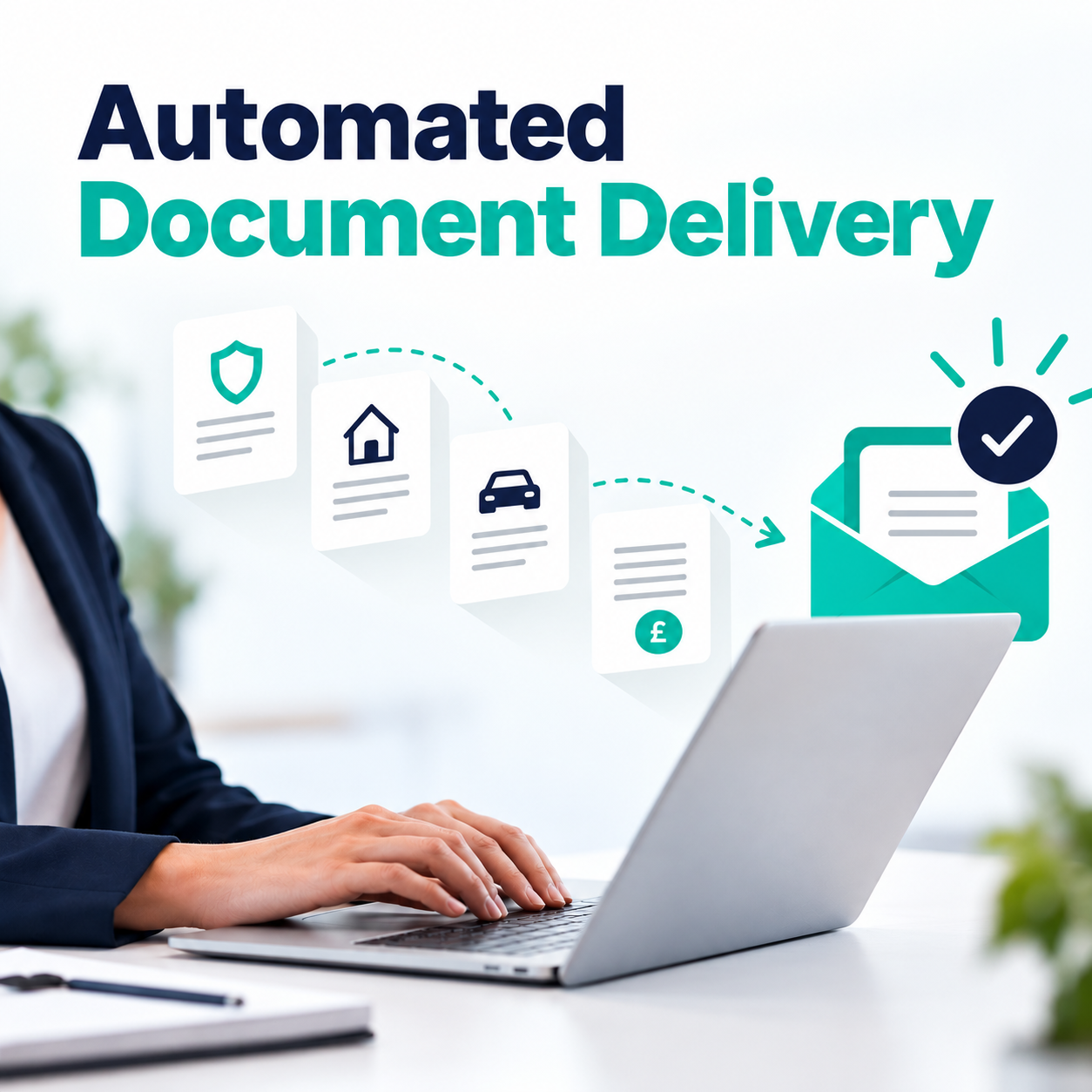
Automated document delivery helps brokerages simplify these processes by distributing insurance documents digitally, reducing repetitive administration, and supporting more consistent client communication.
But its value goes beyond efficiency. As insurance becomes increasingly digital, the way brokers deliver and explain information is becoming an important part of the customer experience.
Here are five ways intelligent document delivery can help insurance brokers improve efficiency, control costs, and strengthen client relationships.
What Is Document Delivery in Insurance?
Document delivery in insurance is the process of distributing policy documents, renewal notices, certificates, and other insurance communications to clients.
Traditional document delivery often involves printing, posting, manually attaching files to emails, or contacting clients individually.
Automated document delivery uses digital workflows to prepare and distribute documents when specific events occur, such as a new policy being issued or an existing policy approaching renewal.
For example, an insurance brokerage can automate the delivery of:
- New business policy documents
- Renewal notices and policy schedules
- Certificates of insurance
- Policy changes and endorsements
- Billing notices and payment reminders
- Claims-related communications
The goal is not simply to replace paper with email. It is to create a more reliable communication process while giving brokers more time for activities that require personal attention.
Why Is Intelligent Document Delivery Becoming More Important?
Insurance brokers operate in an environment where clients expect timely communication, accessible information, and confidence that their personal data is being handled appropriately.
At the same time, insurance technology is evolving.
According to the Lloyd’s Market Association’s 2025 research, 74% of respondents identified data extraction from unstructured documents as a use case for digital workforces in underwriting or claims processes.
The research also identified significant barriers to adopting AI:
- 49% cited data quality and availability.
- 46% identified integration with existing systems.
- 48% pointed to costs and uncertainty around return on investment.
These findings highlight an important distinction: introducing technology is not enough. Insurance organisations need automation that fits their existing processes and solves practical problems.
For insurance brokers, document delivery is one of those practical opportunities.
Rather than introducing unnecessary complexity, an effective delivery workflow can help ensure clients receive relevant documents promptly and securely, with fewer manual steps for brokerage teams.
1. Improve Sales Opportunities Through Timely Document Delivery
A document may seem like a routine administrative requirement, but the communication surrounding it can influence the client’s experience.
Consider what happens after a prospect accepts an insurance quote.
The brokerage must prepare the necessary documents, deliver them, and make sure the client knows what happens next.
When these steps are handled manually, delays can interrupt the customer journey.
Automated document delivery helps maintain momentum by sending relevant information at the appropriate stage of the insurance process.
For example, brokerages can use automated workflows to:
- Deliver new business documents after a policy is issued.
- Send personalised welcome communications.
- Provide clients with digital access to their policy information.
- Follow up on outstanding quotes.
- Support timely renewal communications.
This creates more opportunities for brokers to focus on advice, coverage discussions, and relationship building rather than repetitive administrative tasks.
However, automation alone does not guarantee increased sales. Its value lies in supporting consistent communication and making it easier for brokers to follow up when personal attention matters.
The key principle: Automate document delivery, not the relationship.
Watch: PathwayPort automated insurance communication
2. Reduce Printing, Postage, and Administrative Costs
Paper-based document delivery creates costs that extend beyond printing.
Brokerages may also spend time preparing envelopes, organising postage, handling returned mail, locating documents, and responding to clients who have not received the information they need.
As document volumes increase, these activities can become a significant operational burden.
Automated digital document delivery can reduce:
- Printing and paper consumption
- Postage and physical distribution costs
- Manual document preparation
- Repetitive administrative follow-ups
- Time spent resending misplaced documents
What could automated document delivery save your brokerage?
Consider a brokerage delivering 2,000 document packages each month.
If printing, postage, and handling cost an illustrative £1.50 per package, the annual cost would be:
2,000 × £1.50 × 12 months = £36,000
Moving 70% of these packages to digital delivery would represent £25,200 in potential annual avoided paper-delivery costs, before accounting for software costs, exceptions, and other operational requirements.
This is an illustrative calculation, not an industry benchmark or guaranteed saving.
The actual benefit depends on document volume, existing processes, delivery preferences, and implementation costs.
For many brokerages, the more significant opportunity may be the administrative time recovered, which can be redirected toward client service and revenue-generating activities.
3. Increase Operational Efficiency Without Increasing Workload
Insurance brokers manage multiple communication requirements throughout the policy lifecycle.
Renewal notices need to be delivered. Policy documents must reach clients. Billing reminders need to be sent. Changes to coverage may require updated documentation.
When every task depends on someone remembering to send an email or prepare a document, routine work can create bottlenecks.
Automated document delivery replaces repetitive steps with predefined workflows. “Pathway not only takes away or automates jobs, It’s freeing up our team to concentrate on value-adding tasks.” Read the full case study.
How does automated document delivery work?
A typical process involves five stages:
- Identify the event. A new policy is issued, a renewal approaches, or a document becomes available.
- Prepare the communication. The relevant documents and client information are gathered.
- Apply delivery rules. The system determines which communication should be sent and when.
- Deliver the documents. The client receives a digital notification or access to the documents.
- Manage exceptions and follow-ups. The brokerage reviews outstanding actions or cases requiring attention.
This approach helps establish a more consistent process across teams.
For example, a brokerage managing hundreds of renewals each month can reduce the time spent preparing and distributing routine renewal communications.
Instead of manually managing each delivery, employees can focus on complex renewals, coverage changes, and client questions.
The objective is not to remove brokers from the process. It is to reduce the manual work that prevents them from focusing on clients.
4. Strengthen Client Retention Through Consistent Communication
Client retention depends on more than competitive pricing. Clients also need to understand their coverage, receive relevant information, and feel confident that their broker is available when they need support.
Poor communication can undermine that confidence. For insurance agencies and brokerages, clear communication is also a regulatory consideration.
The Financial Conduct Authority’s guidance on consumer understanding emphasises the importance of helping customers understand and engage with the information provided to them.
This has practical implications for document delivery. Simply sending a document does not necessarily mean the client understands it.
Brokerages should consider whether communications are:
- Timely and relevant
- Written in clear language
- Accessible through suitable channels
- Supported by opportunities to ask questions
- Appropriate for the customer’s information needs
Automated document delivery can help establish consistent communication, while brokers remain responsible for providing the advice and support clients require.
Example: Insurance renewal communication
A brokerage can use automated workflows to notify clients about upcoming renewals, deliver relevant documents, and prompt follow-up where action is required.
The broker can then focus on explaining important changes, reviewing coverage needs, and discussing available options.
This combination of automation and personal service can support a better renewal experience.
Watch: Automated client communication with PathwayPort
5. Enhance Customer Experience With Secure Digital Access
Insurance clients increasingly interact with businesses through digital channels.
For brokers, this creates an opportunity to make insurance documents easier to receive and access.
But convenience must be balanced with security.
Policy documents may contain names, addresses, financial information, and other personal details. Their delivery should therefore be supported by appropriate safeguards.
The UK’s Information Commissioner’s Office (ICO) explains that organisations must implement appropriate technical and organisational measures to protect personal information.
The ICO identifies encryption as one potential security measure, depending on the risks involved.
A well-designed digital document delivery process should therefore consider:
- Appropriate access controls
- Secure transmission of sensitive information
- Clear communication about document availability
- Accurate recipient information
- Suitable retention and access policies
- Alternative delivery arrangements when needed
Digital delivery should also accommodate clients who require additional support or prefer other communication channels.
The best document delivery experience is not necessarily the most automated one. It is the one that makes important information easier to access, understand, and act upon.
Automated Document Delivery vs. Manual Document Delivery
| Process | Manual delivery | Automated delivery |
|---|---|---|
| Document preparation | Individual staff actions | Workflow-based preparation |
| Distribution | Printing, post, or manual emails | Scheduled or event-triggered digital delivery |
| Consistency | Depends on individual processes | Standardised communication rules |
| Follow-ups | Staff-managed reminders | Automated reminders where configured |
| Administration | Repetitive handling | Reduced routine tasks |
| Client experience | May involve longer turnaround times | Potentially faster access to documents |
| Exceptions | Individually identified | Can be routed for review |
Automation does not eliminate the need for human oversight. Brokerages still need appropriate checks, clear responsibilities, and processes for handling exceptions.
How Can Insurance Brokers Measure Document Delivery Performance?
One of the most overlooked benefits of digital document delivery is the opportunity to measure operational performance.
Instead of focusing only on the number of documents sent, brokerages should evaluate whether their processes are becoming more efficient and useful for clients.
Five useful metrics include:
- Digital delivery rate: The percentage of eligible documents delivered digitally.
- Delivery turnaround time: The time between document availability and successful delivery.
- Cost per delivery: The total cost of preparing and distributing each document.
- Manual intervention rate: The percentage of deliveries requiring employee involvement.
- Client response or completion rate: The percentage of communications resulting in the intended action.
These metrics can help brokerage managers identify where automation is delivering value and where processes still need improvement.
For example, a high digital delivery rate may indicate reduced dependence on paper, but a high number of client enquiries could suggest that the accompanying communications need to be clearer.
The most useful measurement combines operational efficiency with customer outcomes.
How PathwayPort Helps Insurance Brokers Automate Document Delivery
PathwayPort helps insurance agencies and brokerages automate routine client communications and document delivery throughout the insurance lifecycle.
Instead of relying on manual processes for every communication, brokerages can establish automated workflows that support consistent, timely client engagement.
With PathwayPort, brokerages can automate communications associated with:
- New Business eDelivery: Deliver policy documents and relevant communications to new clients.
- Renewal eDelivery: Streamline the distribution of renewal documents and notifications.
- Billing Reminders: Automate timely payment-related communications.
- Quote Follow-Up: Keep outstanding quotes visible through scheduled follow-ups.
- Client Recovery: Reconnect with clients through structured communications.
PathwayPort works alongside existing brokerage processes, helping teams reduce repetitive administrative work while maintaining personal relationships with clients.
For brokers using management systems such as Acturis, the broader opportunity is to connect existing policy workflows with more consistent client communication, subject to the integrations and configurations available.
The result is a more efficient approach to routine communication that allows brokers to spend more time advising clients, resolving questions, and developing their business.
Want to spend less time delivering documents and more time supporting clients?
Book a Demo to explore how PathwayPort can help automate document delivery and client communication.
Frequently Asked Questions About Document Delivery
What is document delivery in insurance?
Document delivery in insurance refers to the process of sending policy documents, renewal notices, certificates, and other insurance information to clients. It can be handled through paper-based processes or automated digital workflows.
What is automated document delivery?
Automated document delivery uses predefined rules and workflows to distribute documents when specific events occur. For example, a system can send a notification when a new insurance policy is issued or a renewal document becomes available.
What is intelligent document delivery?
Intelligent document delivery combines automation, client information, delivery preferences, and workflow rules to help ensure documents reach the appropriate recipients at the right stage of the customer journey. Depending on the technology used, it may also incorporate document classification or AI-assisted processing.
What is the difference between document delivery and intelligent document processing?
Intelligent document processing (IDP) focuses on extracting, classifying, and interpreting information from documents. Document delivery focuses on distributing documents to recipients. The two technologies can complement each other but serve different purposes.
How does document delivery automation reduce costs?
Document delivery automation can reduce printing, postage, manual preparation, and repetitive follow-ups. The actual savings depend on document volumes, existing costs, automation coverage, and implementation expenses.
Is digital insurance document delivery secure?
Digital document delivery can be secure when appropriate safeguards are implemented, including access controls, encryption where suitable, recipient verification, and secure communication channels. Organisations must assess their specific data protection obligations and risks.
Can document delivery automation improve client retention?
It can support retention by helping brokers provide consistent, timely communications and easier access to important documents. However, retention also depends on coverage suitability, pricing, advice, service quality, and the overall client relationship.
Can insurance brokers automate renewal document delivery?
Yes. Insurance brokers can use automated workflows to distribute renewal documents and related communications. The available functionality depends on their existing systems, integrations, and automation tools.
Final Thoughts: Better Document Delivery Creates More Time for Clients
Insurance document delivery may appear to be a small part of brokerage operations, but its impact extends across administration, customer communication, costs, and service quality.
When repetitive document distribution is automated, brokerage teams can redirect attention toward activities that require professional expertise.
The future of insurance automation is not about sending more messages or removing human interaction.
It’s about making routine processes more reliable so brokers have more time for the conversations that matter.
PathwayPort helps insurance agencies and brokerages move toward that goal through automated document delivery and client communication workflows.
Recent Posts
 How to Identify Insu…October 20, 2026
 Policy Cancellation:…October 13, 2026
 Email Marketing Insi…August 28, 2026
Collapsible
Leave a Comment
Comments:
Greetings! Very helpful advice on this article! It is the little changes that make the biggest changes. Thanks a lot for sharing!
Comment by gralion torile on March 5, 2022 at 12:37so much fantastic info on here, : D.
Comment by zoritoler imol on April 21, 2022 at 09:31