By using the Pathway platform, we have focused on automating the eDelivery process. This alleviates significant workload for our administrative staff, allowing them to focus on areas that require a personal touch.
Charlotte Steinschifter (Director of People and Culture, Billiard Insurance Group)
Why Insurance Operational Efficiency Is Becoming the Real Automation Goal
Can an insurance agency or brokerage really triple its efficiency?
Possibly. But not simply by sending three times as many automated emails, buying more software or asking employees to manage three times as many policies.
The bigger opportunity is insurance operational efficiency: reducing the manual work, disconnected processes and repetitive administration surrounding the work that actually requires insurance expertise.
That distinction matters.
Insurance businesses have invested heavily in technology, yet employees can still spend significant amounts of time checking management systems, moving information between applications, chasing clients, sending documents, following up on renewals and recording what happened.
The technology may be digital. The process can still be manual.
That’s why the next phase of insurance automation should not be measured by how much technology a brokerage has.
It should be measured by how little unnecessary work its people have to perform.
Automation is not the objective. Operational efficiency is.
What Is Insurance Operational Efficiency?
Insurance operational efficiency is the ability of an insurance organization to service, communicate with and manage a growing book of business while minimizing unnecessary manual work, process friction, duplicated effort and administrative cost.
For agencies and brokerages, this can mean using information already stored in an AMS/BMS to initiate routine processes automatically.
- A policy reaches a certain point before renewal.
- A balance remains outstanding.
- A document becomes available.
- A client has a particular policy but lacks another relevant coverage.
- A quote remains open.
- A client completes a form.
- A service interaction concludes.
Each is more than a piece of data. It is an event that can determine what happens next.
That leads to a different operating model:
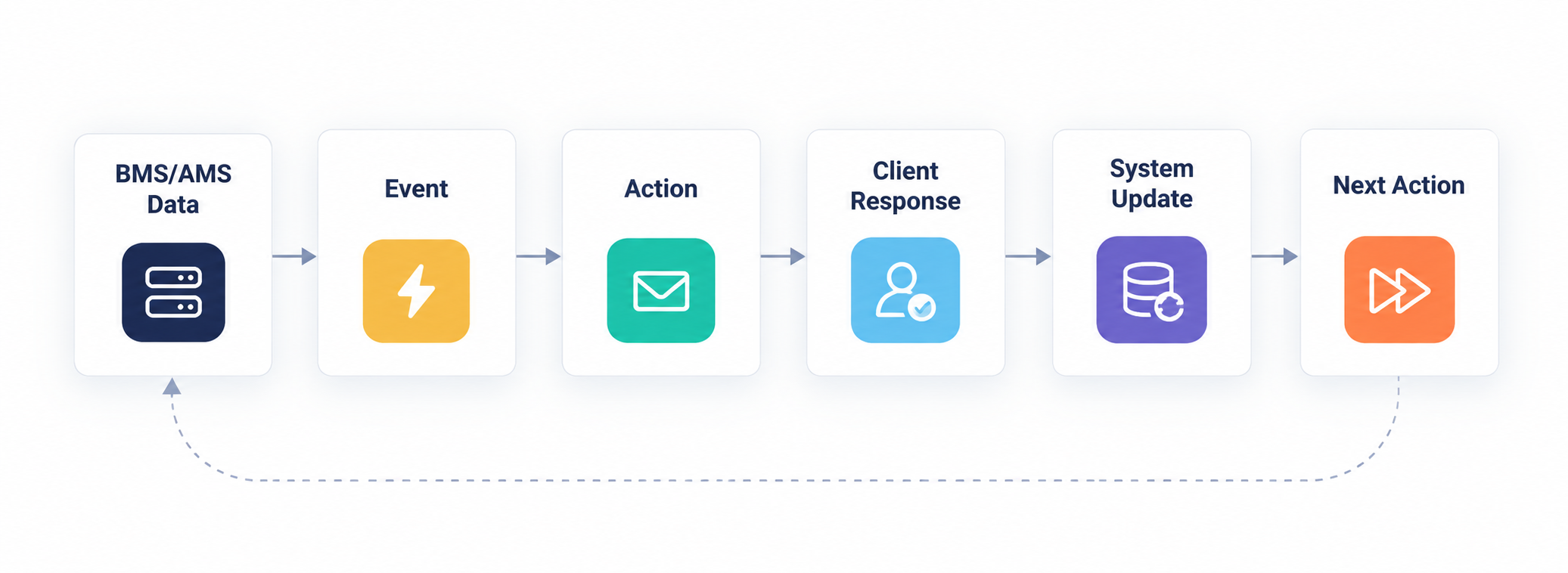
The employee doesn’t disappear from this model. The unnecessary administrative steps surrounding the employee do.
The Insurance Efficiency Problem Isn’t a Lack of Technology
One of the most important lessons from the industry’s digital transformation is that technology adoption and operational efficiency are not the same thing.
McKinsey’s insurance productivity research found that investments in automation increased labor productivity among insurers, but improvements in overall cost efficiency did not automatically follow.
That is an important distinction for insurance leaders.
- Digitizing an inefficient process doesn’t necessarily make it efficient.
- Automating unnecessary steps doesn’t make those steps necessary.
- Adding another system can actually create another place employees have to check.
This is why operational efficiency has to begin with the process rather than the technology.
Before asking: “What can we automate?”
Ask: “Why does someone have to do this manually in the first place?”
5 Signs Your Insurance Business Has an Operational Efficiency Problem
Operational inefficiency doesn’t always look dramatic. Usually, it appears as hundreds of small actions repeated thousands of times.
1. Employees regularly check the BMS/AMS to determine what to do next
The information already exists. The problem is that someone must find it and translate it into action.
2. Routine client communications depend on staff remembering to send them
Renewal reminders, billing notices, quote follow-ups and document notifications are predictable. If they depend primarily on memory and manual task lists, scale becomes difficult.
3. The same information moves manually between systems
Employees copy policy information, update activity records, log communications or move information from one platform into another. Every additional handoff creates time, inconsistency and the possibility of error.
4. Growth creates a proportional need for more administration
If doubling the book of business means approximately doubling the manual servicing workload, technology hasn’t created much operational leverage.
5. Your best people spend significant time on low-judgment work
Experienced insurance professionals create value through advice, coverage knowledge, relationships, negotiation and exception handling.
Their time is expensive. Using that time to repeatedly send routine reminders is an operational design problem.
The PathwayPort Insurance Operational Efficiency Model
From working with hundreds of insurance brokerages across the United States, Canada and the United Kingdom, we’ve found that operational efficiency tends to depend on four connected elements.
1. Integration
2. Automation
3. Digital self-service
4. Human support and exception management
The technology matters. But how those four elements work together matters more.
1. Integration: Your BMS Should Do More Than Store Information
For many brokerages, integration is one of the most important reasons automation creates value.
Why? Because the BMS/AMS already knows the client.
- It knows their policies.
- It knows renewal dates.
- It knows coverage information.
- It knows who manages the account.
- It contains many of the signals required to determine what should happen next.
A separate platform that requires teams to continually export, upload and reconcile that information can simply create another administrative layer.
A more efficient model is:
BMS data → Automation → Client interaction → Activity returned to the BMS
PathwayPort works on top of the broker’s existing management system rather than attempting to replace it.
The BMS/AMS remains the system of record. Pathway uses policy, account and contact information from that system to drive relevant automation. Where supported by the integration, information can also flow back.
That can include client communication activity such as email engagement, form completion or document activity.
The result is important operationally:
The team doesn’t have to choose between automation and visibility.
Automation can happen behind the scenes while the management system continues to provide the operational record.
From a System of Record to a System of Action
This leads to one of the biggest opportunities we see for insurance brokerages.
Historically, the AMS/BMS has primarily answered:
What do we know about this client?
Operational automation adds another question:
What should happen because of what we know?
Consider coverage information.
Knowing which policies a client holds is useful.
But if the data can identify a relevant coverage opportunity, that information can help initiate a cross-sell workflow or bring the opportunity to the attention of the appropriate broker.
Consider renewal dates.
Knowing a policy expires in 60 days is important.
Using that date to initiate the appropriate pre-renewal process is considerably more valuable.
Consider personalization.
Instead of manually building client lists, information already inside the management system can help determine which clients receive which communication and populate messages with relevant account or policy information.
The management system therefore remains the system of record.
Integration helps turn that record into action.
2. Automation: The Best Workflows Happen Behind the Scenes
Insurance automation works best when employees don’t need to constantly initiate it.
- The event happens.
- The data changes.
- The appropriate process begins.
- That’s what we mean by behind-the-scenes automation.
From our experience across different brokerages, some of the most frequently requested processes include:
- renewal reminders;
- cross-sell and upsell communication;
- document delivery;
- billing reminders;
- Net Promoter Score and feedback workflows;
- win-back campaigns;
- quote follow-ups;
- client information collection.
But there isn’t one universal automation template for every brokerage.
That’s another important lesson. Operational efficiency is contextual.
A workflow that produces significant value for a Canadian brokerage may be much less important to a U.S. agency.
Geography Changes the Efficiency Equation
PathwayPort operates across the U.S., Canada and UK, and one thing becomes obvious when working across markets:
Insurance operational efficiency is not identical everywhere.
Canadian and UK brokerages, for example, often place considerable value on billing reminder automation. Many U.S. agencies operate differently because carriers frequently handle premium collection directly. Document delivery is another strong example.
For many Canadian brokerages, secure electronic document delivery can remove a particularly frustrating operational burden while giving clients convenient digital access to policy documents.
The lesson is broader than any individual feature:
Don’t automate according to a generic best-practice list. Automate according to where your own operation creates friction.
3. Digital Self-Service: Efficiency Continues After the Message Is Sent
Operational efficiency shouldn’t stop when communication reaches the client.
The next question is:
Can the client complete the next routine step without creating another manual task for the brokerage?
This is where self-service becomes important.
Accenture’s research found 70% of policyholders were satisfied or very satisfied with how their insurer or agent handled their claim. It identifies settlement speed, omnichannel communication and transparency as important contributors to the claims experience.
Its previous research also found a strong relationship between the quality of the digital experience and whether consumers continue using digital channels.
The implication extends beyond policy purchasing. Clients increasingly expect to complete straightforward actions digitally.
The opportunity for insurance businesses is therefore not simply to communicate digitally but to allow routine servicing to continue digitally where appropriate.
What Happens When Clients Actually Adopt Self-Service?
PathwayPort has seen this effect at significant scale. One of the largest multi-branch Canadian brokerages using Pathway provides a useful example.
These figures are specific to that brokerage and should be treated as directional rather than universal benchmarks because portal adoption varies significantly according to brokerage size, geography, client demographics, internal processes and how consistently digital servicing is promoted.
Over a three-year period:
- Self-service adoption increased from the mid-teens to approximately 35% of active clients.
- Logged-in sessions grew more than 20% year over year.
- Digitally submitted policy-change requests increased approximately 2–3×.
- Document downloads and digital pink-slip activity increased approximately 40–60% year over year.
- Quote and service-form submissions nearly doubled year over year.
But the most interesting numbers aren’t necessarily the login numbers.
The brokerage experienced a 50%+ increase in premium captured through portal-driven policy changes and generated six-figure annualized FTE time savings associated with automated document access and servicing workflows.
Those results shouldn’t be interpreted as a promise that every brokerage will achieve the same numbers.
They demonstrate something more important:
Digital adoption becomes operationally valuable when clients can complete meaningful actions—not simply log into another portal.
4. Human Support Is Part of Operational Efficiency
Automation discussions often focus entirely on software. That’s a mistake.
Someone still has to determine:
- Which processes should be automated?
- Which communications should be used?
- How should the workflow reflect the brokerage’s brand?
- What happens when a client responds?
- Which situations require an employee?
- How should exceptions be handled?
- What happens when the brokerage changes a process?
This is why implementation and ongoing support matter.
At PathwayPort, onboarding can include helping brokerages configure automation and build branded email designs rather than simply handing over software and expecting internal teams to figure everything out.
The objective is not: “Here is another platform. Good luck.”
The objective is: Make the technology reduce work rather than create new work.
The Insurance Operational Efficiency Equation
Based on what we see across brokerages, we think operational efficiency can be understood with a relatively simple framework:
Operational Efficiency =
Connected Data
+ Automated Repetition
+ Digital Self-Service
+ Human Exception Management
− Manual Handoffs
This is important because automation alone doesn’t guarantee efficiency.
- You can automate a communication and still require an employee to manually update the BMS/AMS.
- You can introduce a portal and still have employees manually process everything submitted through it.
- You can automate renewals but still require staff to export spreadsheets to determine who enters the workflow.
Each manual handoff reduces the operational leverage created by the automation around it.
Automation Is Not the Same as Efficiency
This deserves its own distinction.
- Automation is a tool.
- Business process automation is an approach to executing processes.
- Operational efficiency is the outcome.
A brokerage can have dozens of automated workflows and still operate inefficiently.
The objective should therefore not be: “How many things have we automated?”
A better question is: “How much unnecessary human effort remains in this process?”
That changes how automation projects should be evaluated.
The 5 Levels of Insurance Operational Efficiency
A useful way to assess a brokerage is to look at its level of operational maturity.
Level 1 – Manual
People initiate almost everything. Employees check systems, send messages, set reminders and record activities manually. Technology primarily stores information.
Level 2 – Digital
Processes have moved away from paper, but people still move the process forward. Emails replaced letters. Digital forms replaced paper forms. Cloud systems replaced local files. But much of the underlying work remains manual.
Level 3 – Automated
Individual repetitive tasks begin happening automatically.
- Renewal reminders.
- Billing reminders.
- Document notifications.
- Surveys.
- Follow-ups.
The organization saves time, but automation may still exist in separate pockets.
Level 4 – Connected
Automation becomes connected to the BMS/AMS. Policy and account data determine who enters workflows and when. Client interactions can be recorded back where integrations support it. Digital servicing, communication and core insurance data begin operating as one connected environment.
Level 5 – Adaptive
The organization begins using the results of automation to improve the operation itself.
- Which communications generate action?
- Where do clients abandon processes?
- Which workflows require the most staff intervention?
- Which coverage opportunities are being identified?
- Which clients may be at risk?
At this stage, the loop becomes:
Data → Trigger → Action → Client response → Insight → Process optimization
That’s when automation stops being a productivity feature.
It becomes an operating model.
Efficiency Should Not Mean Removing People
There is an important boundary. Not every insurance interaction should be automated.
Deloitte’s Digital Insurance Maturity 2025 study assessed 93 insurers across 16 markets and concluded that digitally enabled engagement has become a business imperative. But the research also points toward a hybrid model combining strong digital channels with personalized advice from agents and intermediaries.
That’s precisely the balance brokerages should pursue. Technology is excellent at predictable repetition. People are excellent at ambiguity, judgment, advice and relationships.
So, the objective should be:
- Automate repetition.
- Escalate exceptions.
- Preserve judgment.
A routine renewal reminder doesn’t necessarily require an experienced broker. A complicated discussion about whether a client has sufficient coverage probably does. Operational efficiency means recognizing the difference.
Why Consistency Is Also a Risk Issue
Efficiency is usually discussed in terms of time and cost. Insurance businesses should also consider consistency and traceability. Manual processes depend on people remembering to perform them.
- People get busy.
- Priorities change.
- Employees leave.
- Messages can be missed.
- Follow-ups can be forgotten.
Insurance automation creates an opportunity to standardize predictable communication and maintain clearer records of what happened.
That doesn’t eliminate Errors & Omissions risk.
But a controlled process with traceable communications can reduce reliance on memory and undocumented manual activity.
For regulated insurance organizations, that matters. Efficient shouldn’t mean uncontrolled. Automation should be rule-based, auditable and designed around predictable behaviour.
The Digital Experience Is Becoming Part of Retention
Operational efficiency is not purely an internal metric. Clients experience the consequences.
Insurance Journal reports that claim satisfaction is more than twice as high when customers find it very easy to communicate with their insurer, while common sources of frustration include repeated calls and a lack of timely email and text follow-ups.
The study also found a striking relationship between digital experience and retention risk.
Among customers who rated their digital claims experience “poor” or “just OK,” 52% were likely to leave or not renew. Among customers rating the experience “excellent” or “perfect,” that figure fell to 4%.
That research relates to carrier claims experiences rather than brokerage operations, so the numbers should not be applied directly to brokerages. But the underlying lesson is highly relevant.
Operational communication becomes part of the customer experience.
- Clients experience whether information arrives.
- Whether documents are accessible.
- Whether someone follows up.
- Whether they have to repeat themselves.
- Whether the business appears to know who they are.
- Operational efficiency and client experience aren’t separate objectives.
They increasingly reinforce each other.
What About AI?
AI is going to change insurance operations. But AI doesn’t eliminate the need for good operational design.
McKinsey’s 2025 report on AI in insurance argues that only a relatively small group of insurers have so far extracted outsized competitive value from AI and that achieving greater value requires a broader enterprise approach.
That’s an important warning. Adding AI to an inefficient process doesn’t necessarily fix the process.
A better sequence is:
Reliable data → Well-designed process → Automation → AI where valuable → Human intervention where necessary
AI can help interpret information, identify patterns, generate content, summarize interactions and support decision-making. But insurance leaders should resist treating AI as the strategy.
Operational efficiency is the strategy. AI is another tool for achieving it.
How Should a Brokerage Measure Operational Efficiency?
This is where insurance businesses should move beyond counting automated emails.
The most useful operational questions are:
How many manual touchpoints does a process require?
A renewal that previously required eight manual actions and now requires two is meaningfully different.
How much employee time is required per account or policy?
This helps reveal whether automation is creating actual operating leverage.
How many policies or clients can the existing team support?
This may be one of the most important measures of scalability.
How consistently are important communications happening?
Efficiency without consistency isn’t much of an improvement.
How many exceptions require human intervention?
Automation should reduce unnecessary involvement without preventing necessary involvement.
How quickly can clients complete routine servicing actions?
Customer effort matters too.
What percentage of routine communication is driven by data rather than memory?
This is a useful indicator of automation maturity.
The Real ROI Question
When PathwayPort looks at automation performance with clients, the conversation increasingly comes back to four outcomes:
- Renewal performance.
- Revenue per account.
- Net-new revenue opportunities.
- Hours returned to employees.
But the fourth can influence all the others.
If automation gives an account manager hours back every week, the question shouldn’t end with: “How much did we save?”
The better question is: “What can that person now do with the capacity we created?”
- Speak with more clients?
- Review more accounts?
- Identify coverage opportunities?
- Address at-risk customers?
- Prepare more thoroughly for renewals?
- Handle a larger book without reducing service quality?
This is why we believe the ROI of automation is frequently underestimated when it is measured only as labor savings.
The bigger return may be capacity.
Don’t Automate More. Operate Better.
The insurance technology market will continue producing more automation.
- More AI.
- More integrations.
- More digital servicing.
- More data.
But more technology doesn’t automatically produce a more efficient brokerage.
The organizations that benefit most will be the ones that connect these capabilities around a clear operating principle:
People should spend their time where people create value.
- Let the BMS remain the trusted system of record.
- Use its data to determine when something needs to happen.
- Automate predictable execution.
- Give clients convenient digital options for routine interactions.
- Return relevant activity to the core system where possible.
- Escalate exceptions to people.
- Then measure what happened and improve the process.
That’s the progression:
Data → Trigger → Communication → Client action → Insight → Optimization
The most efficient insurance organization won’t necessarily be the one with the most automation.
It will be the one where people rarely spend time doing work technology could have handled for them.
And that’s what “triple your efficiency” should really mean. Not working three times harder.
Building an operation that makes every hour more valuable.
Frequently Asked Questions About Insurance Operational Efficiency
What is insurance operational efficiency?
Insurance operational efficiency is the ability to service and grow a book of business while minimizing unnecessary manual work, duplicated processes, administrative cost and operational friction. Technology, automation, integration and self-service can all contribute to efficiency, but they are tools rather than the outcome itself.
How can an insurance brokerage improve operational efficiency?
Start by identifying high-volume processes with repetitive manual steps. Examine where employees check systems, copy information, send predictable communications, chase responses or update records manually. Then determine which steps can be eliminated, automated or triggered using existing AMS/BMS data.
What insurance processes are commonly automated?
Common examples include renewal reminders, billing reminders, document delivery, quote follow-ups, cross-sell and upsell campaigns, client information collection, NPS surveys, review requests and win-back campaigns. The most valuable processes vary by brokerage and market.
How does BMS integration improve operational efficiency?
Integration allows policy, account and contact information already stored in the BMS to trigger relevant processes without repeated manual data transfer. Where two-way functionality is supported, client activity and other information can also be returned to the management system, helping preserve visibility and auditability.
Is operational efficiency the same as business process automation?
No. Business process automation is one method organizations use to automate repeatable processes. Operational efficiency is the broader business outcome: reducing unnecessary effort, time, cost and friction while maintaining or improving service.
Can insurance automation reduce E&O risk?
Automation cannot eliminate E&O risk. However, standardized, controlled and traceable processes can reduce reliance on memory and inconsistent manual communication. Brokerages should design automation around their own compliance, documentation and supervisory requirements.
Does insurance automation replace brokers?
It shouldn’t. The strongest use cases automate repetitive, predictable work while keeping brokers involved in advice, complex coverage decisions, exceptions and relationship-driven interactions.
How should insurance automation ROI be calculated?
Look beyond software cost versus hours saved. Consider administrative time, manual touchpoints, processing time, communication consistency, client adoption, retention, revenue opportunities, capacity per employee and the additional higher-value work employees can perform with the time automation returns.
What is the role of AI in insurance operational efficiency?
AI can enhance efficient processes through summarization, content generation, pattern recognition and decision support. However, AI produces greater operational value when it sits on top of reliable data, well-designed processes and appropriate human controls.
How PathwayPort Can Help
PathwayPort turns the data already in your AMS/BMS into action – automating renewals, follow-ups, document delivery, billing reminders and routine client servicing.
The result: less manual work, more capacity and more time for the conversations that need a human touch.
Recent Posts
 Email Marketing Insi…August 28, 2026
 How Do UK Insurance …August 6, 2026
 Insurance Email Temp…July 30, 2026
Collapsible
Leave a Comment
Comments:
Loving the information on this site, you have done great job on the posts.
Comment by gralion torile on March 6, 2022 at 17:16so much excellent information on here, : D.
Comment by Rolando Moscardelli on May 17, 2022 at 06:21