Insurance workflow automation uses software, AMS/BMS data, and predefined rules to automatically manage repetitive processes across an insurance agency or brokerage. It connects policy and client data with triggers and actions to automate workflows such as renewals, payment reminders, client communication, digital forms, document delivery, quote follow-ups, cross-selling, and review requests. Unlike generic automation, insurance workflow automation works around insurance-specific events and processes, helping agencies reduce manual work while keeping their existing management system at the center of operations.
Studies show that automation can save agencies up to 80% of time spent on repetitive administrative work, while improving policyholder retention rates by as much as 20–30% through proactive communication and renewal reminders. At the same time, automated lead nurturing campaigns can generate over 50% more qualified leads compared to manual outreach.
What Is Insurance Workflow Automation?
Insurance workflow automation uses software, AMS/BMS data, and predefined rules to automatically manage repetitive processes across an insurance agency or brokerage. It connects policy and client data with triggers and actions to automate workflows such as renewals, payment reminders, client communication, digital forms, document delivery, quote follow-ups, cross-selling, and review requests. Unlike generic business automation, insurance workflow automation is built around insurance-specific events and processes, helping agencies reduce manual work while keeping their existing management system at the center of operations.
For agencies and brokerages, that typically covers workflows like:
- Renewals
- Payment reminders
- Quote follow-ups
- Client onboarding
- Digital forms
- Policy document delivery
- Email and SMS communication
- Review requests
- Cross-selling
- Internal notifications
- Administrative processes
A workflow doesn’t have to automate an entire process end to end. Instead, it automates the predictable steps and brings staff back in only when human judgment is required.
That distinction matters: good insurance automation doesn’t remove the agent – it removes the unnecessary manual steps around the agent.
How Insurance Workflow Automation Works
Most automated insurance workflows are built from the same six components.
1. Data The process starts with information that already exists inside the AMS — client details, policy type, expiration date, carrier, renewal history, contact information, and policy activity.
2. Trigger Something happens that tells the system a workflow should begin — a policy hits 60 days from renewal, a payment goes outstanding, or a new client is added.
3. Rules The workflow determines what should happen based on predefined criteria. A commercial renewal, for example, may follow a different path than a personal-lines renewal.
4. Action The automation platform performs the appropriate action: sending an email or SMS, delivering a digital form, sending a document, creating a notification, or kicking off another automated process.
5. Client response The workflow adapts based on what the client does — did they complete the form, respond, or take the required action?
6. Next action The workflow moves to the appropriate next step, or routes a team member in.
In short, instead of staff manually managing every stage, the process becomes:
Event → Rule → Action → Response → Next action
Why the AMS Should Remain at the Center
Insurance agencies have spent years building processes around their AMS. Workflow automation shouldn’t require them to abandon it.
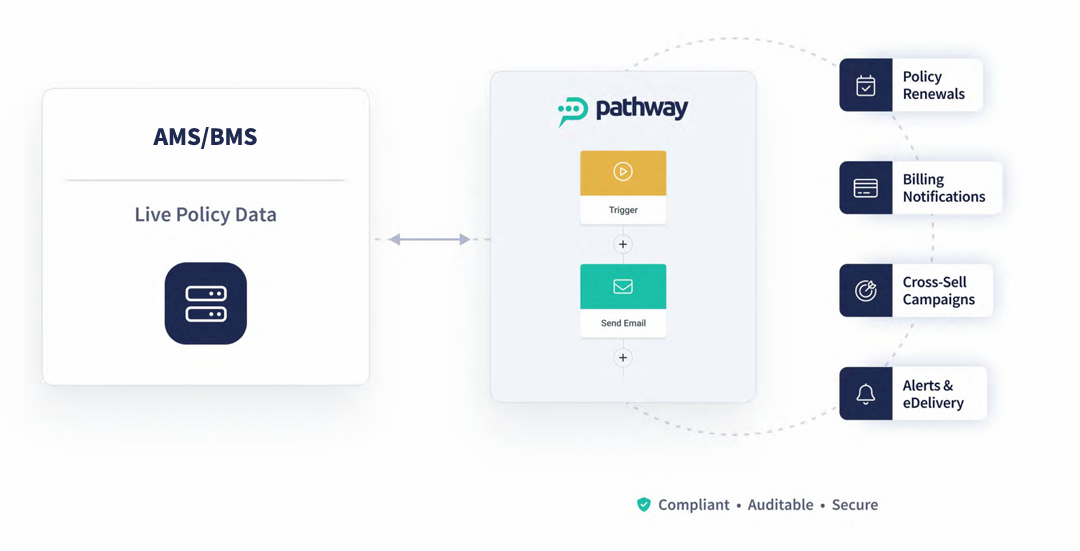
Instead, the AMS stays the system of record, while an automation platform uses the policy and client data already inside it to power workflows around it.
Take a renewal. Your AMS already knows who the client is, what policy they hold, when it expires, and how to reach them. The missing piece is usually turning that information into a repeatable client journey — and that’s where automation comes in.
Without workflow automation: AMS → employee checks renewal → employee drafts email → employee sends questionnaire → employee follows up → employee sends reminder
With workflow automation: AMS → renewal trigger → automated communication → digital form → follow-up → staff intervention where needed
The AMS still holds the core insurance information. Automation simply turns that information into action.
Insurance Workflow Automation vs. Insurance Automation
These terms are related but not interchangeable.
Insurance automation is the broader category. It can include AI, robotic process automation, marketing automation, document processing, and workflow automation.
Insurance workflow automation specifically connects the individual steps of an insurance process.
For example, a payment reminder on its own is an automated action. But:
Payment status → Reminder → Follow-up → Client payment → Stop communication
is an automated workflow.
That distinction is why workflow automation is particularly valuable for agencies: most agency processes aren’t single actions — they’re sequences of actions.
Insurance Workflow Automation vs. Marketing Automation
It’s tempting to treat marketing automation as the whole story, but that muddies the picture. The two serve different purposes:
Marketing automation primarily focuses on email campaigns, SMS, segmentation, lead nurturing, cross-selling, retention, and engagement.
Workflow automation connects multiple steps around an operational or client process — renewals, payments, onboarding, document delivery, information collection, and follow-up.
Marketing automation can be one component of a larger insurance workflow. A renewal workflow, for instance, might use email automation as one step without the renewal itself being a marketing campaign.
10 Insurance Workflows Agencies Can Automate
1. Pre-Renewal Workflow
Policy approaching renewal → personalized pre-renewal email → digital questionnaire → reminder if incomplete → response collected → staff review.
Related: insurance renewal automation
2. Automated Payment Chaser
Outstanding payment → initial reminder → follow-up → payment action → reminders stop once resolved. This reduces repetitive payment chasing while keeping client communication consistent.
Related: insurance billing automation
3. New Client Onboarding
New policy or client → welcome communication → required information → document delivery → educational content → appropriate follow-up. This creates a consistent onboarding experience without relying on individual staff to initiate every step.
4. Policy Document eDelivery
New document available → identify the right client → electronic delivery → notification → activity recorded where supported. This cuts down on repetitive document handling and manual email prep.
Related: insurance document automation
5. Client Information Collection
Information required → digital form → conditional questions → client submission → information routed appropriately → follow-up if incomplete. Particularly useful ahead of renewals.
Related: insurance forms automation
6. Quote Follow-Up
Quote delivered → follow-up communication → reminder → educational content → staff notification when appropriate. Instead of producers manually tracking every open quote, automation keeps follow-up consistent.
7. Lost Prospect Re-Engagement
A prospect who didn’t buy today may still become a client later. Lost opportunity → retain relevant prospect data → wait until the right time → re-engagement communication → new quote opportunity.
8. Cross-Sell Workflow
AMS identifies a coverage gap → client segmented → relevant communication → follow-up → interested client routed to staff. The goal isn’t sending every client the same offer — it’s making better use of the policy information you already have.
9. Client Review Workflow
Successful client interaction → feedback request → review opportunity → follow-up where appropriate. This makes reputation building part of the client journey instead of an occasional campaign.
Related: insurance review automation
10. NPS and Retention Workflow
Client segment selected → NPS survey → response captured → satisfied-client journey or at-risk-client journey → appropriate team follow-up. Automation turns client sentiment into an actionable workflow rather than a one-off survey.
Key Benefits of Insurance Workflow Automation:
- Faster Processing
Automate repetitive tasks like data entry, document verification, and claims handling. What used to take days or weeks, such as underwriting or renewals, can now be completed in minutes or hours. - Greater Accuracy
Reduce human error by relying on consistent, rules-based logic. Automation ensures data is captured and processed correctly, lowering the risk of mistakes, rework, and compliance issues. - Scalability Without Extra Cost
Easily handle higher volumes of policies, renewals, and claims during peak periods (e.g., after a natural disaster) without adding extra staff or operational costs. - Cost Savings Across Operations
Cut labor costs by reducing manual work and paperwork. Minimize expenses tied to errors and rework, while AI-driven fraud detection helps flag suspicious claims and prevent financial losses. - Better Customer Experience
Deliver faster claims resolutions, instant policy issuance, and real-time status updates through mobile apps or portals. Clients get transparency and convenience, which boosts satisfaction and loyalty. - Personalized Engagement
Use data-driven insights to create tailored offers, renewal reminders, and communication. Personalized products and services make customers feel valued and increase retention rates. - Stronger Compliance & Audit Readiness
Embed compliance checks into workflows automatically. This ensures consistent regulatory adherence, centralized documentation, and smooth audit trails. - Competitive Advantage
Agencies using automation operate more efficiently, adapt faster to market changes, and offer superior client experiences, outperforming competitors still relying on manual processes.
Want to see it in action? [📅 Schedule a Demo]
Why Insurance Workflow Automation is Critical for Insurance Agencies and Brokerages
Insurance agencies and brokerages face unique challenges, from managing large volumes of client data to staying competitive in a fast-paced market. Here’s how marketing automation can address these issues:
- Eliminate Time-Consuming Manual Processes: Automate repetitive tasks like email outreach, policy updates, follow-ups, and billing reminders to save hours of manual effort. Leverage intelligent workflow automation to generate and deliver pre-renewal and renewal letters instantly, reducing administrative workload and increasing efficiency.
- Maximize Clients’ Retention & Get More Policyholders: Convert more leads into policyholders and retain existing clients with well-timed, personalized messaging. Drip campaigns, renewal nudges, and tailored insurance offers ensure faster responses, higher renewal rates, and stronger client relationships. By streamlining workflows and leveraging proactive automation, agencies can boost conversions, retain more policyholders, and seize new growth opportunities effortlessly.
- Process Your Renewal Policies Faster: Automatically generate pre-renewal and renewal letters, policy surveys, and required documents using existing data in your management system. By eliminating manual data entry, insurance marketing automation speeds up renewals and reduces errors.
- Enhance the Client Experience with Personalized Communication: Provide a seamless customer journey with trigger-based automated emails tailored to each client’s needs. From onboarding new clients to maintaining ongoing engagement, insurance automation ensures timely, relevant communications that improve satisfaction and loyalty.
Get the best insurance marketing automation tools for your agency or brokerage to streamline marketing efforts, reduce administrative burdens, and improve overall efficiency.
Check how Heath Crawford grew their business in just a year!
“The positive impact of Pathway on our growth trajectory is undeniable. Pathway isn’t just a tool; it’s a growth partner.” – Simon Brewster, Director at Ellis David
Common Automated Workflows for Insurance:
At PathwayPort, we know that insurance agencies and brokerages need automation that delivers real results. That’s why we’ve built smart workflows designed to streamline operations, improve client engagement, and drive policy growth. Here are some of the most impactful use cases:
Integrated CRM & Analytics
Manage client data in one place and track campaign performance with actionable insights to optimize your marketing strategy.
Smart Campaigns for Renewals & Updates
Automatically send personalized emails for policy renewals, updates, and special offers—ensuring clients never miss important communications.
Lead Nurturing Workflows
Guide prospects from inquiry to policy purchase with automated email + SMS sequences, boosting conversions and response rates.
Audience Segmentation
Target clients based on demographics, policy type, or behavior. For example, instantly detect new policy documents in your AMS/BMS and send them securely with tailored messages.
E-Delivery for Documents & Billing
Deliver policies, surveys, and billing reminders electronically, cutting down on paperwork, postage, and manual follow-up.
Automated Billing Reminders
Stay on top of collections with automated reminders synced daily with your AMS/BMS, so your team can focus on growth instead of chasing payments.
Cross-Sell & Upsell Campaigns
Effortlessly promote home, auto, and other policies with targeted offers that increase revenue per client. Learn more about the top cross-selling strategies for insurance agencies and brokerages.
Online Reviews & Feedback Requests
Trigger campaigns to gather NPS scores or customer reviews after renewals or policy changes, building credibility and referrals.
How Insurance Agencies and Brokerages Can Improve Their Workflows, Save Time, and Grow ROI?
PathwayPort delivers cutting-edge insurance automation tools tailored for progressive brokerages and agencies in the UK, USA and Canada. Anticipating industry trends and responding to evolving client needs, our intuitive cloud-based software is specifically designed to empower insurance businesses to succeed.
- User-Friendly Interfaces: Intuitive and easy to use for teams of all sizes.
- Dedicated Support: Our team is here to ensure your success every step of the way.
- Proven Track Record: Trusted by insurance businesses worldwide to deliver measurable results.
- Enhanced Customer Experience: Provide personalised, timely experiences for each client.
- Drive Policy Growth: Maximise client value through cross-selling and upselling.
- Number of work flows: >200 and new are coming up
- Rich library with tailored email templates, and articles: > 500 and new are coming up
- Number of hours saved: medium agency/brokerage can save up to 80% on manual work
- Grow your ROI and reach 70% of growth (in a 5-year period).
Insurance Automation in Action: Grow, Engage, and Scale
Experience the power of insurance automation in action with PathwayPort. Our smart marketing automation is built specifically for insurance agencies and brokerages to streamline operations, automate renewals and follow-ups, and deliver personalized client experiences that drive retention. By reducing manual work and improving engagement, you can boost efficiency, win more policies, and maximize ROI.
Schedule a Demo today and take the first step toward transforming your agency and brokerage.
How to Choose Insurance Workflow Automation Software
- Insurance expertise — does the provider understand renewals, policies, and agency/broker processes and data?
- AMS/BMS integration — can the platform work with the insurance systems you already use?
- Insurance-specific triggers — can policy and client information initiate workflows?
- Multi-channel communication — does it support email, SMS, forms, and eDelivery?
- Workflow flexibility — can processes be configured around how your agency actually operates?
- Two-way data capabilities — where supported, can information or activity flow back to the management system?
- Segmentation — can clients be grouped using relevant policy and customer data?
- Reporting — can you measure workflow performance?
FAQs
1. What is insurance workflow automation?
Insurance workflow automation uses software, rules, and insurance data to automate repetitive steps within processes such as renewals, payments, onboarding, document delivery, and client communication.
2. What insurance workflows can agencies automate?
Common examples include renewal reminders, payment chasing, quote follow-up, client onboarding, digital forms, document delivery, cross-selling, reviews, and client feedback.
3. Does workflow automation replace an AMS?
No. Insurance workflow automation works alongside an existing AMS, using the client and policy information already stored there to initiate and manage processes.
4. What’s the difference between insurance automation and workflow automation?
Insurance automation is the broader category. Workflow automation specifically connects multiple steps within a process using triggers, rules, actions, and responses.
5. What’s the difference between insurance workflow automation and marketing automation?
Marketing automation primarily manages communications and campaigns. Workflow automation connects communication with operational steps, client actions, AMS data, and staff intervention.
6. Can an insurance renewal workflow be automated?
Yes. Policy expiration data can trigger pre-renewal communication, digital questionnaires, reminders, and follow-up steps before staff intervention is required.
7. What should an insurance agency automate first?
Start with a repetitive, high-volume, rules-based process with a measurable outcome – renewals, payment reminders, document delivery, and information collection are common starting points.
Stop Managing Workflows One Task at a Time
The biggest opportunity in insurance automation isn’t automating one email. It’s connecting the steps surrounding the work your team already performs.
When AMS data can trigger communication, forms, documents, reminders, and follow-up automatically, routine processes become more consistent – without requiring staff to manage every step by hand.
That’s the value of insurance workflow automation: let technology manage the predictable steps, and let your people handle the work that actually requires people.
Recent Posts
 Policy Cancellation:…October 13, 2026
 Email Marketing Insi…August 28, 2026
 How Do UK Insurance …August 6, 2026
Collapsible

Leave a Comment