
Making Your Message Stand Out for Insurance Customer
Your brokerage or insurance agency sends renewal reminders. Clients receive policy updates. Your team follows up on quotes, sends newsletters and checks in throughout the year.
Yet some clients still stop responding, shop around or leave without explaining why.
What’s missing?
Insurance customer engagement isn’t measured by how many messages a brokerage or agency sends. It’s measured by whether those interactions help clients understand their insurance, feel supported and take meaningful action.
A client can receive ten emails and still feel disconnected from their broker/agent. Another might receive just three relevant messages and feel confident that their insurance needs are being looked after.
This is the challenge insurance agencies and brokerages need to address in 2027.
According to the 2025 J.D. Power U.S. Individual Life Insurance Study, 58% of agent or advisor relationships were classified as disengaged or transactional. The study also found higher customer satisfaction among people who recalled receiving communication from their insurer during the previous year.
Although the findings relate to life insurance, they raise a broader question for insurance professionals:
Are you building relationships with your clients, or simply completing communication tasks?
Let’s explore why insurance customers disengage, how to recognise the warning signs and where automation can help brokers build stronger relationships.
What Is Insurance Customer Engagement?
Insurance customer engagement is the ongoing relationship between an insurance provider or intermediary and its clients, shaped by communication, service, trust and meaningful interactions throughout the policy lifecycle.
Unlike customer communication, which focuses on exchanging information, engagement considers whether those interactions create value for the client.
For example:
- Sending a renewal reminder is communication. Helping a client understand their changing insurance needs is engagement.
- Sending a quote is communication. Following up to answer questions and explain coverage options is engagement.
- Requesting feedback is communication. Using that feedback to improve service is engagement.
The difference is not necessarily the message itself. It is what happens because of it. For insurance brokers and agents, this distinction matters because clients may receive regular communication without feeling that their individual needs are understood.
Why Do Insurance Customers Disengage?
Customer disengagement rarely happens because of one unanswered email. It may develop gradually through interactions that feel irrelevant, confusing, poorly timed or incomplete.
A client might ignore a renewal reminder because they don’t understand what they need to do. Another may stop responding to cross-sell offers because the suggested products don’t match their circumstances.
Some clients may be satisfied with their coverage but see little reason to interact with their broker between renewals. Others may be frustrated because a question or concern was never resolved. These situations have different causes, but they can produce the same result: declining engagement.
Seven engagement gaps insurance brokers should recognise
| Engagement gap | What the client may experience | What brokers should investigate |
|---|---|---|
| Communication without value | “I keep receiving messages, but nothing useful.” | Is each message relevant? |
| Poor timing | “I needed this information earlier.” | When is communication triggered? |
| Unclear information | “I don’t understand what changed.” | Is the next step clear? |
| Transaction-only relationships | “I only hear from my broker at renewal.” | Are there meaningful interactions between transactions? |
| Irrelevant offers | “They don’t seem to know what insurance I already have.” | Are messages based on accurate policy information? |
| Missing follow-through | “I replied, but nothing happened.” | Who owns the next action? |
| Unnoticed disengagement | “Nobody asked why I left.” | Are warning signs and feedback reviewed? |
These gaps reveal an important distinction. An insurance customer who doesn’t respond is not necessarily an unhappy customer. But a pattern of disengagement can indicate that the relationship needs attention.
Rather than sending more messages automatically, brokers and agents should first understand why existing communication isn’t creating the intended response.
The Four Elements of Meaningful Insurance Customer Engagement
To understand where engagement breaks down, insurance agencies and brokerages can evaluate their communication against four practical criteria.
The PathwayPort Insurance Engagement Framework
1. Timing
Does communication reach the client when it can make a difference?
2. Relevance
Does the message reflect the client’s actual circumstances?
3. Clarity
Does the client understand the information and what to do next?
4. Follow-through
Does the brokerage act when the client needs assistance?
This is a proposed PathwayPort editorial framework for evaluating engagement, not an independently validated industry model.
These four elements provide a way to evaluate the quality of insurance customer engagement beyond email activity or communication frequency.
1. Timing: Are you reaching clients when it matters?
A useful message delivered too late may lose much of its value. Consider an insurance client whose renewal is approaching.
A reminder sent a few days before expiry might technically complete a communication task. However, it may leave little time to review coverage, discuss changes or resolve outstanding questions.
Earlier engagement creates more room for meaningful conversations. The same principle applies to quote follow-ups, billing reminders and client check-ins.
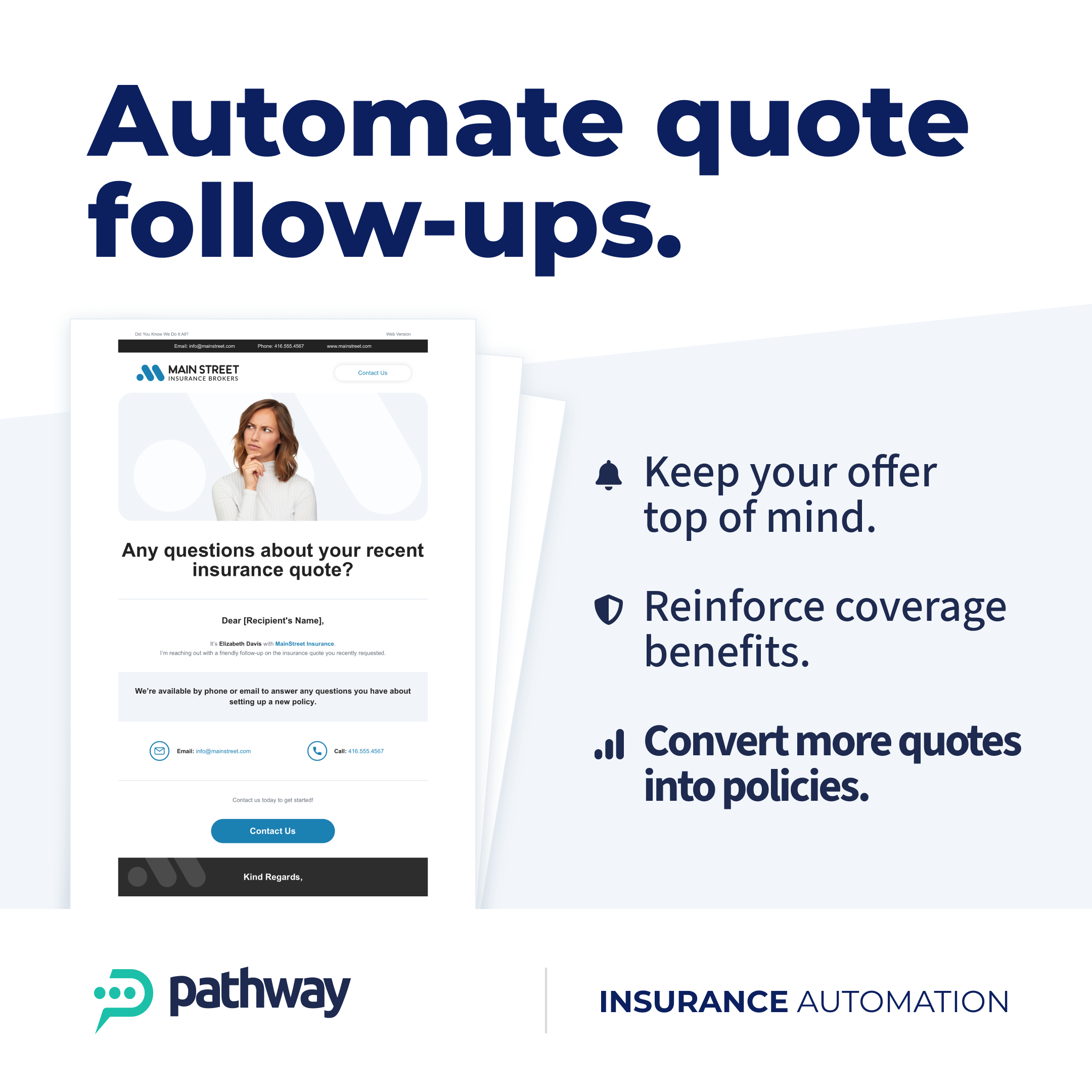
Where automation helps: Event-based workflows can trigger communication according to relevant policy dates and conditions, reducing dependence on employees remembering every follow-up.
For example, PathwayPort can help automate renewal reminders at predefined intervals so brokers and agnets can engage clients before deadlines become urgent.
2. Relevance: Does the message reflect the client’s actual needs?
Imagine a client receiving an offer for home insurance when they already hold a home policy through your brokerage.
The message may be well-written and professionally designed, but it offers little value. Repeated irrelevant communication can make clients less interested in future messages.
Relevance requires more than using a client’s name. It means understanding which information, products or services are appropriate for their circumstances. Where automation helps: Policy-based filters can help brokerages and insurance agencies target communications to eligible clients.
For example, a cross-sell workflow can identify clients who hold one type of coverage but not another, helping brokers avoid unnecessary or poorly targeted offers.
The purpose is not to increase the number of marketing messages. It is to make those messages more useful.
3. Clarity: Do clients understand what you’re telling them?
Insurance terminology can be difficult for policyholders to interpret. Premium changes, exclusions, limits and deductibles may be familiar to brokers but confusing to clients.
According to the 2026 J.D. Power U.S. Auto Insurance Study, only 58% of surveyed customers completely understood their auto insurance policy and what it covered.
The study also reported a 127-point satisfaction difference between customers who fully understood their coverage and those who did not. This highlights why explaining insurance information is an important part of customer engagement.
A client who receives a renewal document may still need help understanding what has changed and whether action is required.
Where automation helps: Automated renewal workflows can organise timely communication, while policy comparison technology can help brokers identify differences that deserve attention.
PathwayPort’s Policy Compare is designed to compare incoming renewal information against current policy records, helping brokers identify relevant changes rather than reviewing every detail manually.
This supports more informed conversations without replacing the broker’s expertise.
4. Follow-through: What happens after the client responds?
A message can arrive at the right time, contain relevant information and be perfectly clear.
But what happens when the client replies?
If their question goes unanswered or their request isn’t followed through, the earlier communication may have little lasting value. This is where customer engagement becomes an operational issue, not simply a marketing activity.
A brokerage and insurance agency needs to know which interactions require action, who is responsible and whether the client’s concern has been addressed.
Where automation helps: Automated workflows can support consistent communication and help teams identify follow-up activities.
However, brokerages still need clear responsibilities and human oversight for complex questions, coverage advice and sensitive client situations.
Automation should make it easier to identify where attention is needed, not create the impression that every client concern can be resolved automatically.
The Hidden Cost of Mistaking Communication for Engagement
A brokerage/agency might send thousands of emails each month and still struggle with client retention.
Why?
Because communication activity and relationship quality are not the same thing. Email opens, clicks and delivery rates can show whether messages are reaching recipients and generating immediate interactions.
They cannot, on their own, establish whether clients understand their coverage, trust their broker or intend to renew.
Consider two hypothetical brokerages.
Brokerage A
Activity-focused
Sends frequent reminders, newsletters and promotional messages. Measures success primarily through email volume and open rates.
Brokerage B
Engagement-focused
Sends fewer, more relevant messages based on client needs and policy events. Measures responses completed follow-ups and relationship outcomes.
Illustrative comparison, not results from a customer study.
Brokerage B isn’t necessarily more successful simply because it sends fewer messages.
The difference is that it has a clearer way to evaluate whether its communication is producing useful outcomes.
This is an important distinction for insurance agencies trying to improve customer engagement without overwhelming their teams.
How Can Insurance Brokers Recognise Disengagement Early?
Disengagement doesn’t always look like a cancelled policy. Sometimes it appears as silence.
A client may stop responding to check-ins, repeatedly delay renewal discussions or become less willing to provide feedback.
These behaviours don’t prove dissatisfaction, but they can help brokers identify relationships that may benefit from attention.
Five signals worth investigating
- Repeatedly unanswered communications. A pattern of non-response may suggest messages are irrelevant, poorly timed or reaching the wrong contact details.
- Delayed renewal decisions. Clients who postpone renewal discussions may need clearer information or additional assistance.
- Declining participation in feedback requests. Lower participation can be a reason to review how and when feedback is requested.
- Unresolved service questions. Repeated enquiries about the same issue may indicate that previous communication wasn’t sufficiently clear or complete.
- Policy cancellations or reduced coverage. These changes may reflect dissatisfaction, changing needs or circumstances unrelated to the brokerage.
The important point is to investigate rather than assume. For example, a policy cancellation doesn’t necessarily mean the client has left the brokerage.
They may have moved coverage, sold an insured asset or no longer require a particular policy. A structured follow-up can help clarify the situation.
Read more in Policy Cancellation: Does It Mean You’ve Lost a Client?.
Why More Automation Doesn’t Automatically Mean Better Engagement
Insurance marketing automation can help brokerages and insurance agencies manage repetitive communication, but automation alone does not guarantee better customer engagement.
An irrelevant automated message is still irrelevant. A poorly timed reminder doesn’t become more useful because software delivered it.
And an unanswered client question remains a service problem, regardless of how efficiently the original message was sent.
This is why brokerages and agencies should distinguish between automating communication and improving engagement.
| Automation-first approach | Engagement-first approach |
|---|---|
| Automate every possible message | Automate messages with a clear purpose |
| Measure how many messages are sent | Measure useful client actions and outcomes |
| Send the same follow-up to broad audiences | Use relevant policy and client conditions |
| Focus on workflow completion | Consider what happens after the client responds |
| Reduce manual work as the main goal | Reduce manual work while improving service |
The strongest approach uses automation to support a clearly defined engagement strategy. For example, a renewal reminder workflow should not be evaluated only by whether reminders were sent.
It should also help the brokerage and agency understand whether clients responded, whether follow-up was required and whether important questions were resolved before renewal.
This is where automation can create value beyond administrative efficiency.
How to Measure Meaningful Insurance Customer Engagement
If communication volume isn’t enough, what should insurance agencies measure?
A useful starting point is to connect engagement metrics with the four elements of the framework.
| Engagement element | Questions to ask | Useful metrics |
|---|---|---|
| Timing | Are clients contacted early enough? | Follow-up timeliness, missed deadlines |
| Relevance | Are messages useful to recipients? | Relevant response rates, opt-outs |
| Clarity | Do clients understand the information? | Repeat enquiries, clarification requests |
| Follow-through | Are client needs addressed? | Outstanding follow-ups, resolution time |
These measures should be considered alongside broader business indicators such as retention, satisfaction and policy cancellations.
For example, a decline in repeat enquiries could indicate that communication has become clearer, although other factors may also explain the change.
Similarly, an increase in client responses might be positive, but only if the brokerage has the capacity to address those responses effectively.
Meaningful insurance customer engagement should be evaluated through both client behaviour and service outcomes, not communication activity alone.
A Practical Example: From Missed Engagement to Meaningful Follow-Up
Consider a hypothetical commercial insurance client approaching renewal. The brokerage/agency sends an automated reminder 60 days before the renewal date. The client doesn’t respond. A second reminder is sent 30 days before renewal. Again, there is no response.
A communication-focused approach might conclude that the brokerage has completed its reminder process. An engagement-focused approach asks a different question:
Why hasn’t the client responded, and is there anything they need help with?
Perhaps the client’s business has changed. Perhaps they are comparing alternatives. Or perhaps they simply haven’t had time to review the documents.
Rather than continuing to send generic reminders, the brokerage could identify the lack of response as a reason for a personal follow-up.
The broker might contact the client to ask whether their coverage still meets their needs or whether they have questions about the renewal.
This example demonstrates how automation and human expertise can work together. Automation manages the routine communication. The broker provides the judgement, context and advice.
The outcome isn’t guaranteed, but the brokerage has a clearer opportunity to understand the client’s situation.
How PathwayPort Helps Insurance Teams Turn Communication into Engagement
Insurance agencies and brokerages often have the information they need to communicate with clients, but maintaining consistent follow-ups across a large portfolio can be time-consuming.
PathwayPort helps automate repetitive client communications and policy-related workflows, allowing teams to spend less time preparing routine messages and more time supporting clients.
With PathwayPort, insurance teams can automate renewal reminders, quote follow-ups, billing reminders, welcome communications, client check-ins, cross-sell campaigns, cancellation follow-ups and feedback requests. Learn more about how to personalize your communication with clients.
These workflows can help teams communicate at relevant moments throughout the policy lifecycle.
For example, policy-based conditions can support more targeted cross-sell messages, while scheduled check-ins can help brokerages maintain contact beyond renewals.
Automated cancellation follow-ups and feedback requests can also help brokers better understand client experiences and identify opportunities for further engagement. The objective is not simply to send more messages.
It’s to automate the predictable interactions so brokers have more time for the conversations that require their expertise.
Make Every Client Interaction Count
Reduce repetitive follow-ups, stay connected with clients and create more time for meaningful conversations. Discover how PathwayPort can support your brokerage’s customer engagement strategy.

Frequently Asked Questions About Insurance Customer Engagement
Why Do Insurance Customers Disengage?
Insurance customers may disengage when communication is irrelevant, unclear, poorly timed or doesn’t lead to useful action. Some clients also prefer limited contact or only need assistance at particular points in the policy lifecycle. Disengagement should be investigated rather than automatically treated as dissatisfaction.
What Is the Difference Between Insurance Customer Engagement and Customer Communication?
Customer communication refers to the exchange of information between a brokerage and its clients. Customer engagement focuses on the value, relevance and outcomes of those interactions, including whether clients understand their coverage, respond to important information and receive appropriate support.
How Can Insurance Businesses Identify Disengaged Clients?
Brokers can review patterns such as repeated non-response, delayed renewal discussions, unresolved service enquiries, negative feedback and policy cancellations. These signals should be interpreted in context because they do not always indicate dissatisfaction.
How Does Insurance Automation Improve Insurance Customer Engagement?
Insurance automation can support customer engagement by sending relevant messages at appropriate times, reducing missed follow-ups and making routine communication more consistent. It also gives brokers more time to focus on complex client needs and personal advice.
Does Sending More Insurance Emails Improve Engagement?
Not necessarily. Sending more messages may increase communication activity without improving relationships. The timing, relevance, clarity and follow-through of each interaction are more useful considerations.
What are the most important insurance customer engagement metrics?
Useful metrics include client response rates, follow-up completion, resolution time, repeat enquiries, satisfaction scores and renewal retention. These measures provide a broader picture than email opens or message volume alone.
What should insurance agencies prioritise in 2027?
Insurance agencies should focus on identifying where clients disengage, improving the relevance and timing of communication, making insurance information easier to understand and ensuring that important client requests receive appropriate follow-up.
Recent Posts
 How to Identify Insu…October 20, 2026
 Policy Cancellation:…October 13, 2026
 Email Marketing Insi…August 28, 2026
Collapsible
Leave a Comment
Comments:
Having read this I believed it was really informative.
Comment by Brianne on February 6, 2022 at 19:10I appreciate you finding the time and effort to put this article together.
I once again find myself spending way too much time both reading and leaving comments.
But so what, it was still worthwhile!
Excellent post. I was checking constantly this blog and I am impressed! Very helpful information specially the last part 🙂 I care for such information a lot. I was seeking this particular info for a long time. Thank you and best of luck.
Comment by gralion torile on March 5, 2022 at 03:52Well I truly liked reading it. This article offered by you is very constructive for good planning.
Comment by zoritoler imol on April 21, 2022 at 21:34