
“Insurance inflation” is one of the most-searched terms in the industry right now, and for good reason. Even as headline inflation has cooled from its post-pandemic peak, insurance costs are still climbing faster than paychecks for millions of households and agencies are caught in the middle, absorbing higher claims costs while trying to keep premiums affordable enough to retain customers.
This guide breaks down what’s actually happening with insurance inflation in 2026, what to expect through 2027, and because reading about the problem doesn’t fix it, a practical playbook for how to automate insurance operations so your agency can protect its margins without cutting service quality.
Insurance Inflation in 2026–2027: How to Automate Insurance Operations and Control Costs
- U.S. annual inflation eased to roughly 3.4% in mid-2026, but insurance-specific costs (claims, replacement parts, building materials, reinsurance) are still rising faster than the headline number in many lines.
- Homeowners and health premiums are outpacing overall inflation, and standard price indexes understate how much affordability has actually declined for households.
- Insurance shopping didn’t slow down the way agencies expected – it’s up double digits year-over-year and is now considered “the new normal” rather than a temporary spike.
- AI and automation have gone from optional to default: most agencies are now investing in it, and the ones automating repetitive work are absorbing rising costs better than the ones adding headcount.
How inflation is still reshaping the insurance industry in 2026
Claims and replacement costs remain elevated
Inflation drives up the cost of everything insurers eventually have to pay for car parts, building materials, medical care, and legal defense. Property and casualty replacement costs have historically run either just above or just below overall CPI depending on the year, and industry economists at the Insurance Information Institute have flagged that replacement-cost growth tends to catch back up to broader inflation even after a temporary slowdown, which keeps pressure on claims severity over time.
Homeowners coverage is a clear example of where the pain is concentrated. Research from the Federal Reserve Bank of Dallas found that standard inflation measures like CPI and PCE actually understate the affordability problem, because they’re built to track price levels rather than how much of a household’s budget insurance is consuming. Reinsurance costs are part of the story too – they climbed roughly 107% between 2019 and 2024 before beginning to ease in 2026, and that pricing cycle still works its way into what agencies quote today.
Health and employer premiums are outpacing wages
It isn’t just property and auto. Average annual premiums for employer-sponsored health coverage reached roughly $9,300 for single coverage and about $27,000 for family coverage, up 5–6% year-over-year, and consulting forecasts point to another 6–7% increase driven by specialty drug costs and rising utilization. For agencies that write group benefits alongside P&C, that’s a second inflation front to manage with clients.
Insurance shopping is up, not down a reversal worth knowing
Here’s where the conventional wisdom needs an update. It used to be assumed that rising costs would simply push people to buy less insurance and shop less overall. The data through 2026 shows the opposite. TransUnion’s Insurance Personal Lines research found auto insurance shopping up roughly 10–11% year-over-year and property shopping up around 5%, even during a season that typically sees shopping slow down. TransUnion now describes regular insurance shopping as “the new normal” rather than a rate-driven spike – consumers are treating a quick online comparison as routine behavior, not a last resort.
That’s a meaningful shift for agencies: inflation isn’t shrinking the pool of active shoppers, it’s making that pool more price-sensitive and more willing to switch. Retention now depends on speed and responsiveness as much as price.
Reinsurance and investment pressure
Insurers still lean heavily on bond and fixed-income portfolios, and while rate conditions have shifted since the 2022 peak, elevated costs across claims lines continue to squeeze underwriting margins. That pressure gets passed downstream to agencies through carrier appetite changes, tighter binding authority, and slower quote turnaround – all of which cost your team time.
What to expect through 2027
- Pricing stays competitive, not runaway. Rate forecasts for 2026 point to gentler increases in commercial property and general liability compared to the sharpest years of the cycle, though commercial auto remains one of the toughest lines to place.
- AI replaces the old hiring-freeze playbook. In past inflation cycles, agencies simply froze hiring and asked existing staff to absorb more work. In 2026, the more common response is automating the repetitive share of that workload instead – which is a big part of why AI adoption has accelerated so quickly (more on the numbers below).
- Customers keep trimming discretionary coverage. Life, travel, rental, and pet insurance remain the first things cost-conscious households cut, while auto and home – the coverages tied to a loan or a lease – stay non-negotiable.
- Marketing budgets stay under scrutiny. Agencies that protect and even grow marketing spend during tight periods tend to outperform competitors who cut it, because the shopper pool hasn’t shrunk – it’s grown.
How to automate insurance operations and protect your margins
Automating insurance work isn’t just a cost-cutting move anymore – it’s become close to standard practice. According to ReSource Pro research, 98% of insurance agencies are planning AI investments in 2026, and Datos Insights found that 73% of carriers now run AI in production, up from 37% just a year earlier. Deloitte separately reported that roughly three-quarters of U.S. insurers have deployed generative AI in at least one business function. The agencies still treating automation as optional are increasingly the exception, not the rule.
Here’s where automation moves the needle fastest:
1. Automate repetitive, low-value work first
Claims intake, document processing, data entry, and compliance checks are the easiest wins because they’re high-volume and rules based. Industry data shows AI-driven claims automation has cut processing time by 55–75%, taking routine claims from a 7–10-day cycle down to 24–48 hours in many cases. That’s staff time you can redirect toward the parts of the job that actually require a human – advising clients and closing new business.
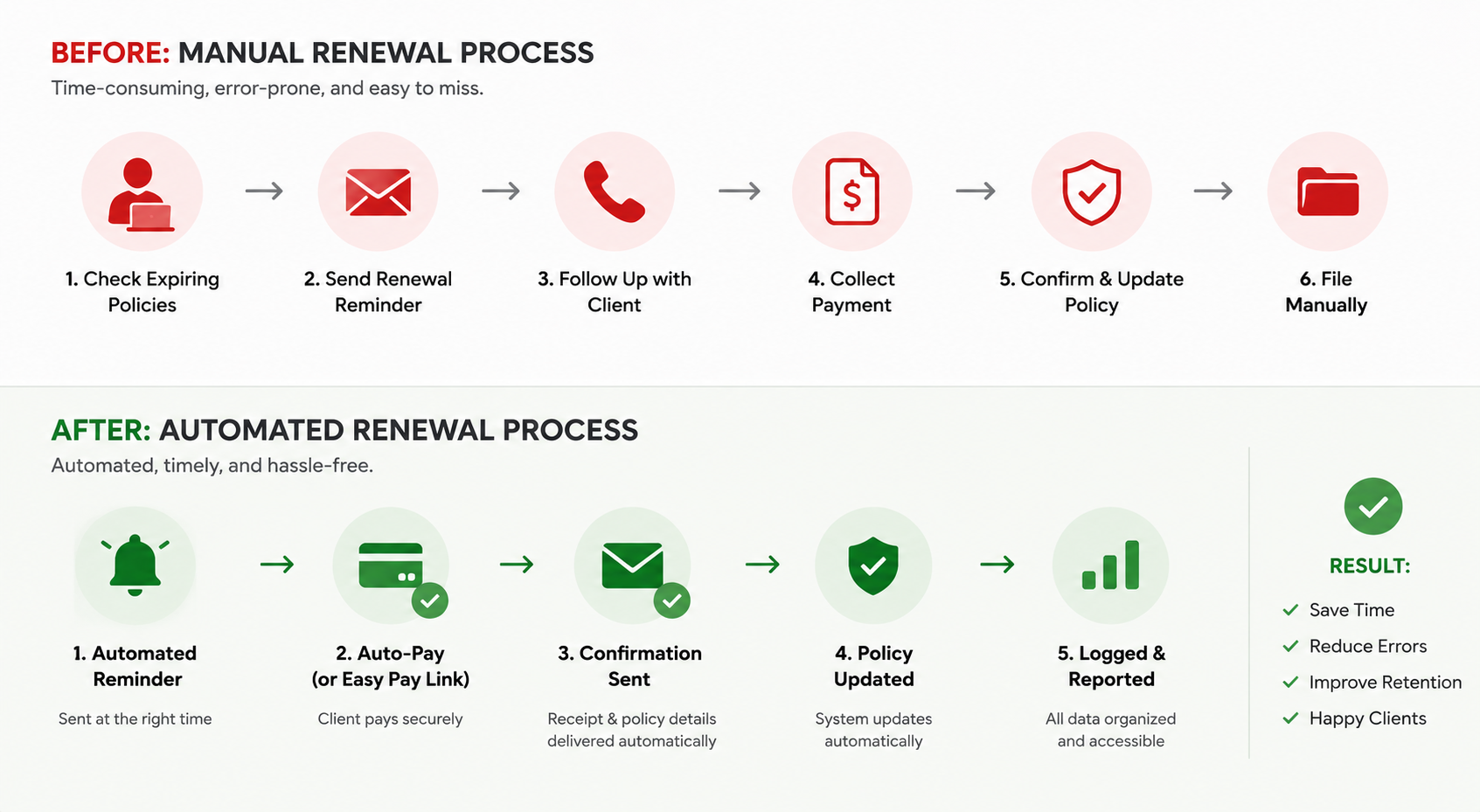
2. Automate renewal reminders and payment nudges
Chasing customers for renewal payments is exactly the kind of task automation was built for. Setting up automatic renewal reminders and auto-pay enrollment removes friction for the customer and removes manual follow-up from your team’s plate, and in a market where switching is up double digits, a smooth renewal experience is a retention tool, not just an efficiency one.
3. Offer flexible billing over annual lump sums
When budgets are tight, asking a customer to pay an entire year upfront is asking them to choose insurance over rent, groceries, or a car payment. Monthly or quarterly billing options make premiums easier to absorb and reduce the odds of a lapse, and this workflow, too, can run on autopilot once it’s set up.
4. Move service to digital-first channels
Chatbots and self-service portals now cost roughly $0.50–$0.70 per interaction compared to $8–$15 for a phone-based support call, a 90%+ reduction in cost per query, while still resolving routine questions like coverage details, ID cards, and billing status. Agent report saving an average of about four hours a week once AI tools are handling the repetitive parts of client communication.
5. Lead with the coverage people actually need right now
Don’t spend limited marketing dollars pitching add-ons when budgets are tight. Focus messaging on the coverage tied to what customers can’t walk away from auto, home, and anything protecting a major asset, and save the cross-sell conversation for after the relationship is secure.
4 ways to build insurance inflation resilience this year
1. Invest only in marketing that’s proven to convert. With shopping activity up across the board, cutting marketing entirely means ceding an active, price-sensitive audience to competitors who are still showing up. Track cost-per-lead and cost-per-bind by channel and reallocate toward what’s actually working. A few resources to help sharpen your marketing spend:
- 6 Ways To Supercharge Your Email Marketing Campaigns
- Are Insurance Marketing Bots Right for You? 7 Use Cases to Know
- Killing the Boring Insurance Brochure: Reinvent Your Marketing Materials
- 7 Elements Your Insurance Website Needs to Succeed
- A Referral Marketing Guide for Insurance Agencies
2. Revisit outdated coverage limits. Replacement costs for homes, vehicles, and business property have moved enough that older policies may leave clients underinsured. A proactive coverage review protects both the client and your agency’s E&O exposure.
3. Deepen existing relationships instead of only chasing new ones. Cross-selling and upselling relevant coverage to current customers costs far less than acquiring a new one, and customers increasingly prefer consolidating with a single trusted agency over shopping multiple providers for each policy.
4. Let automation absorb the labor-cost pressure. Instead of a hiring freeze that stretches your existing team thinner, automate the tasks that don’t require a license or a relationship, and let your team spend its time where it actually moves revenue.
FAQ
Is insurance inflation still a problem in 2026?
Yes, though it’s easing. Headline U.S. inflation was running around 3.4% in mid-2026, down from its earlier peak, but insurance-specific costs, homeowners premiums especially, have continued rising faster than standard inflation measures suggest, according to Federal Reserve research.
Does inflation mean fewer people are shopping for insurance?
No – the opposite has held true through 2026. TransUnion data shows auto and property insurance shopping both increased year-over-year and describes routine comparison shopping as the new normal rather than a rate-driven exception.
What should an insurance agency automate first to deal with rising costs?
Start with high-volume, rules-based tasks: renewal reminders, payment collection, document processing, and routine customer service questions. These are the workflows with the fastest, most measurable ROI and the least disruption to how your team already works.
Will automating insurance operations replace agents?
The data doesn’t support that. Most agencies describe AI as augmenting producers rather than replacing them – automation clears out repetitive admin work so agents can spend more time advising clients and closing business, which is where the relationship (and the revenue) actually lives.
How much can automation actually save an agency?
It varies by workflow, but the gains are measurable: AI-assisted claims processing has cut cycle times by 55–75% in many agencies, and digital customer service channels run at roughly a tenth of the cost of phone-based support per interaction.
The bottom line
Insurance inflation isn’t going away, but it’s also not the same story it was a few years ago, shopping is up, not down, and the agencies pulling ahead are the ones automating the busywork instead of just absorbing it. Pathway helps agencies automate customer relationships, payments, document workflows, and renewals so your team can spend its time where it matters most: with your customers.
Book a demo to see how Pathway can help your agency automate insurance operations and stay resilient through the next inflation cycle.
Recent Posts
 How to Identify Insu…October 20, 2026
 Policy Cancellation:…October 13, 2026
 Email Marketing Insi…August 28, 2026
Collapsible


Leave a Comment